|
Management and Clinical Outcomes of Cats With Ceruminoliths: A Retrospective Study of 31 Cases
猫耵聍石的管理与临床结果:31例回顾性研究
作者:Mélanie Moreira André | Pascal Prélaud | Amaury Briand
翻译:王帆
Keywords: cats | ceruminoliths | otitis externa | tympanum
关键词:猫 | 耵聍石 | 外耳炎 | 鼓膜
ABSTRACT
摘要
Background: Ceruminoliths are accumulations of cerumen and cornified material, in the ear canal that can obstruct the tympanic region (proximal external acoustic meatus). Management typically involves ceruminolytic agents or otic lavage under general anaesthesia.
Hypothesis/Objectives: To describe the clinical presentation, management and outcomes of cats diagnosed with ceruminoliths.
Animals: Medical records of cats diagnosed between 2011 and 2024 were reviewed.
Materials and Methods: Inclusion criteria were visual confirmation of ceruminoliths by otoendoscopy, initiation of treatment and at least one follow- up examination. Treatment efficacy was assessed using otoendoscopy and an owner global assessment of treatment efficacy (OGATE).
Results: Thirty- one cats were included; 26 underwent otoendoscopy- guided lavage under general anaesthesia combined with medical treatment, while five received medical treatment alone. Ceruminolytic cleaners and short- term systemic glucocorticoids (2–7 days) were commonly prescribed. Tympanic lesions were frequent, with perforation in 10 cats and thickening/discolouration in five. At final recheck, four cats had tympanic scarring or other irregularities, and one tympanic perforation persisted. At the initial follow- up, 55% of cats were free of ceruminoliths. At final follow- up, 65% remained recurrence- free. OGATE data were available for 15 owners: 60% reported a positive response, with five rating the outcome as excellent and four as good.
Conclusions and Clinical Relevance: Tympanic lesions were frequent and sometimes permanent. The recurrence of cerumi noliths highlights the need to investigate underlying predisposing factors. This study emphasises the importance of recognising tympanic involvement and the necessity of long- term monitoring in affected cats.
背景:耵聍石是耳道内耵聍和角质化物质的积聚物,可阻塞鼓膜区域(外耳道近端)。管理通常涉及耵聍溶解剂或在全身麻醉下进行耳道灌洗。
假设/目标:描述诊断为猫耵聍石的临床表现、管理和结果。
动物:回顾了2011年至2024年间诊断为猫耵聍石的医疗记录。
材料与方法:纳入标准包括通过耳内镜检查视觉确认耵聍石、开始治疗以及至少进行一次随访检查。使用耳内镜检查和宠主对治疗效果的总体评估(OGATE)来评估治疗效果。
结果:共纳入31只猫;26只在全身麻醉下接受了耳内镜引导灌洗联合药物治疗,而5只仅接受药物治疗。常用处方包括耵聍溶解剂和短期全身性糖皮质激素(2-7天)。鼓膜病变很常见,10只猫出现穿孔,5只出现增厚/变色。在最终复查时,4只猫出现鼓膜瘢痕或其他不规则,1例鼓膜穿孔持续存在。在初次随访时,55%的猫耵聍石消失。在最终随访时,65%的猫保持无复发。15位宠主提供了OGATE数据:60%报告了有效,其中5位评价结果为优秀,4位评价为良好。
结论与临床相关性:鼓膜病变很常见,有时是永久性的。耵聍石的复发凸显了调查潜在易感因素的必要性。本研究强调了认识鼓膜患病以及长期监测患病猫的重要性。
1 | Introduction
1 | 介绍
It is common for the feline ear to contain a moderate amount of dark brown cerumen within the canal. In the absence of other clinical signs, this is not suggestive of otitis externa (OE).
猫耳道内含有中等量的深棕色耵聍是常见的。在没有其他临床症状的情况下,这不提示外耳炎(OE)。
Feline OE is uncommon; one study showed a prevalence of 55% in stray cats, yet older studies reported prevalence rates between 2% and 19%, considering all aetiologies. Among the possible aetiologies, ceruminoliths are mentioned yet rarely described. The aetiology of ceruminoliths remains uncertain, with potential causes including chronic use of ear medications or cleansers, Otodectes cynotis infestation, failure of epithelial migration and allergic skin disease. They are thought to be accu mulations of cerumen, cornified material, and cerumen in the ear canal, which can lead to obstruction of the tympanic region (proximal external acoustic meatus) . They tend to be firm with irregular margins and can act as a foreign body, per petuating inflammation and acting as a nidus of infection. They also may perforate the tympanic membrane.
猫外耳炎并不常见;一项研究显示流浪猫的患病率为55%,而较早的研究报告所有病因的患病率在2%至19%之间。在可能的病因中,提到了耵聍石,但很少被描述。耵聍石的病因仍不确定,潜在原因包括长期使用耳药或洗耳液、耳螨感染、上皮迁移失败和过敏性皮肤病。它们被认为是耳道内耵聍、角质化物质和耵聍的积聚物,可导致鼓膜区域(外耳道近端)阻塞。它们往往质地坚硬,边缘不规则,可作为异物,持续引发炎症并成为感染灶。它们也可能导致鼓膜穿孔。
Once formed, ceruminoliths can be difficult to remove. Some of the more potent ceruminolytic cleaners, such as those containing dioctyl sodium succinate or squalene, can be used to break up the accumulation. Ceruminoliths that are resistant to conservative cleaning methods should be removed under sedation or anaesthesia. They can be grasped using forceps through an operating or video- otoscope, or broken up with ceruminolytics and flushed out. If the ceruminolith adheres to the tympanic membrane, its mechanical removal may inadvertently damage it.
一旦形成,耵聍石可能难以清除。一些更有效的耵聍溶解剂,如含有琥珀酸二辛酯钠或角鲨烯洗耳液,可用于分解积聚物。对保守清洁方法有抵抗力的耵聍石应在镇静或麻醉下移除。可以通过手术或视频耳镜用钳子夹取,或用耵聍溶解剂分解后冲洗出来。如果耵聍石附着在鼓膜上,机械移除可能会无意中损伤鼓膜。
To the best of our knowledge, there are no studies on the man agement and clinical outcomes of ceruminoliths in cats. This retrospective study aimed to describe the clinical presentation, management and outcomes of cats diagnosed with ceruminoliths.
据我们所知,目前尚无关于猫耵聍石管理和临床结果的研究。本回顾性研究旨在描述诊断为耵聍石的猫的临床表现、管理和结果。
2 | Material and Methods
2 | 材料与方法
Patient records of cats diagnosed with ceruminoliths in the der matology department of the veterinary hospital centre [AniCura ADVETIA] between 2011 and 2024 were reviewed. Cats were included in this retrospective study if a ceruminolith had been visualised by otoendoscopy, a treatment had been started, and at least one follow- up examination had been performed. The only exclusion criteria were the absence of a follow- up examination. Data collected included breed, age, sex, clinical signs at presen tation, otoendoscopic and cytological results, imaging (if avail able) and treatment details.
回顾了2011年至2024年间在兽医中心医院皮肤病科诊断为耵聍石的猫的病历记录。如果通过耳内镜检查观察到耵聍石、已开始治疗并至少进行过一次随访检查,则纳入本回顾性研究。唯一的排除标准是缺乏随访检查。收集的数据包括品种、年龄、性别、就诊时的临床症状、耳内镜和细胞学结果、影像学(如有)和治疗细节。
Treatments reported included otoendoscopy- guided ear flushing under general anaesthesia, using cerumenolytics such as calendula/propylene glycol/saponin/salicylic acid solution (Otoclean; Elanco), tromethamine/EDTA/chlorhexidine digluconate solution (Surosolve; Elanco) and dioctyl sodium sulfosuccinate/squalene/ lactic acid solution (Sonotix; Vetoquinol). Systemic treatment included glucocorticoids, antibiotics, gabapentin, cetirizine, ciclosporin and meloxicam. Topical ear medications used included miconazole/polymyxin B/prednisolone suspension (Surolan; Elanco), hydrocortisone aceponate solution (Cortotic; Virbac) and gentamicin/clotrimazole/betamethasone suspension (Otomax; MSD Santé Animale Intervet). Otoendoscopy- guided ear flush ing was performed using sterile saline (NaCl 0.9%), Ringer's lactate and occasionally dioctyl sodium sulfosuccinate/carbamide peroxide/propylene glycol solution (Otoprof; ICF), delivered with a 10 mL syringe connected to a 2 mm urinary catheter (cut at the distal end) inserted through the otoendoscope. The ear canal was flushed under endoscopic visualisation until the ceruminolith was detached. In refractory cases where flushing alone was insuffi cient, a flexible forceps small enough to pass through the otoendo scope was occasionally used to mechanically fragment or extract the ceruminolith. At the end of the procedure, the ear canal was aspirated to remove residual fluid and facilitate drying.
报告的治疗包括在全身麻醉下进行耳内镜引导耳道冲洗,使用的耵聍溶解剂如金盏菊/丙二醇/皂苷/水杨酸溶液、氨丁三醇/EDTA/葡萄糖酸氯己定溶液和二辛基磺基琥珀酸钠/角鲨烯/乳酸溶液。全身治疗包括糖皮质激素、抗生素、加巴喷丁、西替利嗪、环孢素和美洛昔康。使用的外用耳药包括咪康唑/多粘菌素B/泼尼松龙悬浮液、氢化可的松醋丙酯溶液和庆大霉素/克霉唑/倍他米松悬浮液。耳内镜引导耳道冲洗使用无菌生理盐水、乳酸林格液,偶尔使用琥珀酸二辛酯/过氧化脲/丙二醇溶液,通过连接在2mm导尿管(远端剪断)上的10mL注射器,经耳内镜插入进行冲洗。在耳内镜直视下冲洗耳道,直至耵聍石脱落。在仅靠冲洗不足的顽固病例中,偶尔使用足够小能通过耳内镜的柔性钳子机械性破碎或取出耵聍石。手术结束时,抽吸耳道以去除残留液体并促进干燥。
If an ear flushing was performed, the tympanic membrane was evaluated after ceruminolith removal, and a board- certified referral clinician or dermatology resident characterised any le sions. In these cases, all cats left the hospital free of cerumin oliths; treatment efficacy was therefore assessed at follow- up examinations and categorised as follows: resolution was defined as absence of ceruminoliths at follow- up, while recurrence was defined as the formation of a new ceruminolith in the same ear after initial resolution. By contrast, for cats managed with med ical treatment alone, ceruminoliths were still present after the initial consultation. In these cases, treatment efficacy could only be assessed at the first recheck, and outcomes were categorised as either resolution (if ceruminoliths were absent) or failure (if they persisted).
如果进行了耳道冲洗,则在移除耵聍石后评估鼓膜,并由委员会认证的转诊临床医生或皮肤病住院医师描述任何病变。在这些病例中,所有猫出院时均无耵聍石;因此,在随访检查时评估治疗效果,并分类如下:缓解定义为随访时无耵聍石,而复发定义为同一只耳在初始缓解后形成新的耵聍石。相比之下,对于仅接受药物治疗的猫,初次就诊后耵聍石仍然存在。在这些病例中,治疗效果只能在第一次复查时评估,结果分类为缓解(如果耵聍石消失)或失败(如果持续存在)。
The first recheck was typically scheduled about 1 month after treatment was started; however, actual timing varied according to clinical signs and owner availability. This variability is consistent with our routine aim to recheck around 1 month post- treatment, while allowing earlier or later visits when clinically indicated.
第一次复查通常安排在治疗开始后约1个月;然而,实际时间根据临床症状和宠主可用性而有所不同。这种多样性与我们常规目标(治疗后约1个月复查)一致,同时允许在临床需要时提前或推迟复查。
After data collection, an owner global assessment of treatment efficacy (OGATE) was conducted for all included cats. The survey was administered in 2024, mainly via telephone, with email used for owners who could not be reached by phone. The OGATE scale ranged from 0 to 4 (0, no response; 1, poor re sponse; 2, fair response; 3, good response; 4, excellent response). Owners were asked to rate their cat's overall improvement, pri marily regarding comfort and ear- related signs such as pruritus, pain, or visible discharge.
数据收集后,对所有纳入的猫进行了宠主对治疗效果的总体评估(OGATE)。该调查于2024年进行,主要通过电话,对于无法通过电话联系的宠主则使用电子邮件。OGATE量表范围从0到4(0,无效果;1,效果差;2,效果一般;3,效果良好;4,效果优秀)。要求宠主评价其猫的整体改善情况,主要关于舒适度和耳部相关症状,如瘙痒、疼痛或可见分泌物。
This retrospective study was conducted in compliance with institutional ethical standards. Formal ethical committee ap proval was not considered necessary. Owner consent for the use of medical data was obtained at the time of consultation, and verbal consent was obtained when administering the follow- up questionnaire (OGATE).
本回顾性研究符合机构伦理标准。未考虑正式的伦理委员会批准。在就诊时获得了宠主对使用医疗数据的同意,并在进行随访问卷(OGATE)时获得了口头同意。
3 | Results
3 | 结果
Between January 2011 and December 2024, 40 cats with ceru minolith were presented to the clinic. Nine cats were excluded because of a lack of follow- up information, leaving a total of 31 cats which met the inclusion criteria. The most common breed was domestic short hair (25 of 31), followed by British shorthair (two of 31) and one of each of the following breeds: Persian, Abyssinian, Sphynx and Bengal. The median age at diagnosis was 7 years (1–17 years). There were 11 castrated males and 20 spayed females (male- to- female ratio 1:1.8).
2011年1月至2024年12月期间,有40只患有耵聍石的猫就诊。9只猫因缺乏随访信息被排除,最终共有31只猫符合纳入标准。最常见的品种是家养短毛猫(31只中的25只),其次是英国短毛猫(31只中的2只),以及以下品种各1只:波斯猫、阿比西尼亚猫、斯芬克斯猫和孟加拉猫。诊断时的中位年龄为7岁(范围1-17岁)。有11只已去势公猫和20只已绝育母猫(公母比例1:1.8)。
All cats exhibited ear pruritus. Otalgia was reported in three cases, and two cats showed signs of ataxia. Allergic dermatitis was identified as an underlying condition in six cats, and two cats had a history of Otodectes cynotis infestation. Information regarding the use of external antiparasitic treatment was avail able for 16 cats, of which only eight had received a treatment.
所有猫均表现出耳部瘙痒。3例报告了耳痛,2只猫表现出共济失调症状。6只猫被确定患有过敏性皮肤病作为潜在疾病,2只猫有耳螨感染史。16只猫有关于使用外寄生虫治疗的信息,其中只有8只接受过治疗。
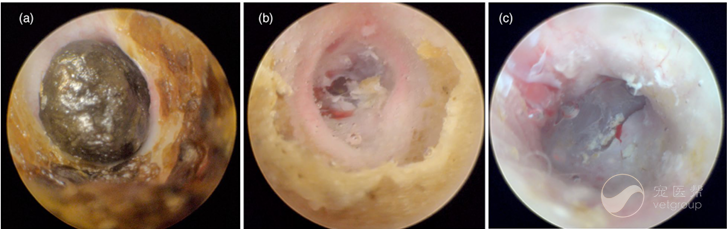
On direct otoendoscopic examination of the external auditory canal, 23 cats had a unilateral proximal accumulation of ceru men forming a plug and obstructing view of the tympanic mem brane (Figure 1a), while eight cats were bilaterally affected, usually with one side more severely involved. Medium- sized purple- to- blue auricular nodules, clinically compatible with au ricular cystadenomas, were observed in three cases.
通过外耳道直接耳内镜检查,23只猫有单侧近端耵聍积聚形成栓子并阻塞鼓膜视野(图1a),而8只猫双侧患病,通常一侧更严重。在3例中观察到中等大小的紫色至蓝色耳廓结节,临床符合耳囊腺瘤。
Swabs for cytological examination were obtained from 17 cats, with negative results in 11. Micro- organisms were detected in six cases, characterised by neutrophilic inflammation and cocci (five of six) or yeasts (one of six).
对17只猫进行了细胞学检查拭子采样,其中11例结果为阴性。在6例中检测到微生物,特征为中性粒细胞性炎症和球菌(6例中的5例)或酵母菌(6例中的1例)。
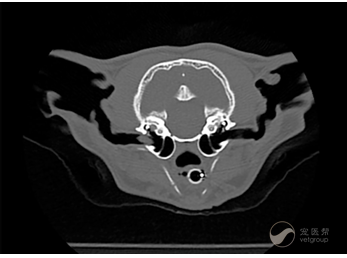
Computed tomography (CT) imaging was performed in 14 of the 31 cats (45%). In four cases, fluid attenuation was noted in the tympanic cavity ipsilateral to the ceruminolith, indicating potential fluid accumulation. One cat had an intact tympanic membrane; a myringotomy was performed followed by systemic antibiotic therapy. In two cats, the tympanic membrane was already perforated, and systemic antibiotics were prescribed. The fourth cat had marked tympanic thickening, yet neither myringotomy nor antibiotics were administered (see Table S1). In the remaining cases, the ceruminolith was described as a well- defined ovoid structure located in the proximal region of the external ear canal, measuring ≤ 7 mm in length. It exhibited soft- tissue attenuation, although its nature could not be defined precisely (Figure 2).
31只猫中有14只(45%)进行了计算机断层扫描(CT)成像。在4例中,注意到与耵聍石同侧的鼓室有液体衰减,表明可能存在积液。1只猫鼓膜完整;进行了鼓膜切开术,随后进行了全身抗生素治疗。2只猫鼓膜已经穿孔,并处方了全身抗生素。第4只猫有明显的鼓膜增厚,但未进行鼓膜切开术或抗生素治疗(见表S1)。在其余病例中,耵聍石被描述为位于外耳道近端区域的边界清晰的卵圆形结构,长度≤7mm。它表现出软组织衰减,尽管其性质无法精确定义(图2)。
Otoendoscopy- guided ear flushing under general anaesthesia was performed in 26 cats (84%), followed by medical treatment. Five cats were managed with medical treatment alone. A combi nation of ceruminolytic cleaners and a short course of systemic glucocorticoids was prescribed in 21 cats (68%). Additional treatments included systemic antibiotics (16 of 31), ear drops (seven of 31), gabapentin (three of 31), meloxicam (two of 31), ciclosporin (one of 31) and cetirizine (one of 31) (see Table S1). For cats managed without ear flushing, treatment efficacy could only be assessed at the first recheck and categorised as resolu tion or failure. By contrast, for cats that underwent flushing, all were initially free of ceruminoliths, and outcomes at follow- up were classified as resolution or recurrence.
26只猫(84%)在全身麻醉下进行了耳内镜引导耳道冲洗,随后进行药物治疗。5只猫仅接受药物治疗。21只猫(68%)处方了耵聍溶解剂和短期全身性糖皮质激素联合治疗。其他治疗包括全身抗生素(31只中的16只)、滴耳液(31只中的7只)、加巴喷丁(31只中的3只)、美洛昔康(31只中的2只)、环孢素(31只中的1只)和西替利嗪(31只中的1只)(见表S1)。对于未进行耳道冲洗的猫,治疗效果只能在第一次复查时评估,并分类为缓解或失败。相比之下,对于接受冲洗的猫,所有猫最初均无耵聍石,随访时的结果分类为缓解或复发。
Tympanic lesions were frequently observed after otoendoscopy- guided flushing: tympanic membrane perforation occurred in 10 cats (32%) (Figure 1b), and thickening or discoloration of the tympanic membrane was seen in five cats (16%) (Figure 1c). Because tympanic assessment was performed immediately after ceruminolith removal, all perforations were first identified post flushing rather than before the procedure. At the final recheck, the outcome of these 10 perforations varied: in six cats, evalu ation was not possible owing to recurrence of ceruminoliths obscuring the tympanic region; three tympanic membranes appeared intact; and one showed linear scarring. Additionally, a persistent perforation was documented in a cat managed med ically, for which the tympanic membrane could not be evaluated at initial presentation owing to the presence of a ceruminolith.
耳内镜引导冲洗后经常观察到鼓膜病变:10只猫(32%)发生鼓膜穿孔(图1b),5只猫(16%)出现鼓膜增厚或变色(图1c)。由于鼓膜评估是在耵聍石移除后立即进行的,所有穿孔都是在冲洗后首次发现,而不是在手术前。在最终复查时,这10例穿孔的结果各不相同:6只猫因耵聍石复发遮挡鼓室区域而无法评估;3例鼓膜看起来完整;1例显示线性瘢痕。此外,在一只接受药物治疗的猫中记录到持久性穿孔,该猫在初次就诊时因存在耵聍石而无法评估鼓膜。
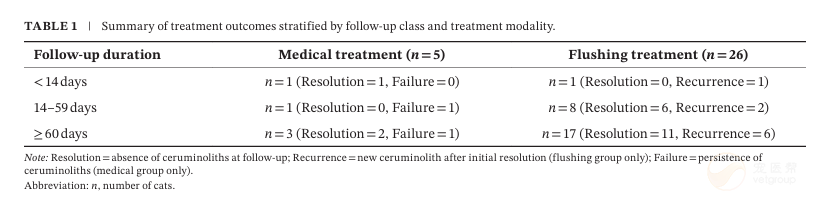
The interval between the initial visit and the first recheck showed substantial variability (median 41 days, range 3–892 days). To aid interpretation, outcomes also are presented stratified by fol low- up length at first recheck (< 14 days, 14–59 days, ≥ 60 days); a summary of outcomes according to follow- up class and treat ment modality is provided in Table 1. Detailed case- level data, including total follow- up duration, tympanic status and out comes, are available in Table S1.
初次就诊与第一次复查之间的间隔存在显著差异(中位数41天,范围3-892天)。为了便于解释,结果也按第一次复查时的随访时长(<14天,14-59天,≥60天)分层呈现;表1总结了按随访类别和治疗方式分类的结果。详细的病例水平数据,包括总随访时间、鼓膜状态和结果,见表S1。
At the first recheck (typically 1 month post- treatment), 17 cats (55%) were free of ceruminoliths: 13 (of 26) following otoendoscopy- guided flushing and four (of five) after medical treatment alone. Recurrence occurred in one cat from each group. Among the 14 cats with persistent ceruminoliths, 13 had initially received an auricular flushing and seven of them un derwent a second ear flushing.
在第一次复查时(通常为治疗后1个月),17只猫(55%)无耵聍石:13只(26只中的13只)在耳内镜引导冲洗后,4只(5只中的4只)在仅药物治疗后。每组各有1只猫复发。在14只持续存在耵聍石的猫中,13只最初接受了耳道冲洗,其中7只进行了第二次耳道冲洗。
At the final recheck, 20 cats (65%) were considered cured: 14 after a single ear flushing and three after repeated flushings (both of 26), and three following medical treatment alone (three of five). In total, seven cats required repeated flushing procedures: three ultimately achieved resolution, while four continued to experience recurrence despite multiple interven tions. Overall, recurrence occurred in 11 cats (35%), most of which (nine) had initially undergone flushing, including four cases requiring repeated procedures under general anaesthe sia. In one case, a ceruminolith developed on the contralat eral side during follow- up. Fourteen cats continued to show signs of pruritus, including five that were free of recurrence. Table S1 summarises the treatment modalities, outcome and tympanic lesions.
在最终复查时,20只猫(65%)被认为治愈:14只通过单次耳道冲洗,3只通过重复冲洗(26只中的3只),以及3只仅通过药物治疗(5只中的3只)。总共有7只猫需要重复冲洗处理:3只最终达到缓解,而4只尽管多次干预仍继续经历复发。总体而言,11只猫(35%)发生复发,其中大多数(9只)最初接受过冲洗,包括4例需要在全身麻醉下重复手术的病例。在1例中,随访期间在对侧耳形成了耵聍石。14只猫继续表现出瘙痒症状,其中5只无复发。表S1总结了治疗方式、结果和鼓膜病变。
The median follow- up period was 8 months (range 7 days to 69 months). The median time to resolution was 73 days (range 9–909 days), and the median time to recurrence was 60 days (range 10–757). Follow- up intervals were heteroge neous (median 41 days, range 3–892 days). Because very short intervals (e.g., early rechecks within a few days) may under estimate recurrence risk and long intervals may capture late events, outcomes were stratified by predefined follow- up classes (< 14 days, 14–59 days, ≥ 60 days) and by treatment modality. These stratified outcomes are presented in Tables 1 and S1.
中位随访期为8个月(范围7天至69个月)。达到缓解的中位时间为73天(范围9-909天),复发的中位时间为60天(范围10-757天)。随访间隔不均一(中位数41天,范围3-892天)。由于非常短的间隔(例如,几天内的早期复查)可能低估复发风险,而长间隔可能捕捉到晚期事件,因此结果按预定义的随访类别(<14天,14-59天,≥60天)和治疗方式分层。这些分层结果见表1和S1。
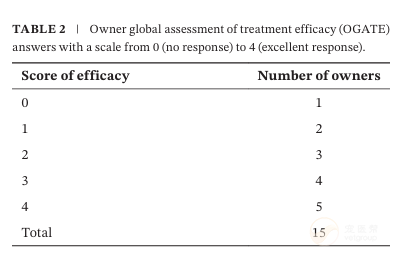
Fifteen of 31 owners completed the OGATE assessment: 13 for otoendoscopy- guided flushing combined with medical treat ment, and two for medical treatment alone. A positive response was defined as a score of 3 (‘good’) or 4 (‘excellent’). Based on this definition, 60% of these owners (nine of 15) reported a posi tive outcome. Three owners rated the response as fair while the remaining three reported no or poor improvement. The answers to the assessment are summarised in Table 2.
31位宠主中的15位完成了OGATE评估:13位针对耳内镜引导冲洗联合药物治疗,2位针对仅药物治疗。有效定义为评分为3(“良好”)或4(“优秀”)。基于此定义,60%的这些宠主(15位中的9位)报告了有效结果。3位宠主评价效果为一般,其余3位报告无改善或改善差。评估答案总结于表2。
4 | Discussion
4 | 讨论
Ceruminoliths are an uncommon yet clinically important cause of pruritus in cats. In this retrospective study of 31 cases, the most consistent clinical feature was chronic ceruminous OE, often refractory to standard treatment. A history of recurrent signs and the presence of firm, dark material in the ear canal should raise suspicion for ceruminoliths.
耵聍石是猫瘙痒的一种不常见但临床上重要的病因。在这项31例的回顾性研究中,最一致的临床特征是慢性耵聍性OE,通常对标准治疗有抵抗性。反复发作的病史和耳道内存在坚硬、深色物质应引起对耵聍石的怀疑。
To the best of our knowledge, this is the largest case series of feline ceruminolithiasis reported. Our findings suggest that manage ment frequently requires mechanical removal under general an aesthesia, sometimes in combination with ceruminolytic agents. Ceruminoliths are often associated with tympanic lesions. The ae tiology remains unclear, and no predisposing factor was identified in this study. Commonly reported causes of feline OE include oto dectic mange (Otodectes cynotis) and infections with Malassezia spp. or Staphylococcus spp. Beyond prompting the use of ear cleaners and topical antimicrobials—which may themselves contribute to material accumulation and ceruminolith forma tion—otodectic mange also can directly damage the epithelial surface of the ear canal and tympanic membrane. Such injury may result in fibrosis or impaired epithelial migration, potentially pre disposing to long- term changes and ceruminolith development. Although these factors could not be directly assessed owing to the retrospective nature of the study, they remain plausible, partic ularly given the referral setting and the likelihood of prior treat ments by general practitioners. In humans, epithelial migration of the tympanic membrane is essential for self- cleaning of the exter nal auditory canal, and impaired migration has been associated with pathological debris accumulation.
据我们所知,这是报道的最大的猫耵聍石病病例系列。我们的研究结果表明,管理通常需要在全身麻醉下进行机械移除,有时联合使用耵聍溶解剂。耵聍石常与鼓膜病变相关。病因仍不清楚,本研究未发现易感因素。猫外耳炎的常见报告原因包括耳螨和马拉色菌属或葡萄球菌属感染。除了促使使用洗耳液和外用抗菌剂(这些本身可能促进物质积聚和耵聍石形成)外,耳螨感染也可能直接损伤耳道和鼓膜的上皮表面。这种损伤可能导致纤维化或上皮迁移受损,可能易导致长期变化和耵聍石发展。尽管由于研究的回顾性性质无法直接评估这些因素,但它们仍然是可能的,特别是在转诊环境和全科医生可能进行过先前治疗的情况下。在人类中,鼓膜的上皮迁移对于外耳道的自我清洁至关重要,迁移受损与病理性碎屑积聚有关。
Interestingly, a high proportion of cats had concurrent otitis media (OM), and a few had stenotic ear canals caused by cystadenomas. Whether these represent predisposing factors or consequences of ceruminoliths is unclear, yet the findings highlight the importance of imaging and thorough otoscopic evaluation. In cats without CT imaging, the tympanic membrane occasionally appeared opaque or less translucent on otoscopy, raising suspicion for middle ear involvement even in the absence of advanced imaging. These ob servations suggest that the prevalence of OM may have been un derestimated in the cohort, underscoring the need for systematic evaluation of the tympanic cavity in future studies.
有趣的是,很大比例的猫并发中耳炎(OM),少数猫因囊腺瘤导致耳道狭窄。这些是易感因素还是耵聍石的结果尚不清楚,但这些发现强调了影像学和彻底耳镜检查的重要性。在没有CT成像的猫中,耳镜检查时鼓膜偶尔显得不透明或透明度降低,即使没有高级成像也引起对中耳患病的怀疑。这些观察结果表明,在该队列中OM的患病率可能被低估,强调了在未来研究中系统评估鼓室的重要性。
One of the most striking observations was the presence of tympanic membrane lesions after ceruminolith removal. These in cluded thickening, erythema, linear scarring or irregularities and even rupture. It should be emphasised that these descriptions were based on visual otoendoscopic assessment rather than his topathological confirmation. Because the tympanic membrane could only be evaluated when the ceruminolith had been re moved, all perforations were first identified immediately after flushing, rather than before the procedure. During follow- up, some perforations appeared to heal, although in several cases assessment was not possible owing to the recurrence of ceru minoliths. In one cat managed medically, a persistent perfora tion was documented, yet the tympanic membrane could not be assessed at the initial presentation. Despite their frequency and potential clinical relevance, tympanic lesions in cats are rarely described in the literature. Their pathogenesis remains unclear yet may involve chronic inflammation, pressure necrosis, or iatrogenic trauma during extraction.
最引人注目的观察之一是耵聍石移除后鼓膜病变的存在。这些包括增厚、发红、线性瘢痕或不规则,甚至破裂。需要强调的是,这些描述是基于视觉耳内镜评估,而非组织病理学确认。因为只有在耵聍石被移除后才能评估鼓膜,所有穿孔都是在冲洗后立即首次发现,而不是在手术前。在随访期间,一些穿孔似乎愈合,尽管在几例中由于耵聍石复发而无法评估。在一只接受药物治疗的猫中,记录到持久性穿孔,但初次就诊时无法评估鼓膜。尽管鼓膜病变在猫中很常见且具有潜在的临床相关性,但文献中很少描述。其发病机制仍不清楚,但可能涉及慢性炎症、压力性坏死或取出过程中的医源性创伤。
The clinical implications of tympanic damage in cats also are poorly understood. While low- frequency hearing loss owing to tympanic perforation has been reported, data on long- term outcomes and specific treatment recommendations are lacking. In our series, some tympanic lesions persisted despite resolution of the ceruminolith, raising questions about healing capacity and the potential for chronic middle ear disease. This underscores the need for future studies to explore the prognostic and therapeutic significance of tympanic membrane lesions.
猫鼓膜损伤的临床意义也知之甚少。虽然有报道称鼓膜穿孔可导致低频听力损失,但缺乏长期结果数据和具体的治疗建议。在我们的系列中,尽管耵聍石缓解,一些鼓膜病变仍然存在,这引发了关于愈合能力和慢性中耳疾病可能性的问题。这强调了未来研究需要探索鼓膜病变的预后和治疗意义。
In some cases, docusate sodium (DSS) might have been used as a ceruminolytic agent during ear flushing procedures, although the integrity of the tympanic membrane was not always con firmed before its application. Experimental studies in guinea pigs have shown that intratympanic bulla DSS is severely oto toxic, causing significant hearing loss and cochlear inflamma tion comparable to gentamicin. While no cats in our study developed clinical signs consistent with otitis interna after the procedure, the potential ototoxicity of DSS highlights the need for caution when using such agents, especially when tympanic perforation cannot be excluded.
在某些病例中,冲洗过程中可能使用了多库酯钠(DSS)作为耵聍溶解剂,尽管在使用前并不总是确认鼓膜的完整性。豚鼠实验研究表明,鼓室内DSS具有严重的耳毒性,导致显著的听力损失和耳蜗炎症,与庆大霉素相当。尽管本研究中没有猫在手术后出现与内耳炎一致的临床症状,但DSS的潜在耳毒性凸显了使用此类药物时需要谨慎,特别是在不能排除鼓膜穿孔的情况下。
Follow- up heterogeneity, inherent to retrospective study designs, may have influenced recurrence detection, with short intervals potentially underestimating and long intervals potentially over- representing events. Recurrence estimates should therefore be interpreted with caution.
回顾性研究设计固有的随访的异质性可能影响了复发的检测,短间隔可能低估,长间隔可能高估事件。因此,复发估计值应谨慎解释。
Recurrence was relatively frequent in both groups, affecting 35% of cats that underwent flushing compared to 40% of those man aged medically (see Table S1). The difference between groups was small, and interpretation is limited by the small sample size, particularly in the medically managed group. Therefore, no clear benefit of flushing on recurrence can be concluded from this study. These findings highlight the need for larger prospec tive studies to better evaluate treatment outcomes and identify factors associated with recurrence.
两组复发都相对频繁,接受冲洗的猫中有35%复发,而接受药物治疗的猫中有40%复发(见表S1)。组间差异很小,并且解释受到样本量小(特别是药物治疗组)的限制。因此,本研究无法得出冲洗对复发有明确益处的结论。这些发现强调需要进行更大规模的前瞻性研究,以更好地评估治疗结果并确定与复发相关的因素。
Treatment efficacy was rated as good- to- excellent by 60% of owners who completed the OGATE questionnaire. The main reason for satisfaction was clinical sign reduction, although some cats continued to exhibit pruritus despite ceruminolith resolution. Interestingly, a few cats still had visible cerumino liths yet were no longer pruritic, which may have contributed to higher- than- expected OGATE scores.
完成OGATE问卷的宠主中有60%将治疗效果评为良好至优秀。满意的主要原因是临床症状减轻,尽管一些猫在耵聍石缓解后仍表现出瘙痒。有趣的是,少数猫仍有可见的耵聍石但不再瘙痒,这可能导致了高于预期的OGATE评分。
This study has several limitations. Its retrospective design in troduces inherent biases, including incomplete data and vari ability in diagnostic and therapeutic protocols. Only cases with confirmed ceruminoliths and at least one follow- up were in cluded, possibly excluding milder or undiagnosed cases. As all patients were seen at a referral hospital, selection bias is likely, and the findings may not reflect the general feline population. Cytological and imaging data were incomplete, limiting the analysis of microbial associations and middle ear involvement. Follow- up duration varied greatly, from a few days to several years, complicating interpretation of recurrence and long- term outcomes. Furthermore, although the OGATE provided useful insight into owner- perceived efficacy, it represents a subjective assessment, and half of the owners did not respond. Moreover, the survey was administered retrospectively, which in some cases was several months or years after treatment, which may have introduced recall bias. These limitations highlight that the questionnaire results should be interpreted cautiously. Finally, no auditory function testing was performed, preventing any conclusions about the clinical impact of tympanic lesions on hearing.
本研究有几个局限性。其回顾性设计引入了固有的偏倚,包括数据不完整以及诊断和治疗方案的多样性。仅纳入了确诊为耵聍石且至少有一次随访的病例,可能排除了较轻或未确诊的病例。由于所有患猫均在转诊医院就诊,可能存在选择偏倚,研究结果可能不能反映一般猫群。细胞学和影像学数据不完整,限制了微生物关联和中耳患病的分析。随访时间差异很大,从几天到几年不等,使复发和长期结果的解释复杂化。此外,尽管OGATE提供了宠主感知疗效的有用见解,但它代表主观评估,且一半的宠主未回应。而且,该调查是回顾性进行的,在某些情况下是治疗后数月或数年,这可能引入了回忆偏倚。这些局限性凸显了应谨慎解释问卷结果。最后,未进行听觉功能测试,无法得出关于鼓膜病变对听力临床影响的任何结论。
5 | Conclusions and Clinical
5 | 结论与临床相关性
Relevance This study provides the first detailed description of the man agement and clinical outcomes of ceruminoliths in cats. Most cats improved following mechanical removal combined with topical therapy, and recurrence was not consistently observed in cases with adequate follow- up. Tympanic involvement was fre quent, underscoring the need for careful otoscopic examination and appropriate assessment of the middle ear. Taken together, these findings demonstrate that ceruminoliths are an under- recognised yet manageable cause of feline otic disease, and offer practical guidance for clinical decision- making.
本研究首次详细描述了猫耵聍石的管理和临床结果。大多数猫在机械移除联合局部治疗后得到改善,并且在有充分随访的病例中并未持续观察到复发。鼓膜患病很常见,强调了仔细耳镜检查和对中耳进行适当评估的必要性。综上所述,这些发现表明耵聍石是猫耳部疾病中一个未被充分认识但可管理的原因,并为临床决策提供了实用指导。
TABLE 2 | Owner global assessment of treatment efficacy (OGATE) answers with a scale from 0 (no response) to 4 (excellent response).
表2 | “治疗效果整体评估”(OGATE)这一指标采用 0 到 4 的评分标准来衡量治疗效果,其中 0 分表示无反应,4 分表示疗效极佳。
|
疗效评分 |
宠主数 |
|
0
1
2
3
4
总分 |
1
2
3
4
5
15 |
TABLE 1 | Summary of treatment outcomes stratified by follow- up class and treatment modality.
表 1 | 按随访类别和治疗方式分层的治疗结果汇总。
FIGURE 2 | Transverse CT scanner of a cat's head at the level of the tympanic bullae and cochleae obtained with a bone algorithm. Luminal ovoid material (~7 × 4 mm), centred on the right external acoustic port, of nonenhancing tissue density (35–40 UH), protruding into the dorso lateral part of the right tympanic bulla.
图 2 | 采用骨算法获取的猫头部鼓室和耳蜗水平的横断层 CT 扫描图像。位于右侧外耳道中心的椭圆形腔内物质(约 7×4 毫米),组织密度为非强化型(35 - 40 UH),突出于右侧鼓室的背外侧部分。
FIGURE 1 | (a) Ceruminolith obstructing the proximal region of the external ear canal visualised through otoendoscopy. (b) Tympanic perfora tion right after ceruminolith removal. (c) Tympanic thickening and discoloration right after tympanic removal.
图 1 | (a)通过耳内镜观察到的耵聍石阻塞外耳道近端区域的图像。 (b)取出耵聍石后鼓膜穿孔的情况。 (c)取出耵聍后鼓膜增厚及变色的情况。
| 


 |Archiver|手机版|小黑屋|宠医帮
( 京ICP备2022012070号-2 )
|Archiver|手机版|小黑屋|宠医帮
( 京ICP备2022012070号-2 ) 




 发表于
发表于 
 收藏
收藏 转播
转播 分享
分享 淘帖
淘帖