|
COMPARISON OF THE EFFICACY OF A GENTAMICIN, MICONAZOLE AND HYDROCORTISONE ACEPONATE FORMULATION AND A FLORFENICOL, TERBINAFINE AND MOMETASONE FUROATE FORMULATION IN THE TREATMENT OF CANINE OTITIS EXTERNA WITH A FOCUS ON ONSET OF ACTION
比较庆大霉素、咪康唑和氢化可的松醋丙酯制剂与氟苯尼考、特比萘芬和糠酸莫米松制剂治疗犬外耳炎的疗效,重点关注起效时间
作者:C. VON SIMSON*, L. POINCELOT†, P. JASMIN†, J. GRIFFIN‡
翻译:王帆
Introduction
介绍
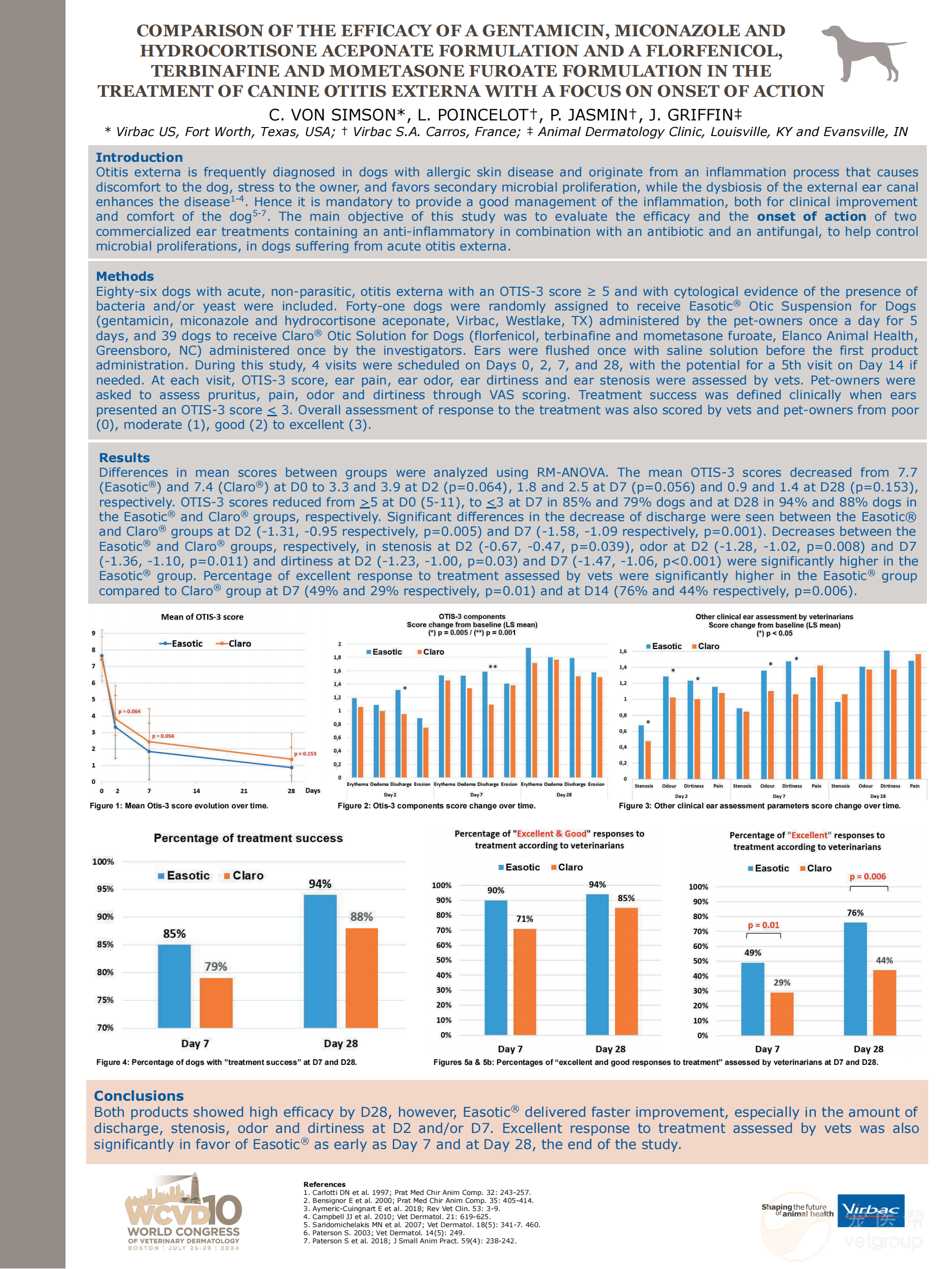
Otitis externa is frequently diagnosed in dogs with allergic skin disease and originate from an inflammation process that causes discomfort to the dog, stress to the owner, and favors secondary microbial proliferation, while the dysbiosis of the external ear canal enhances the disease1-4. Hence it is mandatory to provide a good management of the inflammation, both for clinical improvement and comfort of the dog5-7. The main objective of this study was to evaluate the efficacy and the onset of action of two commercialized ear treatments containing an anti-inflammatory in combination with an antibiotic and an antifungal, to help control microbial proliferations, in dogs suffering from acute otitis externa.
外耳炎在过敏性皮肤病患犬中常见,且源于一种炎症过程,会引起患犬不适、宠主压力,并促进继发微生物增殖,而外耳道的菌群失调加重了疾病。因此,必须对炎症进行良好的管理,以改善临床状况和犬的舒适度。本研究的主要目的是评估两种商业化耳部治疗的疗效及起效时间,这两种治疗均含有抗炎成分,并联合抗生素和抗真菌药物,以帮助控制犬急性外耳炎中微生物的增殖。
Methods
方法
Eighty-six dogs with acute, non-parasitic, otitis externa with an OTIS-3 score ≥ 5 and with cytological evidence of the presence of bacteria and/or yeast were included. Forty-one dogs were randomly assigned to receive Easotic® Otic Suspension for Dogs (gentamicin, miconazole and hydrocortisone aceponate, Virbac, Westlake, TX) administered by the pet-owners once a day for 5 days, and 39 dogs to receive Claro® Otic Solution for Dogs (florfenicol, terbinafine and mometasone furoate, Elanco Animal Health, Greensboro, NC) administered once by the investigators. Ears were flushed once with saline solution before the first product administration. During this study, 4 visits were scheduled on Days 0, 2, 7, and 28, with the potential for a 5th visit on Day 14 if needed. At each visit, OTIS-3 score, ear pain, ear odor, ear dirtiness and ear stenosis were assessed by vets. Pet-owners were asked to assess pruritus, pain, odor and dirtiness through VAS scoring. Treatment success was defined clinically when ears presented an OTIS-3 score ≤3. Overall assessment of response to the treatment was also scored by vets and pet-owners from poor (0), moderate (1), good (2) to excellent (3).
86只患急性非寄生虫性外耳炎,OTIS-3评分≥5分,并且细胞学证据表明存在细菌和/或酵母菌的犬被纳入研究。41只犬被随机分配,使用耳可舒(Easotic®)悬浮液(庆大霉素、咪康唑和氢化可的松醋丙酯)治疗,由宠主每日给药1次,连用5天, 39只犬使用Claro®悬浮液(氟苯尼考、特比萘芬和糠酸莫米松)治疗,由研究者给药1次。第一次给药前患耳用生理盐水冲洗一次。在本研究期间,计划在第0、2、7和28日进行4次就诊,如果需要,可能在第14日进行第5次就诊。每次就诊时,由兽医对OTIS-3评分、耳道疼痛、耳道异味、耳道分泌物、耳道狭窄进行评估。研究人员要求宠主通过VAS评分评估瘙痒、疼痛、异味和耳道脏程度。临床治疗成功定义为OTIS-3评分≤3分。对治疗的总体评估也由兽医和宠主进行评分,从不佳(0),中等(1),良好(2)到极好(3)。
Results
结果
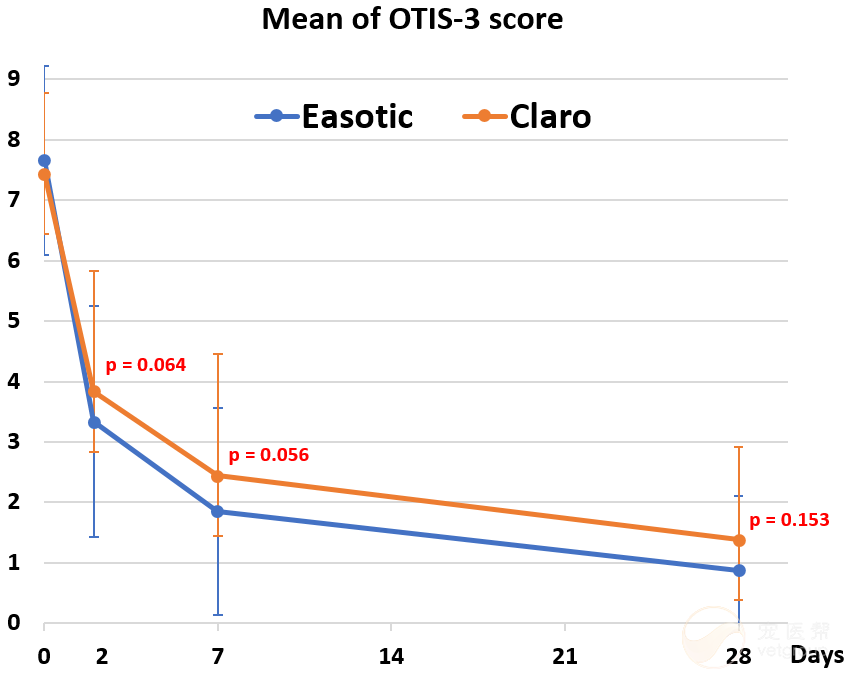
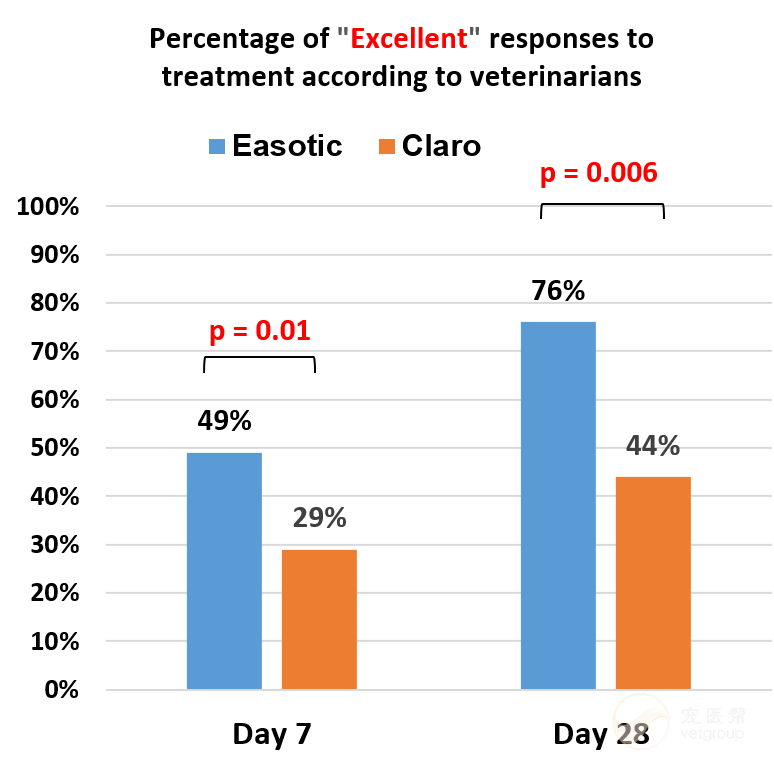
Differences in mean scores between groups were analyzed using RM-ANOVA. The mean OTIS-3 scores decreased from 7.7 (Easotic®) and 7.4 (Claro®) at D0 to 3.3 and 3.9 at D2 (p=0.064), 1.8 and 2.5 at D7 (p=0.056) and 0.9 and 1.4 at D28 (p=0.153), respectively. OTIS-3 scores reduced from >5 at D0 (5-11), to <0.001) were significantly higher in the Easotic® group. Percentage of excellent response to treatment assessed by vets were significantly higher in the Easotic® group compared to Claro® group at D7 (49% and 29% respectively, p=0.01) and at D14 (76% and 44% respectively, p=0.006).
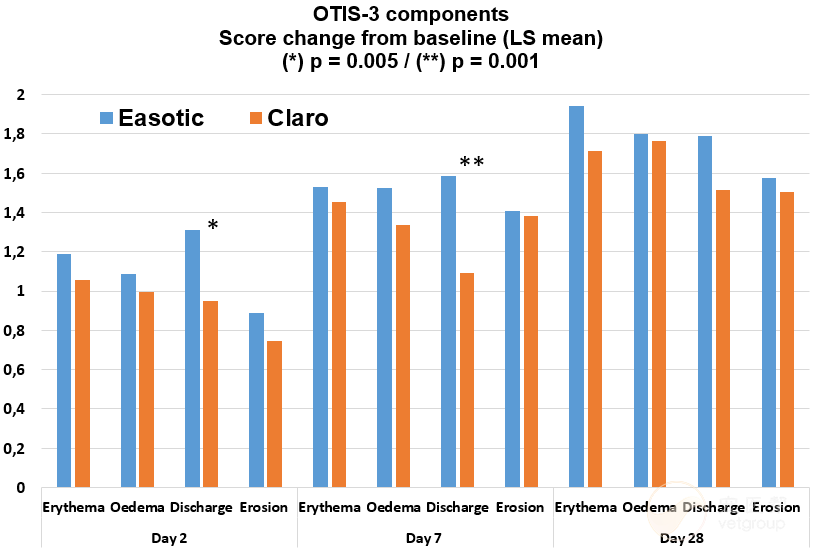
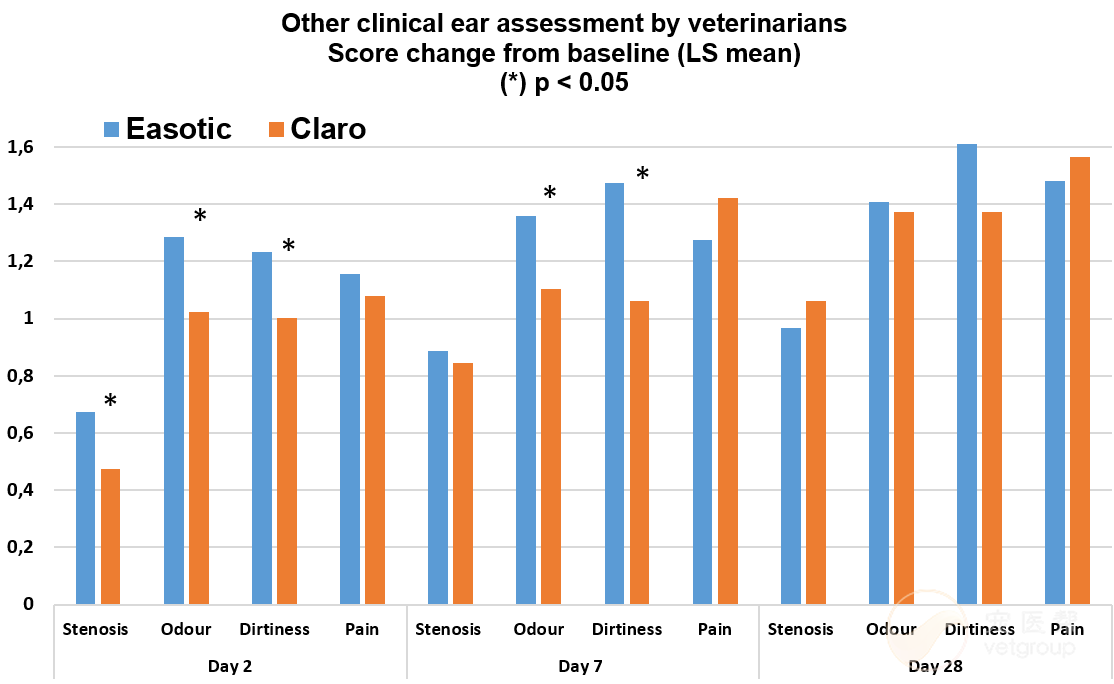
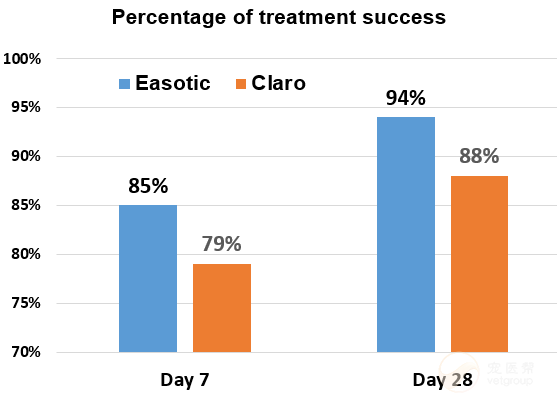
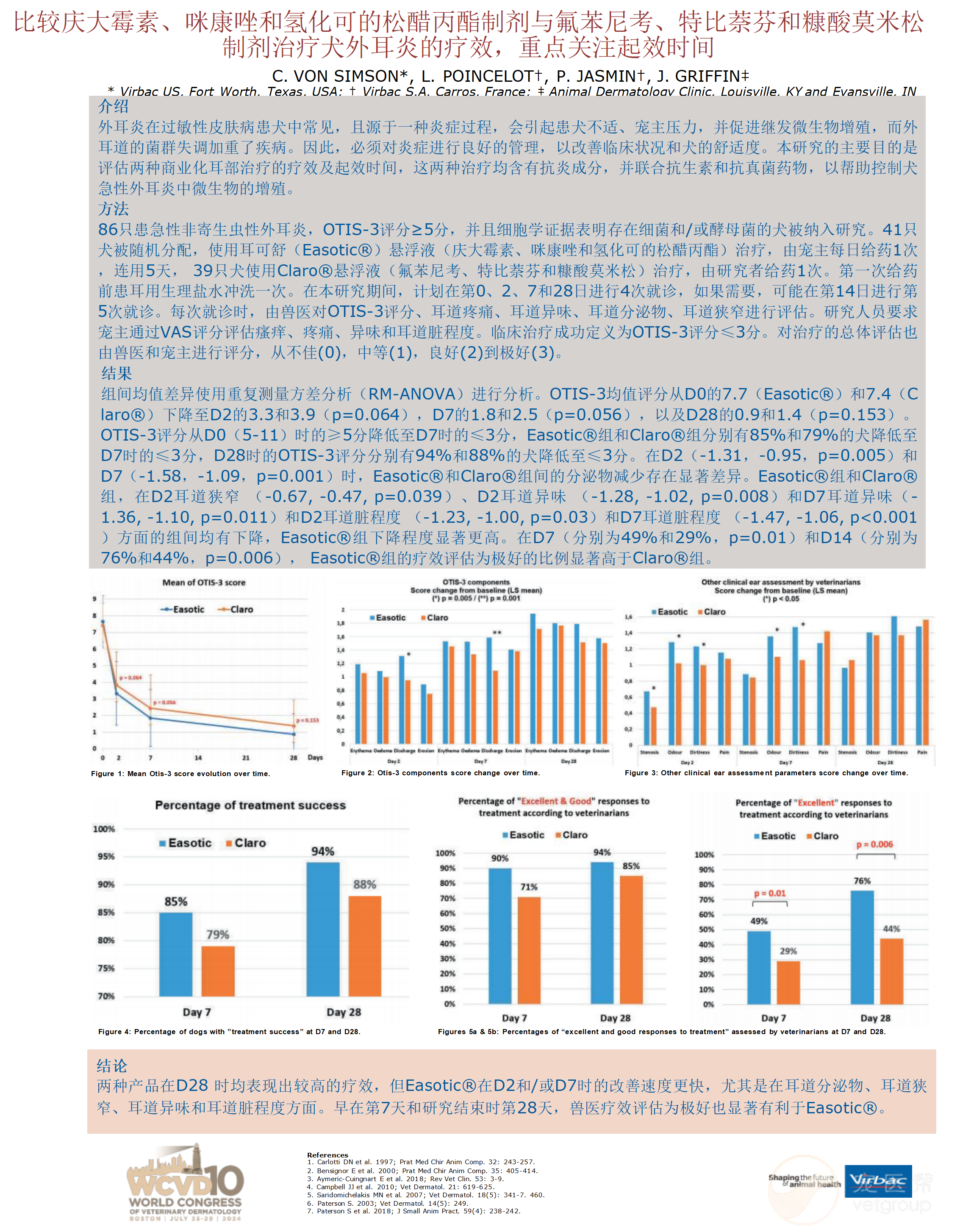
组间均值差异使用重复测量方差分析(RM-ANOVA)进行分析。OTIS-3均值评分从D0的7.7(Easotic®)和7.4(Claro®)下降至D2的3.3和3.9(p=0.064),D7的1.8和2.5(p=0.056),以及D28的0.9和1.4(p=0.153)。OTIS-3评分从D0(5-11)时的≥5分降低至D7时的≤3分,Easotic®组和Claro®组分别有85%和79%的犬降低至D7时的<3分,D28时的OTIS-3评分分别有94%和88%的犬降低至<3分。在D2(-1.31,-0.95,p=0.005)和D7(-1.58,-1.09,p=0.001)时,Easotic®和Claro®组间的分泌物减少存在显著差异。Easotic®组和Claro®组,在D2耳道狭窄 (-0.67, -0.47, p=0.039)、D2耳道异味 (-1.28, -1.02, p=0.008)和D7耳道异味(-1.36, -1.10, p=0.011)和D2耳道脏程度 (-1.23, -1.00, p=0.03)和D7耳道脏程度 (-1.47, -1.06, p<0.001)方面的组间均有下降,Easotic®组下降程度显著更高。在D7(分别为49%和29%,p=0.01)和D14(分别为76%和44%,p=0.006), Easotic®组的疗效评估为极好的比例显著高于Claro®组。
Conclusions
结论
Both products showed high efficacy by D28, however, Easotic® delivered faster improvement, especially in the amount of discharge, stenosis, odor and dirtiness at D2 and/or D7. Excellent response to treatment assessed by vets was also significantly in favor of Easotic® as early as Day 7 and at Day 28, the end of the study.
两种产品在D28 时均表现出较高的疗效,但Easotic®在D2和/或D7时的改善速度更快,尤其是在耳道分泌物、耳道狭窄、耳道异味和耳道脏程度方面。早在第7天和研究结束时第28天,兽医疗效评估为极好也显著有利于Easotic®。
Figure 1: Mean Otis-3 score evolution over time.
图1:随时间变化的Otis-3评分平均值。
Figure 2: Otis-3 components score change over time.
图2:随时间变化的Otis-3各组评分。
Figure 3: Other clinical ear assessment parameters score change over time.
图3:随时间变化的其他耳道临床评估参数得分。
Figure 4: Percentage of dogs with ”treatment success” at D7 and D28.
图4:D7和D28时“治疗成功”的犬的比例。
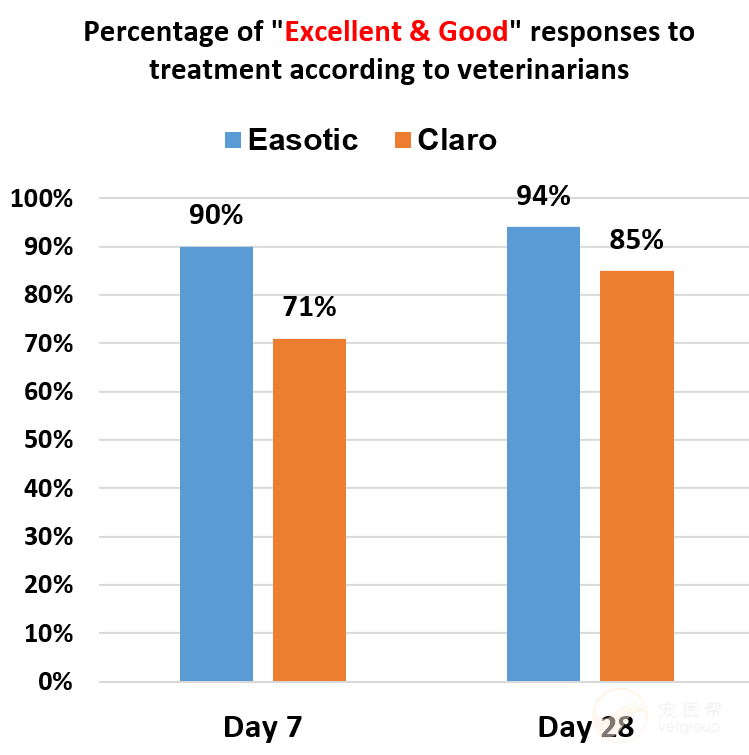
Figures 5a & 5b: Percentages of “excellent and good responses to treatment” assessed by veterinarians at D7 and D28.
图5a和5b:兽医在D7和D28时评估的“疗效良好和极好”的比例。
| 


 |Archiver|手机版|小黑屋|宠医帮
( 京ICP备2022012070号-2 )
|Archiver|手机版|小黑屋|宠医帮
( 京ICP备2022012070号-2 ) 




 发表于 2025-4-5 14:58:09

 收藏
收藏 转播
转播 分享
分享 淘帖
淘帖