|
Putative erythema annulare centrifugum in two Peruvian hairless and one Chinese crested dog
推测2只秘鲁无毛犬和1只中国冠毛犬的离心性环形红斑
作者:Renzo Venturo| Lluís Ferrer Maxence Delverdier | | Pauline Bernard| Emmanuella Guenova Marie- Christine Cadiergues | Daniel Combarros
翻译:王帆
Abstract
摘要
Erythema annulare centrifugum (EAC) is an inflammatory skin condition char acterised in humans by distinctive annular erythematous lesions. Three hair less dogs were examined with clinical and histological features suggestive of EAC. Oral or topical glucocorticoid administration led to complete clinical resolution.
离心性环形红斑(EAC)是一种炎性皮肤病,以人类独特的环形红斑病变为特征。对3只无毛犬进行临床和组织学检查,提示EAC。口服或外用糖皮质激素治疗导致完全的临床解决。
INTRODUCTION
介绍
In humans, erythema annulare centrifugum (EAC) is characterised by annular erythematous lesions that ap pear as urticaria- like papules and enlarge centrifugally, then clear centrally, sometimes with fine scale at the inner edge of the advancing border. EAC can appear at any age without sex predisposition, predominantly affecting the trunk and proximal extremities. Many factors have been associated with EAC, such as infections, drug eruptions or inflammatory diseases, yet direct causality is difficult to prove, and in most cases, EAC is considered idiopathic. Diagnosis is made clinically with histological analysis to exclude common differential diagnoses. The histopathological findings of EAC vary according to its type (superficial or deep) and may be nonspecific with mild spongiosis, microvesiculation, focal parakeratosis, epidermal hyperplasia, minimal superficial perivascular infiltration or papillary dermal oedema. To the best of the authors' knowl edge, EAC has not been reported previously in dogs. This study describes clinical and histopathological find ings suggestive of EAC in three hairless dogs.
在人类中,离心性环形红斑(EAC)的特征是出现环形的红斑性病变,这些病变表现为荨麻疹样丘疹,并呈离心方向增大,随后在中心部位消退,有时在前进边缘的内侧会有细小的皮屑。EAC 可在任何年龄出现,无性别倾向,主要影响躯干和近端四肢。许多因素与 EAC 有关,如感染、药物过敏或炎性疾病,但直接因果关系难以证明,在大多数病例中,EAC 被认为是特发性疾病。诊断是通过临床检查和组织学分析来做出的,以排除常见的鉴别诊断。EAC 的组织病理学表现因类型(浅表型或深部型)而异,可能表现为轻度的海绵样变性、微血管扩张、局灶性角化不全性角化过度、表皮增生、轻微的浅层血管周围浸润或真皮乳头水肿。据作者所知,此前尚未有关于犬患 EAC 的报道。本研究描述了三只无毛犬中具有 EAC 症状的临床和组织病理学发现。
CASE 1
病例1
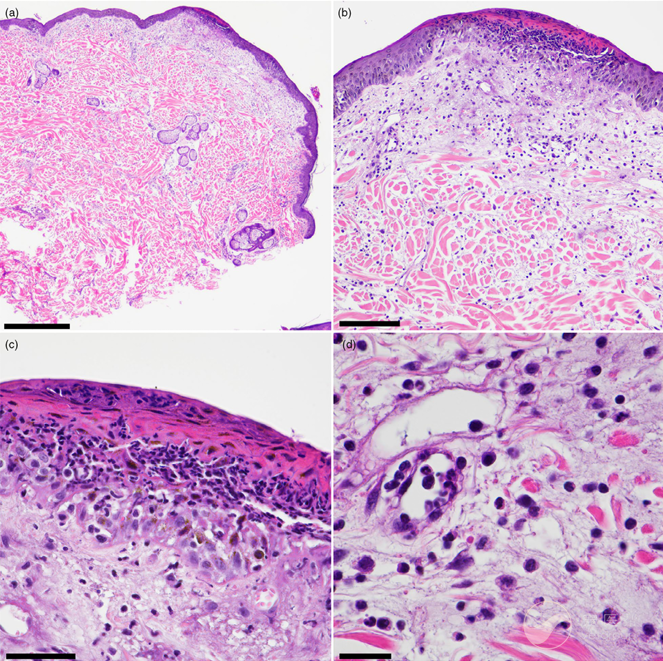
An 11- year- old, castrated male Peruvian hairless dog was presented with a 3- month duration of moderately pruritic dermatitis. The dog was otherwise healthy. A first veterinary surgeon had prescribed oclacitinib (0.5 mg/kg twice daily for 2 weeks then once daily for 2 weeks; Apoquel, Zoetis), terbinafine (35 mg/kg/day for 1 month; Terbinafina, Genfar) and weekly baths with 2% miconazole/chlorhexidine shampoo (VetproDermacare; Petmedica) with no response. The dog received fluralaner (33 mg/kg every 3 months; Bravecto, MSD). On dermatological examination, bilaterally asymmetric, 1–15 cm wide annular and polycyclic erythematous plaques, with a scaly and raised periphery and central hypopigmentation, were found on the trunk and proximal extremities (Figure 1a,b). Differential diagnoses included dermatophytosis and superficial pyoderma. Impression smears performed under the scaly edge revealed neutrophilic inflammation with no micro- organisms; skin scrapings, Wood's lamp examination and fungal culture were all negative. Cutaneous biopsies were performed and processed routinely. Lokivetmab (2 mg/kg subcutaneously; Cytopoint, Zoetis) was administered, unsuccessfully, for itch management. Histological examination of skin biopsy samples revealed moderate superficial perivascular to interstitial lymphocytic and neutrophilic dermatitis with mild superficial oedema, and epidermal hyperplasia with focal spongiosis, neutrophilic exocytosis and serocellular crusts (Figure 2). Gram staining was negative for bacteria (see Figure S1). Based on the dog's history and clinical signs, and taking together the results of the ancillary tests, EAC was considered the most likely diagnosis. Prednisolone (1 mg/kg once daily for 5 days, followed by a tapering regimen of 1 mg/kg every other day for 5 days, then 1 mg/kg every third day for 10 days before discontinuation; Prednovet, Zoovet) led to rapid resolution (Figure 1c,d) within 4 weeks. Twelve months after the initial diagnosis, there had been no relapse.
一只 11 岁、已去势的雄性秘鲁无毛犬被诊断出患有持续 3 个月的中度瘙痒性皮肤病。该犬其他方面健康状况良好。第一位兽医曾开具了奥拉替尼(0.5 毫克/千克,每日两次,持续 2 周,随后改为每日一次,持续 2 周)、特比萘芬(35 毫克/千克/天,持续 1 个月)以及每周使用 2%咪康唑/氯己定香波进行洗澡,但均未见效果。该犬随后接受了氟雷拉纳(每 3 个月 33 毫克/千克)的治疗。在皮肤病学检查中,在躯干和近端四肢上发现了双侧不对称、1 - 15 厘米宽的环形和多环状的红斑性斑块,边缘有皮屑且隆起,中央有色素减退现象(图 1a、b)。可能的诊断包括皮肤癣菌病和浅表性脓皮病。在皮屑边缘进行的皮肤压片显示有中性粒细胞炎症,但未发现微生物;皮肤刮片、伍德灯检查和真菌培养均呈阴性。进行了皮肤活检并按常规程序进行处理。洛基维特单抗(2 毫克/千克,皮下注射; )被用于治疗瘙痒症状,但效果不佳。对皮肤活检样本进行的组织学检查显示,存在中度的浅层血管周围至间质的淋巴细胞和中性粒细胞性皮炎,伴有轻微的浅层水肿,以及表皮增生伴局灶性海绵状变性、中性粒细胞外排和浆液性细胞痂(图 2)。革兰氏染色未发现细菌(见图 S1)。根据该犬的病史和临床症状,并结合辅助检查的结果,嗜酸性细胞增多症被认为是最可能的诊断。泼尼松(1 毫克/千克,每日一次,持续 5 天,随后减量,每两天 1 毫克/千克,持续 5 天,然后减量,每三天 1 毫克/千克,持续 10 天后停药)在 4 周内迅速缓解(图 1c、d)。在初次诊断后的 12 个月里,未出现复发。
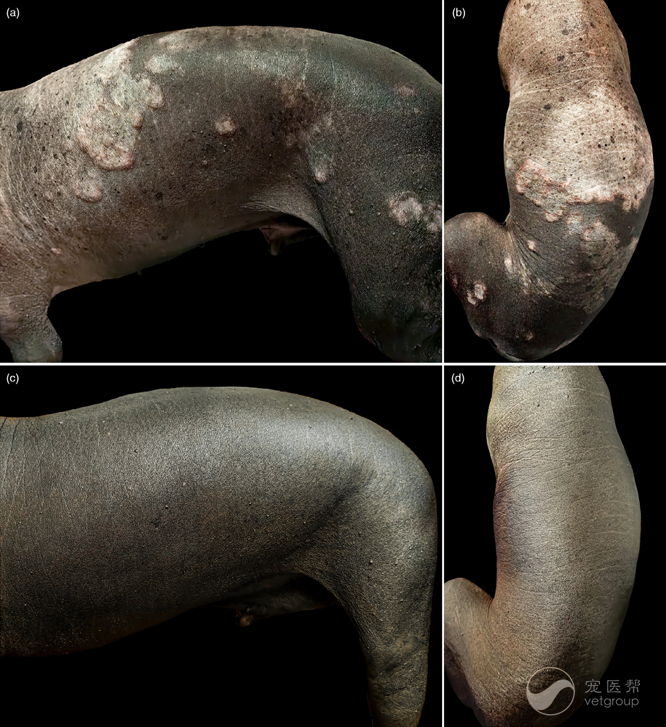 FIGURE 1 Macroscopic pictures of Case 1. Lateral (a) and dorsal (b) photographs at initial presentation. Presence of annular and polycyclic erythematous plaques with scaly and raised periphery and central depigmentation. Lateral (c) and dorsal (d) photographs of Case 1 after treatment with oral prednisolone showing resolution of the lesions
图 1 病例1 的宏观图片。初次就诊时的侧位(a)和背位(b)照片。可见环形和多环状的红斑性斑块,边缘有皮屑且隆起,中央部位有色素减退。治疗后(使用口服泼尼松龙)的侧位(c)和背位(d)照片显示病变已消退。
CASE 2
病例2
A 3- year- old, spayed female Chinese crested dog was presented with severely pruritic and erythematous pododermatitis that had been present for 2 years. The dog's general health was good, and the dog had been receiving sarolaner once monthly (3.2 mg/kg; Simparica, Zoetis). On dermatological examination, pododermatitis of all 4 paws, erythema of the flexural elbow and axillary folds, mild blepharitis, cheilitis and numerous comedones were observed. On the left lateral thorax, a 2 cm diameter annular plaque with raised erythematous periphery and central hypopigmentation was observed (Figure S2a). Cytological examination of interdigital skin revealed mild Malassezia overgrowth. Atopic dermatitis (AD) with secondary Malassezia pododermatitis was considered the most likely diagnosis explaining the clinical signs and pruritus. An elimination diet trial was started to investigate food- induced AD. An injection of lokivetmab at 1.4 mg/kg s.c. (Cytopoint; Zoetis) was given, and 2% chlorhexidine/2% miconazole shampoo (Malaseb; Dechra) was prescribed for distal extremities twice weekly. Impression smear of the annular lesion revealed neutrophils with no bacteria. Because the lesion was nonpruritic and the owners thought that it was an area of trauma, no specific treatment was prescribed.
一只 3 岁、已绝育的雌性中国冠毛犬被诊断出患有严重的瘙痒性红斑性足皮炎,这种病症已持续了 2 年。该犬的整体健康状况良好,且一直在每月服用一次的沙罗拉纳(3.2 毫克/千克)进行治疗。在皮肤检查中,观察到四只脚的足皮炎、肘部和腋窝褶皱处的红斑、轻度结膜炎、唇炎以及大量的粉刺。在左前侧胸部,观察到一个直径 2 厘米的环形斑块,其边缘有隆起的红斑,中央有色素减退(图 S2a)。对趾间皮肤的细胞学检查显示有轻微的马拉色菌过度增殖。特应性皮炎(AD)伴继发性马拉色菌足皮炎被认为是解释临床症状和瘙痒的最可能诊断。开始了一项食物排查试验,以调查食物引起的 AD。给予 1.4 毫克/千克的洛基维特单抗皮下注射,并开具每周两次用于远端四肢的 2%氯己定/2%咪康唑香波。环形病变的皮肤压片显示有中性粒细胞,但没有细菌。因为该病变无瘙痒症状,且主人认为这是受伤所致的区域,所以未给予任何针对性的治疗。
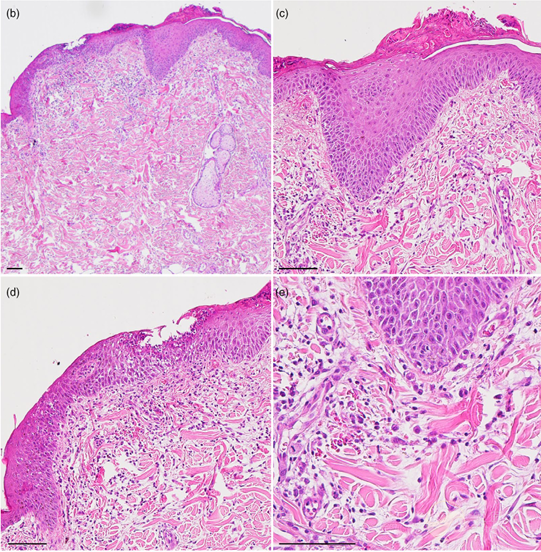
At the follow- up visit, 5 weeks later, pruritus and lesions associated with AD were markedly improved. However, the left lateral thorax lesion had progressed to multifocal plaques with polycyclic and serpiginous raised erythematous and scaly borders with irregular central depigmentation (Figure 3a). Differential diagno sis included dermatophytosis, superficial pyoderma, generalized cutaneous discoid lupus, contact dermati tis, and EAC. Fungal culture was negative, and no bac teria were observed in the cytological samples. Biopsy of the plaques was performed, and samples were pro cessed routinely. Superficial perivascular lymphocytic and neutrophilic dermatitis associated with severe epidermal acanthosis and focal areas of spongiosis, lymphocytic and neutrophilic exocytosis, and focal parakeratosis were observed on histological examination (Figure 3b–e). Gram staining was negative for bacteria (Figure S3). Erythema annulare centrifugum was con sidered the most likely diagnosis. Daily local application of betamethasone 0.05% cream (Diprosone; Organon) led to complete resolution of lesions within 15 days (Figure S2b). At 2 years after initial diagnosis, there had been no relapse of EAC lesions.
在随访检查中(5 周后),特应性皮炎引起的瘙痒和皮肤病变有了明显改善。然而,左侧胸部的皮肤病变已发展为多发性斑块,这些斑块呈多环状和蜿蜒状隆起的红斑和皮屑状边缘,伴有不规则的中心色素减退(图 3a)。鉴别诊断包括皮肤癣菌病、浅表性脓皮病、全身性皮肤盘状红斑狼疮、接触性皮肤病和 EAC。真菌培养结果为阴性,细胞学样本中也未观察到细菌。对斑块进行了活检,并对样本进行了常规处理。组织学检查显示,存在与严重表皮棘层增厚相关的浅表血管周围淋巴细胞和中性粒细胞性皮炎,以及局部的海绵状变性、淋巴细胞和中性粒细胞性外排以及局部角化不全性角化过度(图 3b-e)。革兰氏染色未发现细菌(图 S3)。离心性环形红斑被认为是最可能的诊断。每天局部使用 0.05% 倍他米松乳膏,可使皮肤病变在 15 天内完全消退(图 S2b)。在初次诊断后的两年时间里,EAC病变未出现复发情况。
FIGURE 2 Histopathological findings of skin biopsy samples in Case 1 (haematoxylin and eosin). (a) Superficial perivascular dermatitis with severe dermal oedema, and regular and diffuse epidermal hyperplasia; bar = 500 μm. (b) Close- up of superficial dermis and epidermis; bar = 200 μm. (c) Spongiosis and neutrophilic exocytosis with formation of serocellular crust; bar = 50 μm. (d) Close- up of the superficial mixed inflammatory infiltrate; bar = 25 μm)
图 2 病例1 皮肤活检样本的组织病理学检查结果(苏木精-伊红染色)。(a)表层血管周围性皮炎,伴有严重的皮肤水肿,以及规则且弥漫的表皮增生;图中单位为 500 微米。(b)表层真皮和表皮的特写;图中单位为 200 微米。(c)海绵样变性和中性粒细胞外排,伴有浆细胞样结痂的形成;图中单位为 50 微米。(d)表层混合性炎症浸润的特写;图中单位为 25 微米)
FIGURE 3 Photograph of Case 2 and the corresponding histopathological findings (haematoxylin and eosin). (a) Multifocal arciform to polycyclic lesions with elevated erythematous and scaly borders, and central depigmentation. (b) Superficial perivascular dermatitis with severe irregular epidermal hyperplasia, serocellular crust, and focal parakeratosis; bar = 100 μm. (c) Close- up of superficial dermis and epidermis, note epidermal spongiosis; bar = 100 μm. (d) Marked spongiosis and neutrophilic exocytosis with formation of micro- vesicles; bar = 100 μm. (e) Mixed perivascular inflammatory infiltrate with lymphocytes, histiocytes, neutrophils and mast cells; bar = 100 μm)
图 3 病例 2 的照片及相应的组织病理学结果(苏木精和伊红染色)。(a)多发性弧形至多环形病变,边缘呈红斑状和皮屑状,中央有色素减退。(b)浅表的血管周围性皮炎,伴有严重的不规则表皮增生、浆细胞样结痂和局灶性角化不全角化过度;图中单位为 100 微米。(c)表皮和表层真皮的特写镜头,注意表皮的海绵状变性;图中单位为 100 微米。(d)显著的海绵状变性和中性粒细胞外排,形成微小水泡;图中单位为 100 微米。(e)混合性的血管周围炎症浸润,包含淋巴细胞、组织细胞、中性粒细胞和肥大细胞;图中单位为 100 微米)
CASE 3
病例3
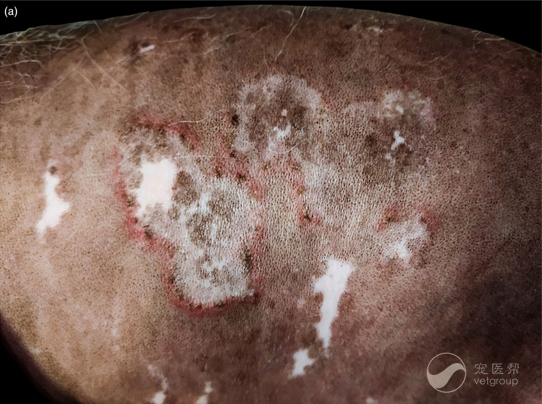
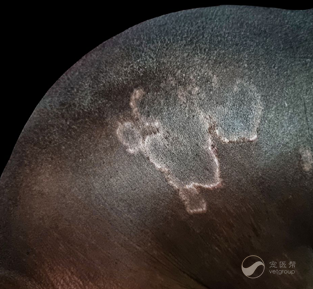
A 2- year- old, male Peruvian hairless dog was presented with a nonpruritic, erythematous linear plaque on the thorax. The dog had been treated with itraconazole (10 mg/kg for 3 weeks; Itraconazol, Zoovet) without response and received fluralaner (40 mg/ kg every 3 months; Bravecto, MSD). Dermatological examination revealed bilateral asymmetric, polycyclic erythematous plaques with raised and scaly borders on the thorax (Figure 4). Differential diagnoses included dermatophytosis, superficial bacterial pyoderma, and EAC. Fungal culture and cytological evaluation (performed by impression smear at the lesion edge) were negative for bacteria and dermatophytes, and EAC was considered the most likely diagnosis. Histological investigation was not performed. The lesions resolved with prednisolone (1 mg/kg once daily for 5 days then tapered for a total of 15 days; Prednovet, Zoovet). The dog was lost to follow- up.
一只 2 岁的雄性秘鲁无毛犬胸部出现了一个非瘙痒性、红斑性的线状斑块。该犬曾使用伊曲康唑(10 毫克/千克,持续 3 周)进行治疗,但未见效果,随后又使用了氟雷拉纳(每 3 个月 40 毫克/千克;)。皮肤检查显示,胸部两侧存在不对称的多环状红斑性斑块,边缘隆起且有皮屑(图 4)。鉴别诊断包括皮肤癣菌病、浅表细菌性脓皮病和 EAC。真菌培养和细胞学评估(在病变边缘进行压片涂片)均未发现细菌和皮肤癣菌,而 EAC 被认为是最可能的诊断。未进行组织学检查。使用泼尼松龙(1 毫克/千克,每日一次,持续 5 天,然后逐渐减量,总计 15 天)使病变消退。该犬失访。
DISCUSSION
讨论
In humans, EAC belongs to the figurate erythemas and is considered a type IV hypersensitivity reaction to an external or internal antigenic stimulus. It is considered to be a clinical reaction pattern rather than a specific clinicopathologic entity. In humans, EAC has been as sociated with many infectious entities (particularly dermatophytes), including viruses (e.g. Epstein–Barr virus, poxvirus, human immunodeficiency virus) and bacte ria (Pseudomonas spp.), ectoparasites (Phtirus pubis), drugs (e.g. cimetidine, rituximab, diuretics), Crohn's disease, pregnancy and malignancy, among others. In most cases, no causative agent is found and EAC is considered idiopathic. In the cases described here, lim ited by the retrospective nature of the work, a full diag nostic work- up of the dogs was not performed. One of the dogs (Case 2) suffered from AD, raising the ques tion of whether this condition could predispose the skin to EAC- like hypersensitivity reaction. It also could be hypothesised that this skin reaction might be second ary to ectoparasite bites. These dogs were otherwise clinically healthy, were treated with routine ectopara site preventives, and two of them were followed for 12–24 months after diagnosis with no signs of relapse.
在人类中,EAC 属于地图状红斑的一种,被视为对外部或内部抗原刺激的 IV 型超敏反应类型。它被认为是一种临床反应模式,而非特定的临床病理实体。在人类中,EAC 与许多感染性疾病有关(尤其是癣菌),包括病毒(如EB病毒、痘病毒、人类免疫缺陷病毒)和细菌(假单胞菌属)、体外寄生虫(阴虱)、药物(如西咪替丁、利妥昔单抗、利尿剂)、克罗恩病、妊娠和恶性肿瘤等。在大多数病例中,未发现致病因子,EAC 被认为是特发性疾病。在本文所述的病例中(受研究回顾性性质的限制),并未对犬进行全面的诊断检查。其中一只犬(病例 2)患有特应性皮炎,这引发了这样一个问题:这种状况是否会使皮肤更容易出现EAC 样超敏反应。也可以假设这种皮肤反应可能是由体外寄生虫叮咬引起的。这些犬在临床上均健康状况良好,接受了常规的体表寄生虫预防治疗,其中两只在确诊后接受了 12 至 24 个月的跟踪观察,期间未出现复发症状。
FIGURE 4 Macroscopic pictures of Case 3. Photograph of linear polycyclic lesions on lateral thorax with raised erythematous and scaly borders.
图 4 病例 3 的宏观图像。侧胸部线性多环状病变的照片,病变区域有隆起的红斑和皮屑状边缘。
The dogs described here belong to two breeds that suffer from ectodermal dysplasia linked to mutations in the forkhead box transcription factor family (FOXI3) on chromosome 17. A link between the FOXI3 mutation and EAC is difficult to imagine. Interestingly, a variant of figurate erythema is described in Sphynx cats from eastern Europe.This breed has a mutation on the ker atin 71 gene that is not linked to ectodermal dysplasia, yet is linked to major hair follicle abnormalities. It is possible that EAC is more common in hairless breeds because of the greater exposure of their skin surface to external antigenic stimuli that can trigger type IV hypersensitivity reactions. Another possibility is that, because of the absence of hair, lesions are easily ob served by both owners and clinicians, while in other breeds they may remain undiscovered because of the fur.
文中所描述的这些犬属于两种患有与 17 号染色体上的叉头框转录因子家族(FOXI3)突变相关的外胚层发育不良症的犬种。很难想象 FOXI3 突变与 EAC 之间存在关联。有趣的是,在来自东欧的斯芬克斯猫中描述了一种图形性红斑的亚型。这种犬种在角蛋白71 基因上存在突变,该突变与外胚层发育不良无关,但与主要的毛囊异常有关。有可能 EAC 在无毛犬种中更为常见,因为它们的皮肤表面更容易暴露于外部抗原刺激之下,从而可能引发 IV 型超敏反应。另一种可能性是,由于没有毛发,病变更容易被主人和临床医生观察到,而在其他犬种中则可能由于毛发的存在而未被发现。
In humans, EAC occurs in two clinical forms: super ficial and deep. In both forms, the initial lesion spreads centrifugally with central healing. The cases described here are more consistent with the superficial form, be cause histological examination revealed nonspecific epidermal and superficial dermal changes. We propose that the diagnosis of this entity in dogs, as in people, should be based on its distinctive clinical presentation and ancillary tests that rule out other differential diagnoses, such as superficial bacterial pyoderma, dermatophytosis or cutaneous discoid lupus. The histological findings are not specific to this condition and could be observed in other superficial skin conditions.
在人类中,EAC 有两种临床表现形式:浅表型和深型。在两种形式中,最初的病变均呈离心性扩散,并伴有中心愈合。所述病例更符合浅表型,因为组织学检查显示非特异性表皮和浅层皮肤变化。我们提出,与人类一样,犬类中这种病症的诊断应基于其独特的临床表现以及排除其他鉴别诊断的辅助检查,例如浅表性细菌性脓皮病、皮肤癣菌病或皮肤盘状红斑狼疮。组织学发现并非该病症的特异性特征,可能在其他浅表皮肤疾病中也观察到。
In humans, treatment of EAC is aetiological. In practice, in most people, the aetiology is unknown, so symptomatic and empirical treatment, with topical or systemic glucocorticoids, remains an option. The cases described were managed with systemic or topical steroids leading to rapid resolution of the lesions in each case. In the follow- up period of cases 1 and 2, the lesions did not relapse. Unfortunately, Case 3 did not have histological evaluation of skin biopsies and was lost to follow- up, which is one of the limitations of this work.
在人类中,EAC治疗属于病因治疗范畴。在实际操作中,对于大多数患者而言,病因尚不明确,因此采取对症治疗和经验性治疗(使用外部或全身性糖皮质激素)仍是可行的选择。所描述的病例均采用全身或外用类固醇进行治疗,结果在每个病例中病变均迅速消退。在病例 1 和 2 的随访期间,病变未复发。不幸的是,病例 3 未进行皮肤活检的组织学评估,且失访,这是本研究的一个局限性。
The lesions described here are clinically suggestive of superficial bacterial pyoderma. Cytological evalua tion, the recommended test for diagnosis, yielded negative results. The use of antibiotics was not justi fied in these cases. Unfortunately, bacterial cultures were not performed; though, even if positive, this would not have confirmed the diagnosis of bacterial pyoderma. Furthermore, Gram staining failed to detect microorganisms in any of the histological sections in two cases. Nevertheless, a hypersensitivity reaction to bacterial antigens present on the skin surface cannot be ruled out.
文中所描述的病变在临床上提示为浅表性细菌性脓皮病。作为诊断推荐的细胞学检查结果为阴性。在这些病例中,使用抗生素并不合理。不幸的是,没有进行细菌培养;即便培养结果呈阳性,这也无法确诊为细菌性脓皮病。此外,在两例病例中,革兰氏染色未能在任何组织切片中检测到微生物。然而,不能排除对皮肤表面存在的细菌抗原的过敏反应。
In conclusion, we describe three hairless dogs with putative EAC. We propose that diagnosis of this condi tion should be based on its distinctive clinical presen tation and the exclusion of other differential diagnoses through cytological evaluation, fungal culture and his tological analysis. Future prospective studies are war ranted to determine whether these animals suffer from an underlying condition that predisposes them to a unique type- IV hypersensitivity reaction.
总之,我们描述了三只推测患有EAC的无毛犬。我们提出,对该病症的诊断应基于其独特的临床表现,并通过细胞学评估、真菌培养和组织学分析排除其他可能的鉴别诊断。未来有必要进行前瞻性研究,以确定这些动物是否患有潜在的疾病,该疾病使它们更容易发生一种独特的 IV 型超敏反应。 | 


 |Archiver|手机版|小黑屋|宠医帮
( 京ICP备2022012070号-2 )
|Archiver|手机版|小黑屋|宠医帮
( 京ICP备2022012070号-2 ) 




 发表于 2025-7-21 16:32:39

 收藏
收藏 转播
转播 分享
分享 淘帖
淘帖