|
UNCOMMON CONDITIONS Treatment can be challenging due to the rarity of immune-mediated dermatoses in cats.
由于猫免疫介导性皮肤病的罕见性,治疗可能具有挑战性。
INSIGHTS IN DERMATOLOGY
皮肤病学见解
Immune-Mediated Dermatoses in Cats
猫的免疫介导性皮肤病(2022)
作者:Heng L. Tham,
DVM, DACVD, Fellow MCVS Virginia-Maryland College of Veterinary Medicine, Virginia Tech
翻译:王帆
Immune-mediated dermatoses in cats are uncommon to rare and in some cases pose challenges in terms of the choice of treatment for induction and maintenance of clinical remission. This article addresses 3 immunemediated skin diseases in cats—plasma cell pododermatitis (PCP), proliferative and necrotizing otitis externa (PNOE), and auricular chondritis (AC)—and reviews the signalment, clinical and histopathologic features, diagnosis, treatments, and outcomes. Information in this article is based on the combination of published supporting evidence as well as the author’s clinical experience.
猫的免疫介导性皮肤病不常见至罕见,在某些病例中,在诱导和维持临床缓解的治疗选择方面存在挑战。本文就猫的3种免疫介导性皮肤病——浆细胞足皮炎(PCP)、增生性坏死性外耳炎(PNOE)和耳软骨炎(AC)的特征、临床和组织病理学特征、诊断、治疗和结果进行综述。本文中的信息是基于已发表的支持证据以及作者的临床经验。
PLASMA CELL PODODERMATITIS
浆细胞足皮炎
PCP, also known as pillow foot, is an uncommon skin disease that has a clinically distinct feature: only the paw pads are affected. Two cases of plasma cell dermatitis affecting the nose and/or nose bridge without involvement of the paw pads have been reported. However, this poorly understood condition will not be discussed in detail in this article as it is unknown whether it is a rare variant of feline PCP or an entirely separate condition.
PCP,也称为“枕足”,是一种不常见的皮肤病,有一个独特的临床特征:只有爪垫患病。已有2例浆细胞皮炎累及鼻部和/或鼻梁但未累及爪垫的病例报告。然而,因为对这种情况,到底是一种罕见的猫PCP亚型,还是一种完全独立的疾病目前了解不充分,因此将不会在本文中详细讨论,。
Etiology
病因学
The etiopathogenesis of PCP is poorly understood. Some cats with PCP are concurrently infected with feline leukemia virus (FeLV) and/or feline immunodeficiency virus (FIV). For one cat, immunohistochemistry (IHC) of a skin biopsy sample from the affected paw pad showed positive reactivity for FeLV, and in another cat FIV immunoreactive cells were detected. According to one abstract, 5 cats were positive for FIV by polymerase chain reaction of biopsy samples of skin lesions. It is unknown if the FIV and/ or FeLV infection(s) contributed to the pathogenesis of PCP or if these cats had 2 unrelated and concurrent conditions. The positive response to immunosuppressive and/or immunomodulatory drugs in cats with PCP suggests that this condition may also be associated with an aberrant immune response.
PCP的发病机制尚不清楚。部分PCP猫同时感染猫白血病病毒(FeLV)和/或猫免疫缺陷病毒(FIV)。有一只猫,患病爪垫皮肤活检样本的免疫组织化学(IHC)显示FeLV阳性反应,另一只猫检测到FIV免疫反应细胞。根据一份摘要,5只猫皮肤病变活检样本经聚合酶链反应检测为FIV阳性。目前尚不清楚是否FIV和/或FeLV感染导致了PCP的发病,或者这些猫是否有两种不相关的并发疾病。PCP猫对免疫抑制和/或免疫调节药物的有效反应表明,这种疾病也可能与异常的免疫反应有关。
Signalment
特征
Most cats with PCP are domestic shorthair cats, but PCP has been reported in cats of other breeds (e.g., European shorthair, Siamese, mixed breeds, Oriental shorthair, British blue, Balinese, Tonkinese). Male cats seemed to be more frequently affected than female cats; of 66 cats in 5 reports that included ≥5 cats, 70% were either intact or neutered male cats.
大多数患PCP的猫是家养短毛猫,但其他品种的猫(如欧洲短毛猫、暹罗猫、杂交品种、东方短毛猫、英国蓝猫、巴厘猫、东京猫)也有PCP的报告。公猫似乎比母猫更容易感染;在包括≥5只猫的5份报告中的66只猫中,70%是未去势或已去势公猫。
Clinical Signs
临床症状
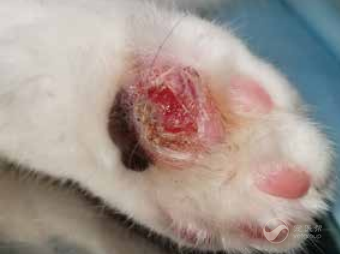
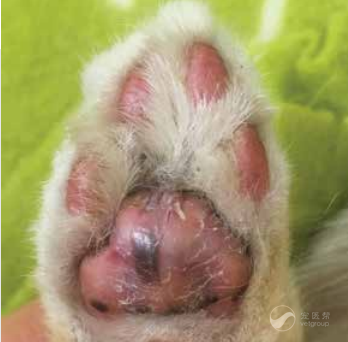
A clinical diagnosis of feline PCP can be based on the distinct skin lesions that are confined to the paw pads. The affected pads are often swollen and soft and exhibit striations and/or scaling/exfoliation (FIGURE 1). As the disease progresses, ulceration with granulation tissue and hemorrhage can develop (FIGURE 2). In cats with light-colored paw pads, discoloration has been reported, ranging from depigmentation and erythema to violaceous (purplish) (FIGURE 3). The affected paw pads could be painful and result in lameness. Of note, more than 70% (n = 41) of cats with this condition were presented to the veterinarian with a primary complaint of lameness and/or pain. The number of paws affected varies from 1 to all 4; most commonly affected are the metacarpal and metatarsal pads, but digital pads can also be affected along with the metacarpal and/or metatarsal pads. For 2 cats, the accessory pads were affected. Most cats with PCP are otherwise healthy, although for a few cats, reported concurrent systemic signs were emaciation, conjunctivitis/blepharitis, lymphadenopathy, and pale mucous membranes. Four cats with PCP were reported to have concurrent oral lesions.
猫PCP的临床诊断可以基于局限于爪垫的独特皮肤病变。患病爪垫通常肿胀、柔软,有条纹和/或皮屑/表皮剥脱(图1)。随着疾病进展,可能出现带有肉芽组织的溃疡和出血(图2)。在浅色爪垫的猫中,有颜色改变,范围从色素减退和发红到紫红色(紫色)(图3)。患爪可能疼痛,且导致跛行。值得注意的是,超过70% (41例)有这种疾病的猫就诊兽医时主诉为跛行和/或疼痛。患爪数量从1到4不等;最常患病的是掌骨垫和跖骨垫,但趾垫也可和掌骨垫和/或跖骨垫一同患病。2只猫的悬指垫患病。大多数患PCP的猫在其他方面是健康的,但有少数猫报告并发的全身性症状是消瘦、结膜炎/睑缘炎、淋巴结肿大和黏膜苍白。据报告,4只患有PCP的猫同时有口腔病变。
Diagnosis
诊断
Diagnosis can be confirmed via biopsy of paw pad lesions. Histopathologic appearance consists of dermal and adipose tissue infiltration with plasma cells, obscuring normal architecture. Often plasma cells contain Russell bodies, and they are referred to as Mott cells. If sedation for biopsy is contraindicated, fine-needle aspirate from the affected paw pad(s) may show large numbers of plasma cells and can be a valuable tool for a PCP diagnosis.
通过对爪垫病变的活检可以确诊。组织病理表现为真皮和脂肪组织浆细胞浸润,使正常结构变模糊。浆细胞通常含有拉塞尔(Russell)小体,被称为莫托(Mott)细胞。如果不能进行镇静活检采样,则从患病爪垫进行细针抽吸检查可能显示大量浆细胞,这可能是诊断PCP的有价值的工具。
Treatments and Outcomes
治疗和结果
Most cats with PCP require treatment; spontaneous resolution without treatment has been reported for only 4 cats. Of note, 1 of the cats for which the disease spontaneously resolved in winter experienced a relapse in summer for 2 years.
大多数患PCP的猫需要治疗;据报道,只有4只猫未经治疗而自行消退。值得注意的是,其中1只猫的疾病在冬季自然消退,但在夏季复发了2年。
Medical therapies that effectively induce clinical remission include oral glucocorticoids, long-acting glucocorticoids (e.g., methylprednisolone acetate), doxycycline, and cyclosporine. Aurothioglucose (no longer available) has been reported to be effective in 3 cats. Surgery, with or without medical therapies, may be an option, especially if the ulcerated paw pads have abundant granulation tissue. For first-line therapy, the author prefers doxycycline (10 mg/kg PO q24h), and if that is ineffective, oral cyclosporine (7 mg/kg PO q24h) as second-line therapy. For most cats, clinical remission can be achieved in 8 weeks, although for 1 cat, time to clinical remission was up to 4 months. For that cat, clinical remission was achieved when oral prednisolone was changed to oral dexamethasone. The prognosis for feline PCP is fair to good as relapse is uncommon after clinical remission.
有效诱导临床缓解的药物疗法包括口服糖皮质激素、长效糖皮质激素(如醋酸甲泼尼龙)、多西环素和环孢素。据报道,金硫葡糖(不再使用)对3只猫有效。手术(联合或不联合药物治疗)可能是一种选择,尤其是有大量肉芽组织的有溃疡的爪垫。对于一线治疗,笔者首选多西环素(10 mg/kg口服,q24h),如无效,则口服环孢素(7 mg/kg口服,q24h)作为二线治疗。大多数猫可在8周内达到临床缓解,但1只猫达到临床缓解的时间长达4个月。将口服泼尼松龙改为口服地塞米松后,该猫临床缓解。猫PCP的预后尚可至良好,因为临床缓解后很少复发。
PROLIFERATIVE AND NECROTIZING OTITIS EXTERNA
增生性坏死性外耳炎
This rare condition was first described in a textbook of histopathology for cats and dogs, published in 2005. Since then, to the author’s knowledge, only 8 case reports have been published, involving a total of 13 cats.
2005年出版的一本犬猫的组织病理学教科书首次描述了这种罕见的疾病。据笔者所知,此后仅发表了8篇病例报道,共涉及13只猫。
Etiology
病因学
The etiology of PNOE is poorly understood; early studies using IHC on skin lesion biopsy samples had negative results for feline herpesvirus, feline calicivirus, and feline papillomavirus. That PNOE may be an immune-mediated disorder is strongly suggested by the histologic features of apoptotic keratinocytes and positive IHC staining for CD3+ T lymphocytes and active caspase-3, as well as clinical remission after treatment with immunosuppressive and immunomodulatory drugs.
PNOE的病因尚不清楚;使用IHC对皮肤病变活检样本进行的早期研究中,猫疱疹病毒、猫杯状病毒和猫乳头状瘤病毒的结果均为阴性。组织学特征包括角质形成细胞凋亡、CD3+ T淋巴细胞的IHC阳性和活化的半胱氨酸天冬氨酸蛋白酶-3,以及经免疫抑制和免疫调节药物治疗后的临床缓解,强烈提示PNOE可能是一种免疫介导性疾病。
Signalment
特征
Of 13 cats in 8 reports, 9 were domestic shorthair, 3 were Persian, and the rest were domestic longhair cats. Patient age at onset of skin lesions ranges from 3 months to 14 years; the median age of onset is 6 months. Skin lesions developed in 70% (n = 13) of cats younger than 1 year of age.
8篇报道中共13只猫,其中家养短毛猫9只,波斯猫3只,其余均为家养长毛猫。发病年龄3月龄至14岁;中位发病年龄为6月龄。70% (13例)患猫出现皮肤病变的年龄为小于1岁。
Clinical Signs
临床症状
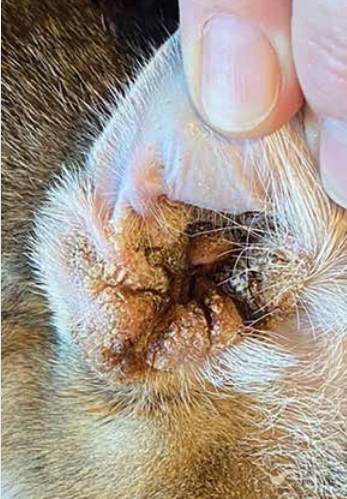
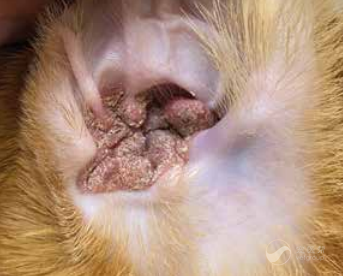
The skin lesions in cats with PNOE consist of vegetative/verrucous/proliferative plaques that are friable and when removed revealed erosion or ulceration beneath; these plaques tend to be light brown to tan (FIGURE 4) but can also be dark brownish to black. Of 13 affected cats, 9 (69%) had only auricular lesions, 3 had auricular and extra-auricular lesions, and the remaining cat did not have auricular involvement. In all but 4 cats, the lesions involved the proximal aspect of both concave pinnae; the convex surfaces of the pinnae were not affected. Of 13 cats, 12 (92%) had lesions in both ear canals,and in 8 (67%) of these cats, the openings of the vertical canals were occluded and otoscopic evaluation was not possible (FIGURE 5). Horizontal canals were involved in 2 cats, and in 1 of these cats, proliferative tissue caused the rupture of the right tympanic membrane and protruded into the right tympanic bulla.
PNOE猫的皮肤病变由脆弱的的菜样/疣状/增生性斑块组成,当清除时显示下方有糜烂或溃疡;这些斑块往往是浅棕色到棕褐色(图4),但也可以是深棕色到黑色。13只患猫中,9只(69%)仅有耳廓患病,3只猫有耳廓及耳外病变,其余1只猫无耳廓病变。除4只猫外,所有猫的病变均累及双侧耳廓凹面的近侧;耳廓凸面不患病。在13只猫中,12只(92%)双侧耳道均有病变,其中8只(67%)的垂直耳道开口被阻塞,无法进行耳镜检查(图5)。2只猫的水平耳道患病,其中1只猫的增生组织导致右侧鼓膜破裂,并突出到右侧鼓泡中。
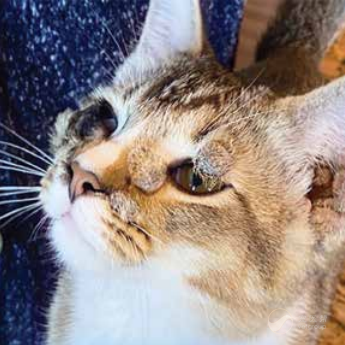
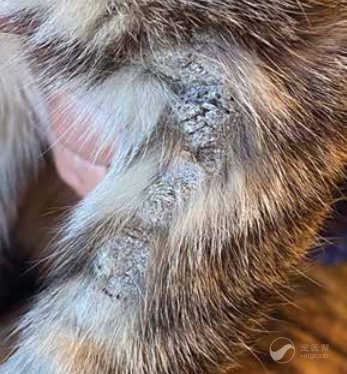
Of the 4 cats with extra-auricular involvement, the affected regions were the face (FIGURE 6), eyelids, head, ventrum (neck, axillae, abdomen, and inguinal region), and perineum. These extra-auricular lesions were clinically and histopathologically similar to the auricular lesions. The cat with no pinnal lesions but only extra-auricular involvement had lesions on the face.The author has also seen lesions on the limbs (FIGURE 7).
在4只耳外病变患病猫中,患病部位包括面部(图6)、眼睑、头部、腹侧(颈部、腋窝、腹部和腹股沟区)和会阴部。这些耳外病变在临床和组织病理学上与耳廓病变相似。只有耳外患病而无耳廓病变的猫病变位于面部。作者还见过病变位于四肢的病例(图7)。
Diagnosis
诊断
Definitive diagnosis of feline PNOE is achieved via skin biopsy in combination with the compatible skin lesions. Histopathologic features of PNOE consist of marked epidermal and follicular parakeratotic hyperkeratosis with shrunken and hypereosinophilic keratinocytes and pyknotic nuclei (apoptotic keratinocytes) at multiple levels in the epidermis and/or follicular outer root sheath. Lymphocytic satellitosis has been reported for only 4 cats.
猫PNOE的确诊需要通过皮肤活检结合相应的皮肤病变。PNOE的组织病理学特征包括明显的表皮和毛囊角化不全性角化过度,在表皮和/或毛囊外根鞘的多个层面有萎缩和高嗜酸性角质形成细胞和固缩核(凋亡角质形成细胞)。目前仅4只猫有淋巴细胞卫星现象的报道。
Treatments and Outcomes
治疗和结果
Spontaneous remission of PNOE has been reported for 2 cats, and complete remission has been achieved for 8 cats that received treatment. Time to clinical remission ranges from 3 weeks to 12 months. Treatments that lead to clinical remission include topical tacrolimus (as monotherapy or in combination with oral glucocorticoids) or cyclosporine. Other effective treatments include oral glucocorticoids, either as monotherapy or with interferon-α and a novel protein diet. Skin lesions resolved for 1 cat that received 1 intralesional injection of methylprednisolone acetate followed by application of 0.05% clobetasol cream.
据报道,2只猫的PNOE自行缓解,8只接受治疗的猫达到了完全缓解。至临床缓解时间为3周至12个月。能达到临床缓解的治疗包括外用他克莫司(单药治疗或与口服糖皮质激素联合治疗)或环孢素。其他有效的治疗包括口服糖皮质激素(单药治疗或与干扰素-α和新奇蛋白日粮联合治疗)。1只猫接受了1次皮肤病变内注射醋酸甲泼尼龙,随后应用0.05%氯倍他索乳膏,皮肤病变消退。
AURICULAR CHONDRITIS
耳软骨炎
AC refers to inflammation of the cartilage of the pinna. This condition is also referred to as relapsing polychondritis because in humans it affects multiple organs (i.e., auricular and nasal cartilage, eyes, heart valves) and often relapses.
AC指耳廓软骨的炎症。这种疾病也被称为复发性多软骨炎,因为在人类,此病影响多个器官(即耳廓软骨和鼻软骨、眼睛、心脏瓣膜),并且经常复发。
Etiology
病因学
The pathogenesis of AC is unknown, but in humans it is considered an immune-mediated skin condition. AC is rare in cats and, to the author’s knowledge, only 10 reports of AC in cats have been published in veterinary journals or abstracts. Clinical information is available for only 18 cats, including 7 cats reported in a thesis cited by Gerber et al.
AC的发病机制尚不清楚,但在人类中,它被认为是一种免疫介导的皮肤疾病。AC在猫中很罕见,据作者所知,只有10份关于猫AC的报告发表在兽医杂志或摘要上。只有18只猫的临床资料,包括7只在Gerber等人引用的论文中报道的猫。
Signalment
特征
Most cats with AC (n = 18; 72%) are domestic shorthair. Other breeds include Siamese, Himalayan mixed breed, and a mixed breed. The age of cats diagnosed with AC ranges from 1.5 to 14.5 years; median age is 3 years. For all except 3 cats, bilateral pinnae were involved; for 2 cats, the lesions first developed in only 1 ear before affecting both pinnae.
大多数AC患猫(18例;72%)是家养短毛猫。其他品种包括暹罗猫、喜马拉雅杂交品种和一只杂交猫。诊断AC的猫的年龄范围为1.5至14.5岁;中位年龄3岁。除3只猫外,其余均双侧耳廓患病;对于2只猫,病变首先发生在1只耳朵,然后影响两个耳廓。
Clinical Signs
临床症状
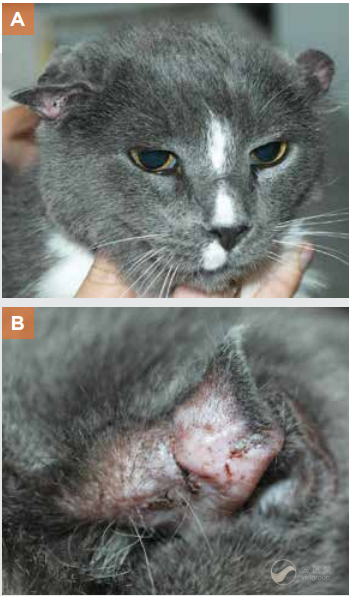
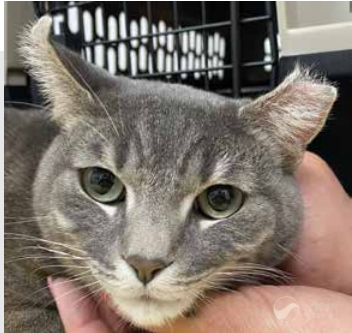
The 2 most common lesions associated with AC are swelling and deformity of the pinna(e) (FIGURE 8). Deformity of the pinna may result in curling of the ear (FIGURE 9), reported for 10 cats. Other reported lesions included erythema, pain, thickened pinna(e), and firm papules and plaques. Systemic signs of fever and polyarthritis have each been reported for 2 cats, whereas corneal opacity was reported for 2 other cats.
与AC相关的两种最常见的病变是耳廓肿胀和畸形(e)(图8)。耳廓畸形可能导致耳弯曲(图9),已报道有10只猫。其他报告的病变包括发红、疼痛、耳廓增厚以及坚硬的丘疹和斑块。2只猫分别报告了发热和多关节炎的全身性症状,而另外2只猫报告了角膜不透明。
Diagnosis
诊断
Differential diagnoses for cats presented for similar pinnal lesions include aural hematoma (for swelling of the pinna and/or deformity caused by fibrosis), contact dermatitis (for erythematous pinnae), and iatrogenic hypercortisolism (for curling of the pinna). Therefore, definitive diagnosis requires biopsy of the lesion on the pinna, which necessitates full-thickness biopsy of the pinna to include the cartilage. Histopathologic features of feline AC include lymphoplasmacytic inflammation, loss of cartilage basophilia, and cartilage necrosis.
猫出现类似耳廓病变的鉴别诊断包括耳血肿(耳廓肿胀和/或纤维化引起的畸形),接触性皮炎(耳廓发红)和医源性皮质醇增多症(耳廓卷曲)。因此,明确诊断需要对耳廓病变进行活检,这需要对耳廓进行包括软骨在内的全层活检。猫AC的组织病理学特征包括淋巴细胞浆细胞炎症、软骨嗜碱性丧失和软骨坏死。
Treatments and Outcomes
治疗和结果
There are only a few case reports on the treatments and outcomes of AC in cats. Of 18 cases reported, 12 cats received treatment and satisfactory improvement to clinical remission was reported for 6 cats. Medical therapies used at the time of clinical remission included systemic glucocorticoid monotherapy, systemic glucocorticoid and dapsone combination therapy, and dapsone monotherapy. For one cat, bilateral pinnectomy was performed after oral prednisolone failed to induce clinical remission. Time to improvement varied from 10 days to 6 months. For one cat in which clinical remission was achieved, a relapse was reported when oral prednisolone was stopped.
目前关于猫AC的治疗和转归的病例报道很少。18只猫中,12只接受了治疗,其中6只猫临床症状改善满意。临床缓解时使用的药物治疗包括全身性糖皮质激素单药治疗、全身性糖皮质激素和氨苯砜联合治疗以及氨苯砜单药治疗。1只猫在口服泼尼松龙诱导临床缓解失败后,行双侧耳廓切除术。改善时间从10天至6个月不等。对于一只达到临床缓解的猫,在停止口服泼尼松龙后报告有复发。
SUMMARY
总结
PCP, PNOE, and AC are immune-mediated dermatoses in cats that, for the most part, affect very specific anatomic locations. These 3 dermatoses can be diagnosed via biopsy of lesional areas; for AC, a full-thickness biopsy including the cartilage is required. Of these 3 dermatoses, the better prognosis is for PCP as treatment with doxycycline or oral cyclosporine often results in clinical remission. Although spontaneous remission has been reported for cats with PNOE, most cats require treatment; the most favorable outcome is associated with treatment with topical tacrolimus in combination with oral cyclosporine or a glucocorticoid. The rarity of feline AC, which often leads to pinnal swelling, deformity, and pain, makes assessment of treatment effectiveness challenging, but a few case reports indicate that systemic glucocorticoids and dapsone are reasonable treatments.
PCP、PNOE和AC是猫的免疫介导性皮肤病,在很大程度上影响非常特定的解剖部位。这3种皮肤病均可通过皮肤病变部位活检确诊;对于AC,需要进行包括软骨在内的全层活检。在这3种皮肤病中,PCP的预后较好,多西环素或口服环孢素治疗常可达到临床缓解。虽然有报道称PNOE猫可自行缓解,但大多数猫需要治疗;外用他克莫司联合口服环孢素或一种糖皮质激素治疗是最有利的结果。猫AC罕见,常导致耳廓肿胀、畸形和疼痛,使评估治疗效果具有挑战性,但少数病例报告表明,全身性糖皮质激素和氨苯砜是合理的治疗方法。
|
Take-Home Points
结论
Plasma cell pododermatitis (PCP) n
浆细胞性足皮炎
A clinical diagnosis of feline PCP can be based on the distinct skin lesions that are confined to the paw pads, which are often swollen, soft, and exhibit striations and/or scaling/exfoliation. n
For 70% of cats with PCP, the primary complaint is lameness or pain. n
Doxycycline and oral cyclosporine are safe and effective treatments.
猫PCP的临床诊断可以基于局限于爪垫的独特皮肤病变,爪垫通常肿胀、柔软,并表现出条纹和/或皮屑/表皮剥脱。n
70%PCP患猫的主要主诉是跛行或疼痛。n
多西环素和口服环孢素是安全有效的治疗方法。
Proliferative and necrotizing otitis externa (PNOE) n
增生性和坏死性外耳炎(PNOE)n
Clinically distinctive lesions of PNOE are vegetative or proliferative plaques that are friable and confined to the concave pinnae and opening of the vertical canal. n
Extra-auricular lesions can develop on the face, head, eyelids, ventrum, and perineum. n
Effective treatments are topical tacrolimus, with or without oral cyclosporine.
PNOE的临床特征性病变是脆弱的、局限于耳廓凹面和垂直耳道开口的增生性或增生性斑块。n
耳外病变可发生在面部、头部、眼睑、腹侧和会阴。n
有效的治疗方法是外用他克莫司,联合或不联合口服环孢素。
Auricular chondritis (AC) n
耳软骨炎(AC)n
Cats with AC often exhibit swollen, painful, deformed, and erythematous pinnae. n
Definitive diagnosis requires full-thickness pinnal biopsy that includes the cartilage. n
Although information on treatment outcomes is scarce, systemic glucocorticoids and dapsone have been reported to be effective.
患有AC的猫经常表现为耳廓肿胀、疼痛、变形和发红。n
明确诊断需要包括软骨在内的耳廓全层活检。n
虽然关于治疗结果的信息很少,但据报道全身性糖皮质激素和氨苯砜有效。 |
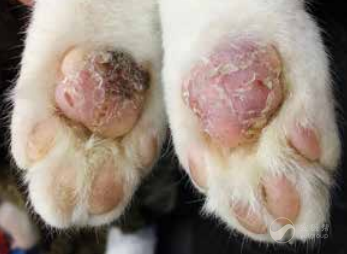 FIGURE 1. Swollen metatarsal pads with striations and exfoliation.
图1。跖骨垫肿胀伴条纹和表皮剥脱。
FIGURE 2. Swollen metacarpal pad with ulceration and granulation tissue.
图2。掌骨垫肿胀伴溃疡和肉芽组织。
FIGURE 3. Erythematous to violaceous discoloration of the metacarpal pad.
图3。掌骨垫有发红到紫红色的颜色改变。
FIGURE 4. Vegetative and proliferative plaques on the concave surface of the pinna.
图4。在耳廓凹面上的植物性和增生性斑块。
FIGURE 5. Severe proliferative tissue at the proximal aspect of the concave pinna and surrounding the opening of the vertical canal, leading to complete occlusion.
图5。在耳廓凹面的近侧和垂直耳道开口周围有严重的增生组织,导致开口完全阻塞。
FIGURE 6. Extra-auricular lesions on the face of a cat with proliferative and necrotizing otitis externa.
图6。一只患增生性坏死性外耳炎的猫位于面部的耳外病变。
FIGURE 7. Vegetative plaques along the forelimb of a cat with extra-auricular proliferative and necrotizing otitis externa.
图7。一只有耳外病变的增生性坏死性外耳炎的猫前肢的菜样斑块。
FIGURE 8. Cat with auricular chondritis. (A) Deformity of the pinna. (B) Close-up view of a deformed left pinna.
图8。猫耳软骨炎。(A)耳廓畸形。(B)左侧耳廓畸形的特写。
FIGURE 9. Dorsal curling of the right pinna in a cat with auricular chondritis.
图9。患耳软骨炎的猫右耳廓背侧卷曲。
| 


 |Archiver|手机版|小黑屋|宠医帮
( 京ICP备2022012070号-2 )
|Archiver|手机版|小黑屋|宠医帮
( 京ICP备2022012070号-2 ) 




 发表于 2026-3-5 22:04:37


 收藏
收藏 转播
转播 分享
分享 淘帖
淘帖