|
Brainstem auditory evoked responses in 37 dogs with otitis media before and after topical therapy
37只中耳炎犬外部治疗前后的脑干听觉诱发反应
作者:S.Paterson
翻译:王帆
OBJECTIVES : The objective of this study was to determine whether intra-aural administration of aqueous solutions of marbofloxacin, gentamicin, tobramycin and ticarcillin (used off-licence) was associated with changes in hearing as measured by brainstem auditory evoked responses.
MATERIALS AND METHODS : Dogs diagnosed with otitis media (n=37) underwent brainstem auditory evoked response testing and then were treated for their ear disease. First, the external ear canal and middle ear were flushed with sterile saline followed by EDTA tris with 0·15% chlorhexidine. Then, a combination of aqueous antibiotic mixed with an aqueous solution of EDTA tris was instilled into the middle ear. Follow-up examinations were undertaken for each dog, and treatment was continued until there were no detected infectious organisms or inflammatory infiltrate. Brainstem auditory evoked response testing was repeated after resolution of the infection and discontinuation of therapy.
RESULTS : Brainstem auditory evoked responses in dogs treated with aqueous solutions of marbofloxacin or gentamicin remained unchanged or improved after therapy of otitis media but were impaired in dogs treated with ticarcillin or tobramycin.
CLINICAL SIGNIFICANCE : If off-licence use of topical antibiotics is deemed necessary in cases of otitis media, aqueous solutions of marbofloxacin and gentamicin appear to be less ototoxic than aqueous solutions of ticarcillin or tobramycin.
目的:本研究的目的是确定马坡沙星、庆大霉素、妥布霉素和替卡西林(在许可证外使用)水溶液的耳内给药是否与通过脑干听觉诱发反应测量的听力变化相关。
材料和方法:确诊中耳炎患犬(n=37)进行了脑干听觉诱发反应测试,然后对其耳病进行治疗。首先用无菌生理盐水冲洗外耳道和中耳,然后用EDTAtris+0.15%氯己定冲洗。然后,将抗生素水溶液与EDTA tris水溶液混合后注入中耳。我们对每只犬进行了随访检查,并继续治疗,直至未检测到感染性微生物或炎症浸润。在感染消退和停止治疗后,重复进行脑干听觉诱发反应检查。
结果:马坡沙星或庆大霉素水溶液治疗犬的脑干听觉诱发反应保持不变或在中耳炎治疗后改善,但替卡西林或妥布霉素治疗犬的脑干听觉诱发反应受损。
临床意义:在中耳炎病例中,如果认为有必要标签外使用外用抗生素,马坡沙星和庆大霉素水溶液的耳毒性似乎比替卡西林或妥布霉素水溶液低。
INTRODUCTION
介绍
Dogs with otitis media (OM) commonly demonstrate a reduction in their hearing as measured by brainstem auditory evoked responses (BAER). This hearing loss may be conductive because of reduction in the lumen of the ear canal, damage to the tym panic membrane or accumulation of fluid within the middle ear or sensorineural damage due to the penetration of bacterial toxins or ototoxic drugs through the round window to cause cochlear damage. Current therapeutic recommendations for OM are to flush the tympanic bulla and then instil topical drugs. Depending on diagnostic findings, treatment may consist of glucocorticoids, antibiotics or both. Choosing appropriate topical therapy is difficult. There are very few well-designed clinical trials investigating ototoxicity from ear medications in humans. Animal reports and case reports make up most of the data. The same is true for dogs and cats, where much of the information is based on results in guinea pigs, mice, rabbits and chinchillas or what are often anec dotal case reports. The lack of clinical evidence, together with the lack of topical drugs licensed for canine OM, makes therapeutic decisions difficult. Veterinary surgeons must therefore try to select drugs for therapy that have the low est potential for ototoxicity whilst being mindful that a failure to treat infection adequately may lead to hearing loss and vestibular disease through the elaboration of exotoxins from the bacteria. In an attempt to provide useful information on the ototoxic potential of drugs used to treat OM, this retrospective study describes the changes in minimum auditory thresholds before and after administration of topical therapy to the tympanic bulla. Data is taken from the clinical records of cases presented to the author and reflects the standard treatment protocol under taken in the clinic, where BAER testing is always performed at the time of the dog’s first examination and again after complete clinical and cytological resolution of the disease. In all cases, written owner consent was obtained before admission of the dog for investigation and therapy, including the potential use of unlicensed drugs.
患中耳炎(OM)的犬通常表现为通过脑干听觉诱发反应(BAER)测量的听力下降。这种听力损失可能是传导性的,原因是耳道腔减少、鼓膜损伤或中耳内积液,或者是细菌毒素或耳毒性药物通过圆窗造成耳蜗损伤,从而造成感觉神经性损伤。目前对OM的治疗建议是鼓泡冲洗,然后滴入外用药物。根据诊断结果,治疗可能包括糖皮质激素、抗生素或两者兼用。选择合适的外部治疗是困难的。人医很少有设计良好的临床试验来研究耳用药的耳毒性。动物报告和病例报告构成了大部分数据。犬和猫也是如此,大部分的信息是基于结果在豚鼠、老鼠、兔子和龙猫或者坊间案例报告。由于缺乏临床证据,再加上缺乏获准用于治疗犬OM的外用药物,治疗决策变得困难。因此,兽医必须努力选择对耳毒性可能性最低的药物进行治疗,同时要注意,感染治疗失败可能会导致听力损失和前庭疾病,因为细菌会产生外毒素。为了提供关于用于治疗OM的药物的耳毒性潜能的有用信息,这项回顾性研究描述了鼓泡外部治疗前后最低听阈的变化。数据来自提交给作者的病例的临床记录,反映了在诊所采取的标准治疗方案,BAER检测总是在犬的第一次检查时进行,并在疾病的临床和细胞学完全缓解后再次进行。在所有病例中,在犬入院前均获得了主人的书面同意,以便对其进行调查和治疗,包括可能使用的标签外药物。
MATERIALS AND METHODS
材料和方法
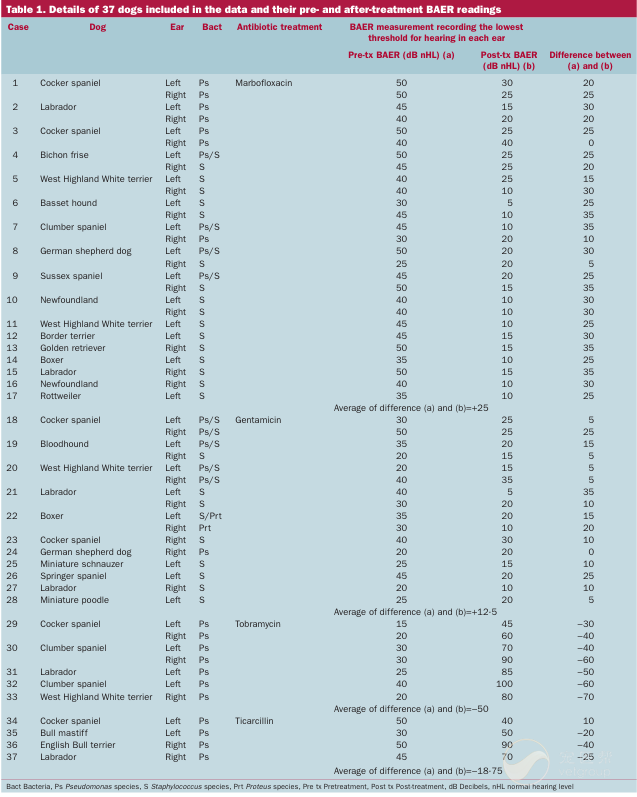
The data assessed in this study represent that obtained from 37 dogs that were presented to the author’s clinic during a 12-month period for the investigation and eventual successful treatment of infectious OM. During this period, a total of 60 dogs were referred with OM. Six were deemed after examination to have irreversible otitis and were referred for total ear canal ablation and bulla osteotomy. Data from 17 dogs were excluded because of the following reasons: their medication was changed part way through their course (8), they failed to respond to medical therapy and were treated surgically (4), they failed to come back for reassessment whilst still on medication and only returned when the disease had relapsed (3), they failed to have treatment administered by the owner due to their behavioural problems (1) or were lost to follow-up (1). Of the 37 dogs included, 17 had bilateral OM and 20 had unilateral OM, accounting for a total of 54 ears. In all cases, a diagnosis of OM was made by the referring clinician on the basis of clinical signs, cytology, culture and otoscopic examination, which had confirmed the absence of a tympanic membrane in all cases. At the time of admission, all owners were made aware of the potential use of off-licence drugs in the treatment of OM and the potential for the drugs to produce ototoxic effects. They were also made aware that there are currently no drugs licensed to treat OM. All clients provided written informed consent for their dogs to be treated. After admission, a physical and dermatological examination, includ ing a basic neurological assessment, was performed on all dogs. Both left and right ears were examined initially with a hand-held otoscope (MacroView; Welch Allyn). All dogs were sedated using 10 mcg/kg medetomidine hydrochloride (1 mg/mL Domitor; Elanco Animal Health) and 0·1 mg/kg butorphanol (10 mg/mL Torbugesic; Pfizer Ltd). A full general anaesthetic was induced using 1·5 mg/kg propofol (10 mg/mL Propoflo; Abbott Labora tories). All dogs were intubated and maintained on inhalation anaesthesia with isoflurane (100% w/w IsoFlo; Abbott Labo ratories). All ears were examined using a video-otoscope (Karl Storz, GmbH and Co). An electrophysiological examination of 2 hearing was performed in all cases before ear flushing, according to a standard protocol (Mason et al. 2013 ), using BAER. The BAER was recorded using a neurodiagnostic unit with a built in signal averager (Nihon Kohden Neuropack µ model; Nihon Kohden, Surbiton). Stainless steel electrodes were placed subcu taneously (sc) with the active electrode (+) placed at the vertex (skull mid-line approximately mid-way between the eyes and the nuchal crest), the reference electrode (−) at the tragus (just rostral to the ear canal of the stimulated ear) and the ground electrode at an inactive site on the dorsal neck. To ensure correct insertion of electrodes, the recording electrode impedance was checked to see if it was less than 5 k Ω . The pinna was folded dorsomedially, and to avoid ear canal collapse, a headphone was gently held in con tact with the ear being tested and positioned to direct noise into the ear canal. The BAER was elicited by applying multiple click stimuli of 0·1-millisecond duration. Impulses were filtered at 100 Hz to 3 kHz, averaged and displayed on a computer screen. An average of 600 click stimuli were delivered to the ear, and the response from the first 10 milliseconds after click stimulus was averaged until the waveform remained stable. Masking noise was used for the contralateral ear. Positive electrode activity at the recording (vertex) electrode produced an upwards-deflected read ing. The initial stimulus level in each dog was 90 decibels (dB) normal hearing level (nHL) . The stimulus level was then reduced by 20 dB increments until no response could be detected. The ear was then tested with increasing five decibels increments until the minimum hearing threshold (MHT) was determined in the patient. This was defined as the smallest dB measurement when waveform V was detected and five decibels above when the BAER reading was flat and non-responsive. The procedure was repeated on the contralateral ear where appropriate. These BAER readings were recorded as pretreatment values (see Table 1 ).
本研究评估的数据来自37只犬,这些犬在12个月期间被送到作者的诊所进行研究,并最终成功治疗了感染性OM。在此期间,共有60只犬因OM被转诊。6例在检查后被认为患不可逆性耳炎,被转诊接受全耳道消融术和鼓泡截骨术。17只犬的数据被排除,因为以下原因:在治疗过程中改变了部分药物(8),它们对药物治疗没有反应并接受了手术治疗(4),它们在药物治疗期间没有复诊,只有在疾病复发时才复诊(3),它们因为行为问题而没有得到主人的治疗(1)或失访(1)。纳入的37只犬中,17只为双侧OM, 20只为单侧OM,共54耳。所有病例均由转诊医师根据临床症状、细胞学检查、细菌培养和耳镜检查做出OM诊断,耳镜检查证实所有病例均无鼓膜。入院时,所有宠主均被告知在治疗OM时可能使用违禁药物,以及这些药物可能产生耳毒性作用。他们还了解到,目前还没有被批准用于治疗OM的药物。所有的客户都提供了书面的知情同意他们的犬接受治疗。入院后,对所有犬进行体格检查和皮肤科检查,包括基本的神经系统评估。最初使用手持耳镜检查左右耳。所有犬均使用10 mcg/kg盐酸美托咪定和0.1 mg/kg布托啡诺。全身麻醉诱导:静脉注射丙泊酚1.5 mg/kg。所有犬气管插管并维持异氟醚吸入麻醉。采用视频耳镜进行检查。根据标准方案,所有患犬在耳道冲洗前均采用BAER进行2项听力电生理检查。使用内置信号平均器的神经诊断设备记录BAER。不锈钢电极同时放置于皮下(sc),活性电极(+)放置于顶点(颅骨中线,大约在眼睛和颈项嵴之间的中间位置),参考电极(-)放置于耳屏(仅位于受刺激耳的耳道吻侧),接地电极放置于颈背的非活性部位。为确保电极正确插入,检查记录的电极阻抗是否小于5 k Ω。耳廓向背内侧折叠,为避免耳道塌陷,将耳机轻轻握住与被测试耳接触,并将噪声引导至耳道。采用持续0.1毫秒的多次点击刺激诱发BAER。脉冲以100赫兹到3 kHz的频率过滤,取平均值并显示在电脑屏幕上。耳朵平均收到600次点击刺激,从点击刺激后的前10毫秒的反应是平均的,直到波形保持稳定。对侧耳使用掩蔽噪声。记录(顶点)电极的正电极活动产生向上偏转的读数。每只犬的初始刺激水平为90分贝(dB)正常听力水平(nHL)。然后将刺激强度降低20 dB,直到检测不到反应为止。然后以5分贝递增的方式对患犬的耳朵进行测试,直到确定患犬的最低听阈(MHT)。当检测到波形V时,dB测量值最小;当BAER读数平坦且无反应时,dB测量值高于5分贝。适当时对对侧耳重复该手术。这些BAER读数被记录为预处理值(表1)。
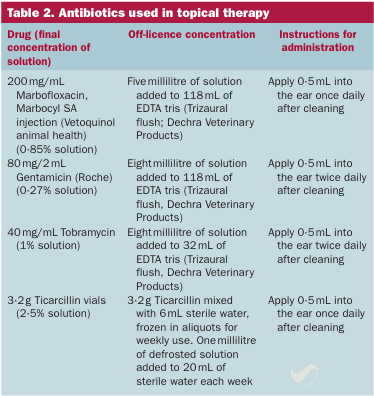
A standard OM treatment protocol was undertaken in each case. Samples of mucopurulent material were taken from the tympanic bulla by aspiration through a 5 Fr catheter (Karl Storz). A sample of the discharge was submitted for culture and sensitivity, and a small amount of discharge was smeared onto a microscope slide, heat-fixed and stained with Diff Quik. All discharge was then removed from the canal by flushing with ster ile saline through a clean 5 Fr catheter via the working channel of the video-otoscope. Once the ear was clean, a second flush of ethylene diamine tetra-acetic acid (EDTA) tris with 0·15% chlorhexidine (Trizchlor flush, Dechra Veterinary Products) was performed through a further clean catheter. After this, 0·5 mL of a combination of EDTA tris (Trizaural flush, Dechra Veterinary Products) and antibiotic (see Table 2 ) was instilled into the bulla. The initial choice of antibiotic was made on the basis of previ ous culture and sensitivity results. If no culture and sensitivity results were available, marbofloxacin was chosen as the first-line antibiotic. If there was resistance to a fluoroquinolone but not to gentamicin on a previous culture and sensitivity, gentamicin was chosen as the second-line antibiotic. Tobramycin or ticarcil lin were only selected as topical therapy if resistance had been identified to fluoroquinolone and gentamicin but not to these drugs. Where subsequent culture and sensitivity showed resis tance to the prescribed antibiotic, it was changed on the basis of the sensitivity result but that case’s data was not included (eight cases). An intravenous injection of dexamethasone (2 mg/ mL Dexadreson; MSD Animal Health) at a dose of 0·1 mg/kg bodyweight was given at the end of the procedure and before anaesthetic recovery to reduce inflammation caused through the flushing process.
每例患犬均采用标准OM治疗方案。通过5 Fr导管从鼓泡中抽吸采集黏液脓性物质样本。将分泌物样本进行细菌培养和药敏试验,并将少量分泌物涂抹在显微镜载玻片上,加热固定并使用Diff Quik染色。然后通过视频耳镜的工作通道,用干净的5fr导管用盐水冲洗,将分泌物从耳道中清除。耳道清洁后,通过另一根清洁导管进行EDTAtris + 0.15%氯己定第二次冲洗。之后,向鼓泡内注入0.5 mL EDTA tris 和抗生素的组合(见表2)。根据既往细菌培养及药敏结果选择抗生素。若无培养及药敏结果,则选择马坡沙星作为一线抗生素。如果之前的细菌培养和药敏结果显示对氟喹诺酮类药物耐药,但对庆大霉素未耐药,则选择庆大霉素作为二线抗生素。只有在对氟喹诺酮和庆大霉素耐药而对这些药物不耐药的情况下,才选择妥布霉素或替卡西林作为外部治疗。如果随后的细菌培养和药敏显示出对处方抗生素的耐药,则根据药敏结果进行了更改,但该病例的数据不包括在内(8例)。静脉注射地塞米松;在操作结束时和麻醉恢复前给予0.1 mg/kg体重,以减少通过冲洗过程引起的炎症。
Dogs were discharged with flush solution EDTA tris with 0·15% chlorhexidine (Trizchlor flush, Dechra Veterinary Prod ucts) and the extra-label combination of EDTA tris (Trizaural flush, Dechra Veterinary Products) and antibiotic as treatment. Owners were instructed to flood the ear with flush solution once daily to clean it before instilling 0·5 mL of the treatment solution once or twice daily (see Table 2 ). All dogs were reas sessed at three-week intervals. At these time points, each dog was examined in the clinic, and the affected ear(s) re-examined using a hand-held otoscope. A sample of discharge taken from the horizontal canal was examined by cytology. Dogs were considered to be infection-free when examination of the external ear canal showed no visual signs of disease and cytology failed to reveal signs of an inflammatory infiltrate or bacteria. In all 37 cases, this occurred at the six-week recheck. At this point, the dog was readmitted to the clinic and anaesthetised according to the previously described protocol. The ear was reassessed using video-otoscopy to ensure that the tympanic membrane had healed, and a repeat BAER was performed; results were recorded as after-treatment levels. Where video-otoscopy six weeks after starting therapy revealed recovery from infection was incom plete, that is, bacteria or inflammatory cell remained on samples or the tympanic membrane had not healed (four cases) or where therapy had been changed during the treatment process (eight cases), the dog’s clinical details were not included in the final data. The readings from the pre- and after-treatment BAER values were compared for each case, and the difference between the two values was also recorded in Table 1 .
犬出院时使用含0.15%氯己定的冲洗液和EDTA冲洗液和抗生素的超标签组合作为治疗。患犬被告知每日1次用冲洗液冲洗耳朵以清洁耳朵,然后每日1次或2次滴入0.5 mL治疗溶液(见表2)。所有犬每隔3周进行一次测试。在这些时间点,每只犬都在诊所接受检查,并使用手持耳镜再次检查患耳。取水平耳道的分泌物样本进行细胞学检查。当外耳道检查未显示疾病的视觉征象和细胞学检查未显示炎性浸润或细菌的征象时,认为犬无感染。37例均在6周复查时进行。此时,犬被再次送入诊所,并按照之前描述的方案进行麻醉。使用视频耳镜重新评估耳廓,以确保鼓膜已愈合,并再次进行BAER;结果记录为治疗后水平。在开始治疗6周后的视频耳镜检查显示感染恢复不完全,即细菌或炎症细胞残留在样本上或鼓膜未愈合(4例)或在治疗过程中改变了治疗(8例),犬的临床细节不包括在最终数据中。比较每例患犬治疗前后的BAER值,并将两者的差值记录在表1中。
RESULTS
结果
BAER measurements were recorded in decibels (nHL) for each dog for the lowest threshold for hearing for each ear as a pre treatment and an after-treatment level. The lowest threshold was assessed as the point where the typical five-peak wave form of the BAER was lost and the trace became flat. A mean score was calculated for each case based on the difference between the two BAER values. These are tabulated in Table 1 . This work was undertaken by a veterinary nurse in the practice (see Acknowl edgements section) without any knowledge of the treatment that had been prescribed for each dog. A value of zero was taken as an indication that the threshold had remained unchanged. A positive value was taken as an indication that the hearing had improved, that is, the lowest threshold for hearing was lower. A negative value was taken as deterioration in hearing, that is, the lowest threshold for hearing had increased. For the marbofloxa cin group, no negative scores were obtained. The range of scores was from 0 to 35, and the mean score was 25. For the gentamicin group, no negative scores were obtained. The range of scores was 0 to 35 with a mean value of 12·5. For the tobramycin group, all scores were negative scores. The range of scores was from −30 to −70 with a mean score of −50. For the ticarcillin group, three out of four scores were negative. The range of scores was from 10 to −40, and the mean value was −18·75.
BAER测量以分贝(nHL)为单位记录每只犬每耳的最低听力阈值,作为治疗前和治疗后的水平。最低阈值为BAER典型五峰波形消失和迹线变平的点。根据两种BAER值的差异计算每个病例的平均评分。表1列出了这些。这项工作是由一名兽医护士在不知晓为每只犬开出的治疗方案的情况下完成的(见确认附录部分)。0表示阈值保持不变。取正值表示听力有所提高,即最低听阈降低。取负值表示听力下降,即最低听阈提高。马坡沙星组未获得阴性评分。评分范围为0 ~ 35分,平均25分。庆大霉素组未获得阴性评分。评分范围为0 ~ 35分,平均12.5分。妥布霉素组所有评分均为阴性。评分范围为- 30 ~ - 70分,平均得分为- 50分。替卡西林组的4项评分中有3项为阴性。评分范围为10 ~ - 40分,平均值为- 18.75分。
DISCUSSION
讨论
Canine OM presents a difficult therapeutic challenge. In most cases in dogs, OM occurs because of a descending infection from the external ear canal. Once infection becomes trapped inside the middle ear, lavage of the tympanic bulla and administration of topical drugs is recommended as treatment. Although there are numerous texts detailing treatment protocols, there are only a handful of papers detailing the potential ototoxicity of drugs that may be used. The aim of this retrospective study was to compare the ototoxicity of four different aqueous antibiotic solutions used to treat OM. Aqueous solutions were chosen because of the fact that some solvents, such as propylene glycol, can have ototoxic effects in experimental animals. To allow a meaningful comparison of all four antibiotics, as many factors as possible were kept constant. This included the initial flushing process, the flush solution, the solution in which antibiotics were mixed and the volume of drugs administered. The end point in each case was designated when there was no inflammatory infiltrate or bacteria on cytology samples taken from the horizontal canal and the tympanic membrane had healed. Where drugs were changed part way through the treatment process or dogs had failed to respond to treatment after six weeks of therapy, their data were not included.
犬OM是一个棘手的治疗难题。在大多数病例中,犬的OM是由外耳道的下行感染引起的。一旦感染被卡在中耳内,则建议对鼓泡进行灌洗和外部用药。尽管有大量的文本详细描述了治疗方案,但只有少数论文详细描述了可能使用的药物的潜在耳毒性。本回顾性研究的目的是比较用于治疗OM的四种不同抗生素水溶液的耳毒性。选择水溶液是因为一些溶剂,如丙二醇,在实验动物中具有耳毒性作用。为了对所有四种抗生素进行有意义的比较,我们保持尽可能多的因素不变。这包括最初的冲洗过程、冲洗液、混合抗生素的溶液和给药的量。每个病例的终点被指定为当从水平耳道取下的细胞学样本中没有炎症浸润或细菌,并且鼓膜已愈合时。如果在治疗过程中更换了部分药物,或者犬在治疗6周后对治疗没有反应,他们的数据不包括在内。
EDTA tris was chosen as a diluent for the antibiotic solutions because it is recognised as having a low ototoxic potential. A combined EDTA tris with 0·15% chlorhexidine was used to flush the ears before application of topical antibiotics. Chlorhexidine at concentrations of less than 0·2% has also been shown to be safe within the middle ear of dogs. BAER testing was used to try to assess the ototoxic effects of therapy by recording the lowest thresholds for hearing for each drug before and after therapy. The greatest limitation of this methodology is that because the BAER readings were obtained using air conduction sounds, rather than through vibrations using a bone stimulation transducer, it is impossible to differentiate between sensorineural and conductive hearing loss. Pretreatment BAER values were therefore likely to be a combination of conductive hearing loss caused by a reduc tion in the lumen of the ear canal due to swelling, damage to the tympanic membrane and/or through fluid within the middle ear together with sensorineural damage due to the penetration of bacterial toxins through the round window causing cochlear damage. After-treatment values would similarly be a combination of some conductive hearing loss due to the lack of a normal otic anat omy together with the presence of fluid within the ear and some sensorineural loss due to damage from infection and the effect of topical medication. It was hoped that by standardising tech niques, the degree of conductive hearing loss could be kept con stant. In addition, by only using cases where the correct therapy was selected initially, on-going hearing damage from infection could be minimised, meaning changes in the minimum auditory threshold could be attributed to the treatment. The differences between the lowest threshold for hearing before therapy and at the end of therapy were recorded as an indication of any ototoxic effects of the topical drug. Where hearing thresholds remained unchanged after resolution of the disease, it was assumed that the initial hearing loss had been a combination of sensorineural and conductive effects and that topical therapy had not lead to oto toxic damage. Where the minimum hearing threshold improved (positive value), it was assumed that hearing loss had principally been conductive, and resolution of the disease together with an improvement in the condition of the middle ear and external ear canal had led to an improvement in hearing. In these cases, it appears unlikely that the drug had produced any ototoxic effects. Where the hearing threshold increased (negative value) after therapy, it was assumed that despite improvement of the condition of the ear and resolution of disease, the drugs must have produced ototoxic effects, leading to sensorineural hearing loss.
EDTA tris被选为抗生素溶液的稀释剂,因为它被认为具有较低的耳毒性。在外用抗生素之前,使用EDTAtris和0.15%氯己定冲洗耳朵。低于0.2%浓度的氯己定也被证明在犬的中耳内是安全的。BAER检测通过记录治疗前后每种药物的最低听力阈值,试图评估治疗的耳毒性作用。该方法的最大局限性在于,由于BAER读数是通过空气传导声音获得,而不是通过骨刺激换能器的振动获得,因此无法区分感觉神经性听力损失和传导性听力损失。因此,治疗前的BAER值很可能是以下两方面的综合结果:肿胀导致耳道狭窄、鼓膜损伤和/或通过中耳内的液体造成传导性听力损失,以及细菌毒素通过圆窗造成耳蜗损伤造成的感觉神经性损伤。治疗后的数值同样是由于缺乏正常的耳鼻咽喉部和耳内存在液体而引起的一些传导性听力损失,以及由于感染和外部用药的影响而引起的一些感觉神经性听力损失的组合。希望通过标准化技术,使传导性听力损失程度保持恒定。此外,通过仅使用最初选择了正确治疗的病例,可以将感染造成的持续性听力损伤降至最低,这意味着最低听阈的变化可归因于治疗。治疗前和治疗结束时的最低听力阈值之间的差异被记录为外用药物的耳毒性作用的指征。如果听力阈值在疾病消退后保持不变,则可以认为最初的听力损失是感觉神经和传导效应的综合作用,并且外部治疗未导致耳毒性损伤。当最低听阈改善(正值)时,认为听力损失主要是传导性的,疾病的缓解以及中耳和外耳道状况的改善导致了听力的改善。在这些病例中,药物似乎不太可能产生任何耳毒性作用。如果治疗后听阈升高(负值),则认为尽管耳状况改善,疾病消退,但药物一定产生了耳毒性作用,导致感觉神经性听力损失。
Minimum auditory threshold scores after the use of topi cal marbofloxacin produced no negative values. Scores ranged from 0 to 35 with a mean value of 25, suggesting no ototoxic ity was seen with this drug. There are no references in either the veterinary or human literature about the topical use of mar bofloxacin to treat OM. There are numerous papers discussing the topical use of ciprofloxacin, a closely related drug, in mice , guinea pigs and humans. Results from these studies suggest it is a very safe drug when used topically in OM; in fact, current opinions in human otology are that fluoroquinolones are safer than aminoglycosides when used topically and should be considered as first-line drugs for OM. The results from this study would concur with that view. No negative scores were found in the gentamicin group. Scores ranged from 0 to 35 with a mean value of 12·5. Gentamicin is commonly used to treat OM in people, and most authors suggest that it is relative safe but should only be used for short periods ; others report hearing loss. A single report in the veterinary literature suggests gentamicin based solutions are safe in the canine middle ear; these results also suggest that aqueous gentimicin may be applied safely to the canine middle ear. As both tobramycin and ticarcillin were not used as first-line treatments in this study, the numbers of dogs in these groups was much smaller. Despite this, significant changes were seen in the minimum auditory thresholds for both drugs after successful therapy. For the tobramycin group, all scores had negative values. The range of scores was −30 to −70 with a mean score of −50. Tobramycin is recognised as having ototoxic effects when it is given systemi cally, but there are only a few reports of its effect when used topically in humans or ani mals, where it appears to show a variable degree of ototoxicity. In this study, it led to an increase in the threshold for hearing in all of the dogs treated with it. Although it was successful in resolving their infections, it appeared to lead to a reduction in their hearing. Although the final concentra tion of tobramycin was used according to the recommendation of previous authors, it should be noted that the final treatment concentration was approximately four times the concentration of the gentamicin (gentamicin 0·27% solution, tobramycin 1·0% solution). It may be that at lower concentra tions the tobramycin may not show the same degree of ototoxic ity, although it is also questionable whether it would produce the same therapeutic benefits. For the ticarcillin group, three out of four scores were negative. The range of scores was 10 to −40 with a mean value of −18·75. There is only a single veterinary study describing ticarcillin in the treatment of otitis externa in the dog. There are no studies describing the use of ticarcillin in canine OM and only a single report that describes the changes that ticarcillin produces in the middle ear, and this is in chinchillas: significant toxic effects were described in the middle and inner ear that included inflammation, haemorrhage and effusions. Moreover, with prolonged use, cholesteatomas were observed at four weeks. The recommendations from Jakob et al. ’s study were that ticarcillin should not be used in ototopical preparations. These findings would be in agreement with those from the current study, which also sug gest that ticarcillin is an ototoxic drug. However, as in the case of the tobramycin, ticarcillin was used at a high concentration (2·5%) compared to the other drugs and the ototoxic effects may also be, in part, due to the high concentration. Therapy with ticarcillin led to a dramatic reduction in the hearing of 75% of the dogs with OM. This would mean that whilst it may be suit able to treat cases of otitis externa, it should not be used if the ear drum is damaged or cannot be seen.
外部使用马坡沙星后的最低听阈评分未产生负值。评分范围为0 ~ 35分,平均值为25分,提示该药未观察到耳毒性。在兽医或人类文献中都没有关于外部使用马坡沙星治疗OM的参考文献。有许多论文讨论了环丙沙星(一种密切相关的药物)在小鼠、豚鼠和人类中的外部使用。这些研究的结果表明,当外部用于OM时,它是一种非常安全的药物;事实上,目前人类耳科的观点是,外部使用氟喹诺酮类药物比氨基糖苷类药物更安全,应考虑作为OM的一线药物。这项研究的结果将与这一观点一致。庆大霉素组未发现阴性评分。评分范围为0 ~ 35分,平均12.5分。庆大霉素常用于治疗人类OM,大多数作者认为它相对安全,但应仅短期使用;其他人报告听力损失。兽医文献中的一份报告表明,庆大霉素溶液用于犬中耳是安全的;这些结果也提示庆大霉素溶液应用于犬中耳是安全的。由于妥布霉素和替卡西林在本研究中均未被用作一线治疗,因此这些组的犬数量要少得多。尽管如此,在成功治疗后,我们观察到两种药物的最低听阈有显著变化。对于妥布霉素组,所有评分均为负值。评分范围为- 30 ~ - 70分,平均得分为- 50分。妥布霉素被认为在全身用药时具有耳毒性,但只有少数关于其在人类或动物外部用药时的作用的报告,在这些报告中,妥布霉素似乎显示出不同程度的耳毒性。在这项研究中,它使所有接受治疗的犬的听力阈值都提高了。虽然它成功地解决了他们的感染,但似乎导致了他们的听力下降。虽然妥布霉素的最终浓度是根据之前作者的建议使用的,但应该注意的是,最终治疗浓度约为庆大霉素浓度的4倍(庆大霉素0.27%溶液,妥布霉素1.0%溶液)。妥布霉素在较低浓度时可能没有表现出相同程度的耳毒性,但妥布霉素是否能产生相同的治疗益处也值得怀疑。替卡西林组的4项评分中有3项为阴性。评分范围为10 ~ - 40分,平均值为- 18.75分。目前只有一项关于替卡西林治疗犬外耳炎的兽医研究。目前还没有研究描述替卡西林对犬OM的作用,只有一份报告描述替卡西林对中耳产生的变化,这一变化发生在龙猫上:对中耳和内耳有显著的毒性作用,包括炎症、出血和积液。此外,随着使用时间的延长,在4周时观察到胆脂瘤。Jakob等人的研究建议,替卡西林不应用于耳外用制剂。这些发现与本研究的结果一致,本研究也提示替卡西林是一种耳毒性药物。然而,与妥布霉素的情况相比,替卡西林的使用浓度较高(2.5%),耳毒性作用也可能部分是由于浓度较高。替卡西林治疗可使75%患OM的犬的听力显著下降。这意味着,虽然它可能适合治疗外耳炎病例,但如果鼓膜受损或看不到,则不应使用。
In summary, successful therapy of infectious OM is possible with topical drugs. Topical antibiotics can be used in combination with flushes with a low degree of ototoxicity. Based on current literature and the results from this study, aqueous solutions of fluoroquinolones appear to be the safest. Gentamicin also appears safe, but both tobramycin and ticarcillin appear to be ototoxic when used topically to treat OM. Neither of these drugs should be used unless fluoroquinolones, gentamicin or a combination of both have failed to resolve infection. In all cases, owners should be made aware of the unlicensed use of aqueous antibiotics to treat OM and the potential ototoxic effects. Addi tionally, if tobramycin or ticarcillin are used to resolve infection to avoid the need for total ear canal ablation and bulla osteotomy, owners should be made aware of the risk of damage to their dog’s hearing.
总之,外用药物可以成功治疗感染性OM。外部抗生素可与冲洗液联合使用,耳毒性低。根据目前的文献和本研究的结果,氟喹诺酮类药物的水溶液似乎最安全。庆大霉素似乎也安全,但妥布霉素和替卡西林用于外部治疗OM时似乎均有耳毒性。除非氟喹诺酮类、庆大霉素或两者联用均未能治愈感染,否则这两种药物均不应使用。在所有病例中,应告知宠主使用标签外抗生素溶液治疗OM以及潜在的耳毒性作用。此外,如果使用妥布霉素或替卡西林来解决感染,从而避免了全耳道消融术和鼓泡切除术,应让主人意识到对犬的听力造成损害的风险。
Table 2 . Antibiotics used in topical therapy
表2,外用抗生素
|
药物(溶液最终浓度) |
标签外浓度 |
管理说明 |
|
200mg/ml马坡沙星(0.85%溶液) |
5毫升溶液加入118毫升
EDTAtris |
洗耳后每日一次每次每耳0.5ml |
|
80mg/2ml庆大霉素(0.27%溶液) |
8毫升溶液加入118毫升
EDTAtris |
洗耳后每日两次每次每耳0.5ml |
|
40mg/ml妥布霉素(1%溶液) |
8毫升溶液加入32毫升
EDTA tris |
洗耳后每日两次每次每耳0.5ml |
|
3.2g替卡西林(2.5%溶液) |
3.2 g替卡西林与6 mL无菌水混合,等份冷冻,每周使用。每周将1毫升解冻溶液加入20毫升无菌水中 |
洗耳后每日一次每次每耳0.5ml |
Table 1 . Details of 37 dogs included in the data and their pre- and after-treatment BAER readings
表1。数据中包括37只犬的详细信息及其治疗前后的BAER读数
| 


 |Archiver|手机版|小黑屋|宠医帮
( 京ICP备2022012070号-2 )
|Archiver|手机版|小黑屋|宠医帮
( 京ICP备2022012070号-2 ) 




 发表于 2025-6-3 00:54:06

 收藏
收藏 转播
转播 分享
分享 淘帖
淘帖