|
Feline atopic syndrome — An update
猫特应性综合征-最新进展(2021)
作者:Jangi Bajwa
The International Committee on Allergic Diseases of Animals (ICADA) recently published 4 foundational review papers related to feline allergic disease. The committee performed a thorough literature review of available publications and prepared detailed guidelines on clinical signs, diagnosis, immunopathogenesis, and treatment of the newly coined Feline Atopic Syndrome (FAS).
国际动物过敏性疾病委员会(ICADA)最近发表了4篇与猫过敏性疾病相关的基础综述论文。该委员会对现有出版物进行了全面的文献审查,并就新出现的猫特应性综合征(FAS)的临床症状、诊断、免疫发病机制和治疗制定了详细的指南。
By reviewing and summarizing all published work related to feline allergic disease, these papers provide a comprehensive overview of available scientific information for feline allergies. This work also identifies limitations in the available knowledge base, and therefore should guide future feline allergy specific research and knowledge, rather than relying on information extrapolated from allergies in dogs and humans. Following is a brief summary of the current ICADA guidelines, including proposed terminology. Interested readers are encouraged to retrieve and read the ICADA review papers.
通过回顾和总结所有已发表的与猫过敏疾病相关的工作,这些论文全面概述了现有的猫过敏科学信息。这项工作也发现了现有知识库的局限性,因此应该指导未来针对猫过敏的具体研究和知识,而不是依赖于从犬和人的过敏情况推断出的信息。以下是对当前ICADA准则的简要总结,包括拟议的术语。鼓励有兴趣的读者检索和阅读ICADA综述论文。
Feline atopic syndrome (FAS)
猫特应性综合征(FAS)
This syndrome encompasses a variety of allergic diseases including the skin, gastrointestinal tract, and respiratory tract in cats. These disorders include allergic dermatitis, asthma/respiratory diseases, and gastrointestinal diseases that may be associated with a hypersensitivity to environmental allergens and foods, and which may coexist with flea allergy dermatitis.
这种综合征包括各种过敏性疾病,包括猫的皮肤、胃肠道和呼吸道。这些疾病包括过敏性皮肤病、哮喘/呼吸系统疾病和可能与环境过敏原和食物过敏相关的胃肠道疾病,可能与跳蚤过敏性皮肤病共存。
Feline atopic skin syndrome (FASS)
猫特应性皮肤综合征(FASS)
Feline atopic skin syndrome is an inflammatory and pruritic skin syndrome of cats manifested by a spectrum of reaction patterns, that may be associated with IgE antibodies to environmental allergens. This syndrome is, therefore, the equivalent of what has previously been described as feline atopy or “nonflea nonfoodinduced feline hypersensitivity dermatitis” .
猫特应性皮肤综合征是一种炎症性和瘙痒性皮肤综合征,表现为一系列反应模式,可能与对环境过敏原的IgE抗体有关。因此,这种综合征相当于以前所描述的猫特应性或“非跳蚤非食物诱发的猫过敏性皮炎”。
Both flea allergy dermatitis and food allergy can present with clinical signs that overlap or are identical to FASS. Specifically excluded from the atopic designation are feline flea allergy dermatitis and mosquito-bite hypersensitivity. The spectrum of reaction patterns noted in FASS and its differential diagnoses are described later in this article. These reaction patterns are not considered specific for FASS. Irrespective of the primary disease, the reaction patterns may be exhibited either alone or in combination.
跳蚤过敏皮肤病和食物过敏都可能出现与FASS重叠或相同的临床症状。猫跳蚤过敏皮肤病和蚊虫叮咬过敏反应被排除在特应性疾病的范畴之外。在FASS中注意到的反应模式谱及其鉴别诊断将在本文后面进行描述。这些反应模式不被认为是FASS特有的。不论原发疾病如何,反应模式可单独或联合表现。
Food allergy (FA)
食物过敏
This etiological diagnosis refers to any clinical manifestations, including those of FASS, attributable to immunological reactivity to an ingested food item.
这种病原学诊断是指任何临床表现,包括FASS,归因于对摄入的食物的免疫反应。
Flea allergy dermatitis (FAD)
跳蚤过敏性皮肤病
One of the most important differentials for FASS is FAD. Clinical criteria have not yet been developed specifically for the diagnosis of FAD in cats, as signs of flea allergy in cats are usually not very distinctive, unlike that in dogs.
FASS最重要的鉴别诊断之一是FAD。目前还没有专门用于猫FAD诊断的临床标准,因为猫对跳蚤过敏的症状通常不是很明显,不像犬。
Note: FAD and FA in cats may manifest in any of the 4 major clinical reaction patterns, similar to FASS.
注:猫的FAD和FA可能表现为4种主要临床反应模式中的任何一种,类似于FASS。
Feline asthma
猫哮喘
Asthma is an eosinophilic inflammatory disease affecting the bronchioles and leading to spontaneous reversible bronchocon-striction and airway remodelling. It is manifested by acute respiratory distress or chronic coughing and expiratory wheezing and may be associated with IgE antibodies to inhaled allergens. Diagnosis is based on history, clinical signs, thoracic imaging, bronchoalveolar lavage (BAL) sampling, and cytological examination. Cytological examination of the BAL is key for differential diagnosis from chronic bronchitis. Whereas neutrophils are markers of chronic non-allergic bronchial inflammation (feline chronic bronchitis), asthma is characterized by allergic eosinophilic inflammation. In clinically healthy cats, eosinophils comprise 6 to 7% (up to 18%) of the total BAL cell population. Consequently, bronchial eosinophilia is defined as the eosinophil count exceeding 17 to 20%.
哮喘是一种影响细支气管的嗜酸性炎症性疾病,导致自发性可逆性支气管收缩和气道重塑。其表现为急性呼吸窘迫或慢性咳嗽和呼气喘息,可能与吸入过敏原的IgE抗体有关。诊断依据是病史、临床症状、胸部影像学、支气管肺泡灌洗(BAL)取样和细胞学检查。BAL细胞学检查是慢性支气管炎鉴别诊断的关键。中性粒细胞是慢性非过敏性支气管炎症(猫慢性支气管炎)的标志,而哮喘的特征是过敏性嗜酸性炎症。在临床健康的猫中,嗜酸性粒细胞占BAL细胞总数的6 - 7%(高达18%)。因此,支气管嗜酸性粒细胞增多被定义为嗜酸性粒细胞计数超过17 ~ 20%。
Reaction patterns in feline allergic disease
猫过敏性疾病反应模式
The reaction patterns involved in FASS and its differentials, include miliary dermatitis (MD), self-inflicted alopecia/hypotrichosis (SIAH), head and neck pruritus (HNP), and eosinophilic granuloma complex (EGC). Some of these reaction patterns appear to be unique for cats.
参与FASS的反应模式及其差异,包括粟粒性皮炎(MD)、自损性脱毛/少毛症(SIAH)、头颈部瘙痒症(HNP)和嗜酸性肉芽肿复合物(EGC)。其中一些反应模式似乎是猫所特有的。
Miliary dermatitis (MD)
粟粒性皮炎(MD)
Miliary dermatitis presents as several small (typically1 to 2 mm) papulo-crusted dermatitis lesions, which may be present locally or be generalized. Pruritus is usually present. Patients with “non-pruritic” MD may appear clinically normal from a distance, with lesions becoming obvious only upon handling the cat and closely inspecting the skin.
粟粒性皮炎表现为几个小的(典型为1 - 2mm)丘疹结痂性皮炎,可局部出现或全身性。通常有瘙痒。患有“非瘙痒性”MD的患猫从远处看可能是临床正常的,只有在处理猫并仔细检查皮肤时,病变才会变得明显。
Self-inflicted alopecia/hypotrichosis (SIAH)
自损性脱毛/少毛症(SIAH)
The pruritic cat removes hairs either by repetitively licking, biting, or pulling its fur, occasionally accompanied by scratching. Swallowing of excessive hair and formation of hairballs is likely and may cause vomiting. Exuberant over-grooming may or may not be noted by the pet owner. Over-grooming usually indicates pruritus and should not be misinterpreted as a response to a stressful condition. Stress-related “psychogenic alopecia” is a differential diagnosis, but primary behavior-based over-grooming appears to be uncommon in cats. In a study of 21 cats referred for evaluation of psychogenic alopecia, a primary behavioral or psychogenic cause was demonstrated in only 2 cats. However, 16 of those cats were suffering from pruritic dermatitis alone, with the remaining 3 cats afflicted by pruritic disease with a superimposed behavioral component.
瘙痒的猫通过反复舔、咬或拉毛来除去毛发,偶尔还伴有抓挠。吞食过多的毛发和形成毛球很可能导致呕吐。过度理毛可能会引起宠物主人的注意,也可能不会。过度理毛通常表明瘙痒,不应该被误解为对压力的反应。与压力相关的“精神性脱毛”是一种鉴别诊断,但原发行为为基础的过度理毛似乎在猫中并不常见。在一项针对21只猫的心理性脱毛评估研究中,只有2只猫证实了原发行为或心理性脱毛病因。然而,其中16只猫只患有瘙痒性皮肤病,其余3只猫患有瘙痒性疾病,并伴有叠加的行为成分。
Head and neck pruritus (HNP)
头颈部瘙痒(HNP)
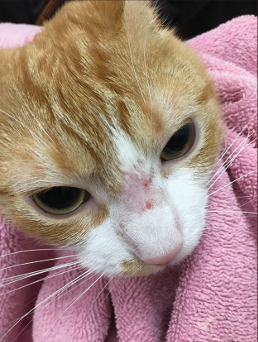
Head and neck pruritus is characterized by pruritus of the face, head, and neck (Figure 1). Pruritus is often intense, resulting in varying degrees of excoriation, erosion, and ulceration. Head and neck pruritus can be particularly severe, requiring drug therapy and/or protective collars to minimize self-trauma. Blepharitis and/or corneal ulceration may occur.
头颈部瘙痒的特征是面部、头颈部瘙痒(图1)。瘙痒通常很强烈,可导致不同程度的抓痕、糜烂和溃疡。头颈部瘙痒可能特别严重,需要药物治疗和/或保护项圈,以减少自我伤害。可能发生睑缘炎和/或角膜溃疡。
Figure 1. Feline atopic skin syndrome patient affected with head and neck pruritus, as well as facial miliary dermatitis lesions (photograph credit, Jangi Bajwa).
图 1. 一只患有猫特应性皮肤综合征的猫,其头部和颈部出现瘙痒症状,同时面部还出现了粟粒状皮炎(图片由贾吉·巴贾瓦提供)
Eosinophilic granuloma complex (EGC)
嗜酸性肉芽肿复合物(EGC)
This “complex” consists of a loosely grouped set of clinical syndromes, including:
这种“复杂”包括一组松散的临床症状,包括:
1. Indolent ulcer (or “rodent ulcer”) — typically affects the upper lip, at or immediately adjacent to the muco-cutaneous junction, with lesions initially starting as focal ulceration on the lip margin, with progression to fibrosis and deformation. This syndrome is typically not pruritic unless complicated by bacterial infection.
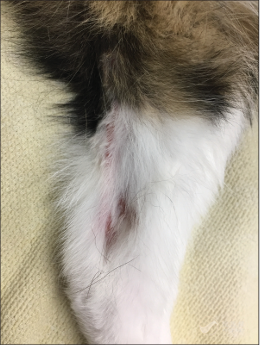
2. Eosinophilic granuloma (or “linear granuloma”) — lesions can appear in various locations, typically on the rear legs as linear areas of dermal thickening on the caudal aspect of the thigh and may extend distally past the stifle fold onto the caudal crus (Figure 2). Erosion or ulceration is common. Proliferative oral lesions, especially on the tongue or hard palate, or as poorly defined chin swelling (“fat chin”) may be noted. Pruritus may be present.
3. Eosinophilic plaque — lesions may appear anywhere, most frequently on ventral abdomen and medial thighs. Lesions are characterized by circular, to oval, to serpiginous, raised, frequently eroded, or ulcerated areas. These lesions are often associated with intense pruritus, with self-inflicted damage resulting in a self-perpetuating, positive feedback of inflammation. These lesions are often complicated by secondary bacterial infections.
1. 无痛性溃疡(或“惰性溃疡”)——通常影响上唇,位于或紧邻黏膜-皮肤交界处,病变最初始于唇缘局灶性溃疡,随后发展为纤维化和变形。这种综合征通常不会瘙痒,除非并发细菌感染。
2. 嗜酸性肉芽肿(或“线状肉芽肿”)——病变可出现在不同部位,典型表现为大腿尾部真皮线性增厚,并可向远端延伸至小腿尾部(图2)。糜烂或溃疡是常见的。增生性口腔病变,特别是在舌头或硬腭,或定义不清的下巴肿胀(“胖下巴”)可能会被注意到。可能有瘙痒。
3.嗜酸性斑块-病变可出现在任何部位,最常出现在腹部和大腿内侧。病变的特征是圆形、椭圆形、蛇形、隆起、经常被糜烂或溃疡的区域。这些病变通常与强烈的瘙痒有关,与自损导致炎症的自我持续、积极反馈有关。这些病变常因继发性细菌感染而复杂化。
Figure 2. Linear eosinophilic granuloma in a cat with suspected flea allergy dermatitis (photograph credit, Jangi Bajwa).
图 2.一只疑似因跳蚤过敏性皮炎的猫的线性嗜酸性肉芽肿(照片由贾吉·巴贾瓦提供)
Feline atopic skin syndrome (FASS)
猫特应性皮肤综合征(FASS)
Similar to atopic dermatitis in dogs, FASS is a clinical diagnosis based on presence of compatible clinical signs and exclusion of other diseases with similar clinical features. Elimination or exclusion of fleas/flea allergy, other parasites, infections, and FA is mandatory before reaching a diagnosis of FASS.
与犬的特应性皮炎相似,FASS是一种临床诊断,其基础是存在一致的临床症状,并排除具有相似临床特征的其他疾病。在诊断为FASS之前,必须排除跳蚤/跳蚤过敏、其他寄生虫、感染和FA。
In humans and dogs, atopic dermatitis is typically associated with a limited range and distribution of clinical signs. However, cutaneous lesions of FASS are far more variable in appearance and less predictable in distribution. Also, in contrast to humans and dogs, little is known regarding contributions of heritability to FASS. There is only some evidence for a heritable component to development of allergic dermatitis in cats from a few studies, including in the Abyssinian, Somali, Ocicat, Siamese, Persian, Maine coon, Devon rex, and Himalayan breeds.
在人类和犬,特应性皮炎通常与有限的范围和分布的临床症状。然而,FASS皮肤病变在外观上的变动性更大,在分布上的可预测性更低。此外,与人类和犬相比,关于遗传性对FASS的贡献知之甚少。从一些研究中,包括阿比西尼亚猫、索马里猫、奥西猫、暹罗猫、波斯猫、缅因猫、德文卷毛猫和喜马拉雅猫的研究中,只有一些证据表明猫的过敏病皮肤病炎的发展具有遗传成分。
A review of 10 manuscripts describing 263 cats diagnosed exclusively with FASS provided the following prevalence rates for the 4 allergic reaction patterns: 31.2% with MD; 60.1% with SIAH; 43.0% with HNP; and 25.9% with EGC (1 or more forms). Of the 263 FASS cats, 37.7% were reported as having at least 2 syndromes.
一项对263只被诊断为FASS的猫的10份手稿的综述提供了以下4种过敏反应模式的患病率:31.2%患有MD;与SIAH 60.1%;43.0%的HNP;25.9%含有EGC(1种或更多形式)。在263只FASS猫中,37.7%的猫至少有两种症状。
Of 230 cats affected by FASS, described in 7 manuscripts in which specifics regarding the presence of extra-cutaneous signs were provided, 8.3% (19 of 230) of the cats reportedly had some form of respiratory disease, including sneezing and asthma. Conjunctivitis was reported in 4.8% (11 of 230) of cats and gastrointestinal signs in 3.9% (9 of 230). Respiratory disease diagnosed as probable or definitive asthma was reported as accompanying 6 to 7% of 145 cats in 2 publications of cats diagnosed with FASS. There are additional reports describing co-existing allergic dermatitis with asthma, including evidence of improvements from intradermal allergy test (IDAT) based allergen specific immunotherapy (ASIT). Efficacy of allergy test based ASIT for spontaneous feline asthma has been demonstrated and could be 1 of the treatments of choice for spontaneous feline asthma, so long as the causative allergens can be precisely identified by either IDAT or allergenspecific IgE serology (ASIS). Allergy testing in cats can be pursued using IDAT and/or ASIS. As in dogs, IDAT is the “gold standard” in feline allergy medicine. Although IDAT gives immediate results and is biologically relevant, it lacks standardization. Furthermore, whereas ASIS is more widely available and more convenient, it only measures circulating allergen-specific IgE and does not take into account cutaneous histaminergic and non-histaminergic pathways and test reliability is variable.
在7份手稿中描述的230只FASS患猫中,据报道8.3%(230只猫中的19只)患有某种形式的呼吸道疾病,包括打喷嚏和哮喘。据报道,有4.8%(230只猫中的11只)患有结膜炎,3.9%(230只猫中的9只)有胃肠道症状。在两份关于被诊断为FASS的猫的出版物中,145只猫中有6 - 7%被诊断为可能或确定的哮喘的呼吸系统疾病。还有其他报告描述了过敏性皮肤病与哮喘共存,包括基于皮内过敏试验(IDAT)的过敏原特异性免疫疗法(ASIT)改善的证据。基于ASIT的过敏试验对自发性猫哮喘的疗效已经得到证实,只要能通过IDAT或过敏源特异性IgE血清学(ASIS)准确识别致敏原,ASIT可能是自发性猫哮喘的首选治疗方法之一。可以使用IDAT和/或ASIS对猫进行过敏测试。和犬一样,IDAT是猫类过敏药物的“金标准”。虽然IDAT可以立即产生结果,并且具有生物学相关性,但它缺乏标准化。此外,尽管ASIS更广泛、更方便,但它只测量循环中的过敏原特异性IgE,没有考虑皮肤组胺能和非组胺能途径,而且测试的可靠性是可变的。
The last of the ICADA review articles (4) includes the first systematic review of therapeutic interventions for FAS, including both FASS and feline asthma. Good evidence for efficacy of systemic glucocorticoids and cyclosporin, and limited evidence for efficacy of topical glucocorticoids, oclacitinib and ASIT, were noted for FASS. For feline asthma, there was good evidence for efficacy of oral and inhaled glucocorticoids, and limited evidence of moderate efficacy for ASIT. Evidence pointed to low-tomoderate efficacy for antihistamines, fatty acids, and palmitoyl ethanolamide for FASS. Furthermore, for feline asthma, there was low-to-moderate efficacy of mesenchymal stem cells, inhaled lidocaine and oclacitinib.
ICADA的最后一篇综述文章(4)首次系统综述了FAS的治疗干预措施,包括FASS和猫哮喘。FASS的全身糖皮质激素和环孢素疗效证据良好,外用糖皮质激素、奥拉替尼和ASIT疗效证据有限。对于猫哮喘,口服和吸入糖皮质激素的疗效有很好的证据,而ASIT中度疗效的证据有限。有证据表明抗组胺、脂肪酸和棕榈醇酰胺对FASS的低-中度疗效。此外,间充质干细胞、吸入利多卡因和奥拉替尼对猫哮喘的疗效为中低。
In summary, regarding feline allergic disease, some of the key conclusions include:
• feline diseases of presumed allergic etiology have some features comparable to those in human atopic diseases and canine atopic dermatitis;
• although strong evidence of a genetic basis is missing, that cats can suffer from the triad of allergic dermatitis, allergic enteritis and asthma, often in combination and with some evidence for involvement of IgE, provides justification for designating FAS and related conditions as likely atopic diseases;
• contrary to dogs (in which the atopic disease manifests mainly with cutaneous signs), asthma may have an important role in FAS cats, often underestimated by dermatologists and general practitioners. This emphasizes the strong connection among cutaneous, gastrointestinal, and respiratory systems in allergic cats;
• inflammation noted in both FASS and feline asthma is accompanied by eosinophils and lymphocytes; these findings, together with cytokine expression, are suggestive in some cats of T-helper type 2 immune dysregulation;
• FA and FAD can both either mimic and/or contribute to FAS and FASS, and their potential role must be assessed before a diagnosis can be finalized and before deciding on a therapeutic approach;
• due to strong clinical similarities between cats with FA and cats with FASS, if perennial clinical signs are present, food allergy must be excluded via 1 or more strict food trial(s). Extra-cutaneous clinical signs can occur in both FASS- and FA-affected cats;
• good evidence is available for the efficacy of systemic glucocorticoids and cyclosporin in treatment of FASS. Good evidence for the efficacy of oral and inhaled glucocorticoids is also available for feline asthma; and
• limited evidence for the efficacy is available for other anecdotally effective treatments including allergen-specific immunotherapy and oclacitinib. For almost all therapeutic options (except for glucocorticoids and cyclosporin), more randomized controlled trials are needed.
• FAS is a complex syndrome, involving multiple organs including skin, gastrointestinal, and respiratory systems;
综上所述,关于猫过敏性疾病,一些关键结论包括:
•假定猫过敏性疾病病因具有与人类特应性疾病和犬特应性皮炎相似的一些特征;
•虽然缺乏遗传基础的有力证据,但猫可能患有过敏性皮炎、过敏性肠炎和哮喘这三种疾病,通常是合并的,并且有一些证据表明IgE参与其中,这为将FAS和相关病症指定为可能的特应性疾病提供了理由;
•与犬的情况不同(在犬上,过敏性疾病主要表现为皮肤症状),哮喘在FAS猫中可能起着重要作用,而这一情况往往被皮肤科医生和全科医生所忽视。这突显了过敏症猫的皮肤、消化系统和呼吸系统之间的紧密联系。
•FASS和猫哮喘的炎症均伴有嗜酸性粒细胞和淋巴细胞;这些发现,加上细胞因子的表达,提示某些猫存在T辅助细胞2型免疫失调;
•FA和FAD可以模仿和/或促进FAS和FASS,必须在最终诊断和决定治疗方法之前评估其潜在作用;
•由于患有FA的猫与患有FASS的猫在临床表现上有很强的相似性,如果存在常年临床症状,必须通过1项或更多严格的食物试验排除食物过敏。FASS和FA患猫都可能出现皮肤外临床症状;
•良好的证据表明全身性糖皮质激素和环孢素治疗FASS有效。口服和吸入糖皮质激素治疗猫哮喘的疗效也有很好的证据;而且
•目前对于其他一些具有一定疗效的疗法(包括针对过敏原的免疫疗法和奥拉替尼)的有效性证据有限。对于几乎所有治疗方案(除了糖皮质激素和环孢素之外),都需要更多的随机对照试验来验证其疗效。
•FAS 是一种复杂的综合征,涉及多个器官,包括皮肤、消化系统和呼吸系统;
| 


 |Archiver|手机版|小黑屋|宠医帮
( 京ICP备2022012070号-2 )
|Archiver|手机版|小黑屋|宠医帮
( 京ICP备2022012070号-2 ) 




 发表于 2026-3-24 23:05:24

 收藏
收藏 转播
转播 分享
分享 淘帖
淘帖