|
Acquired central diabetes insipidus secondary to severe, chronic otitis media and interna in an 8-year-old Spanish Mastiff dog (canine)
一只8岁西班牙獒犬因严重慢性中耳炎及内耳炎继发获得性中枢性尿崩症(犬)
作者:Kevin Gooch Kyle L. Granger Jr. PaulaYoon ChrisOlmo MeiLunMui Sarrah E. Hoppers Kelly E. Hall
翻译:王帆
Abstract
摘要
An 8-year-old spayed female Spanish Mastiff dog presented with a five-month history of polyuria, polydipsia, persistent isosthenuria to hyposthenuria, urinary incontinence, and bilateral otitis externa, progressing to acute vestibular dysfunction. Endocrine testing excluded hypo- and hyperadrenocorticism, and the clinical signs were inconsistent with primary psychogenic polydipsia. Magnetic resonance imaging revealed severe left sided otitis media and interna and mild pituitary enlargement with signal characteristics suggestive of depleted arginine vasopressin stores. Transient central diabetes insipidus (CDI) was diagnosed secondary to chronic otitis media/interna based on imaging findings and a rapid response to desmopressin acetate. Treatment consisted of targeted otitis therapy, desmopressin acetate (DDAVP), and anti-inflammatory glucocorticoids. Although glucocorticoids transiently reduced DDAVP responsiveness, this resolved after the course of glucocorticoids was completed. Following resolution of the otitis, DDAVP was discontinued and the dog’s water balance normalized without recurrence, confirming a reversible CDI secondary to localized inflammatory disease.
一只8岁已绝育雌性西班牙獒犬就诊,有五个月的多尿、多饮、持续性等渗尿至低渗尿、尿失禁和双侧外耳炎病史,并进展为急性前庭功能障碍。内分泌检查排除了肾上腺皮质功能减退和肾上腺皮质功能亢进,且临床症状与原发性精神性多饮不符。磁共振成像显示严重的左侧中耳炎和内耳炎,以及轻度垂体增大,其信号特征提示精氨酸加压素储存耗竭。基于影像学结果和对醋酸去氨加压素的快速反应,诊断为继发于慢性中耳炎/内耳炎的暂时性中枢性尿崩症(CDI)。治疗包括针对性的耳炎治疗、醋酸去氨加压素(DDAVP)和抗炎糖皮质激素。尽管糖皮质激素暂时降低了醋酸去氨加压素的反应性,但在糖皮质激素疗程结束后此情况得到缓解。耳炎解决后,停用醋酸去氨加压素,犬的水分平衡恢复正常且无复发,证实了继发于局部炎症性疾病的可逆性CDI。
KEYWORDS
关键词
clinical practice, critical care, diagnostic imaging, ear, endocrinology, nose and throat (ENT), otitis media
临床实践,重症监护,诊断影像学,耳,内分泌学,鼻喉(ENT),中耳炎
BACKGROUND
背景
Central diabetes insipidus (CDI) is a rare but clinically significant endocrinopathy in veterinary medicine,characterised by an inability of the kidneys to concentrate urine due to insufficient secretion of antidiuretic hormone (ADH), also known as arginine vasopressin (AVP).AVP, synthesised in the hypothalamus and stored in the posterior pituitary, regulates water homeostasis via action on the renal collecting ducts to promote water reabsorption. Its secretion is regulated by neural osmoreceptors in the hypothalamus and by nonosmotic factors, which would include hypovolaemia, activation of the renin-angiotensin-aldosterone system, cortisol levels and thyroid hormones. Disruption of AVP production or release leads to excessive free water loss through the urine and results in profound polyuria, compensatory polydipsia, and potentially deleterious hypernatraemia and dehydration if water intake is restricted.
中枢性尿崩症(CDI)是兽医医学中一种罕见但具有临床意义的内分泌疾病,其特征是由于抗利尿激素(ADH),也称为精氨酸加压素(AVP)分泌不足,导致肾脏无法浓缩尿液。AVP在下丘脑合成并储存于垂体后叶,通过作用于肾集合管促进水分重吸收来调节水稳态。其分泌受下丘脑神经渗透压感受器以及非渗透压因素(包括低血容量、肾素-血管紧张素-醛固酮系统激活、皮质醇水平和甲状腺激素)的调节。AVP产生或释放受阻会导致尿液过量丢失游离水,并导致严重多尿、代偿性多饮,如果饮水受限,还可能导致有害的高钠血症和脱水。
Acquired CDI most commonly arises secondary to trauma, neoplasia or inflammatory processes that involve the hypothalamic–pituitary axis.While trauma and neoplasia are well-documented causes in both veterinary and human medicine,inflammation leading to CDI, particularly secondary to conditions such as otitis media and interna, remains unreported in veterinary literature. This report details the diagnostic workup and treatment of a canine patient diagnosed with transient CDI secondary to severe chronic otitis media and interna.
获得性CDI最常见继发于涉及下丘脑-垂体轴的外伤、肿瘤或炎症过程。虽然外伤和肿瘤在兽医和人类医学中都是有充分记载的病因,但由炎症(特别是继发于中耳炎和内耳炎等疾病)导致的CDI在兽医文献中尚未见报道。本报告详细描述了一例继发于严重慢性中耳炎和内耳炎的暂时性CDI患犬的诊断检查与治疗过程。
CASE PRESENTATION
病例介绍
An 8-year-old, 82-kg, spayed, female Spanish Mastiff was referred to a tertiary academic veterinary teaching hospital (VTH) for evaluationof acute vestibular dysfunction, polyuria/polydipsia (PU/PD), and a history of persistent urinary incontinence.
一只8岁、82公斤、已绝育的雌性西班牙獒被转诊至一家三级学术兽医教学医院,以评估急性前庭功能障碍、多尿/多尿(PU/PD)以及持续性尿失禁病史。
Initial signs of incontinence began 5 months before presentation, at which time isosthenuria was noted with a urine specific gravity (USG) of 1.012 (reference interval [RI]: >1.030). Urinary incontinence was initially unresponsive to medication, but improved with a combination of estriol (0.03 mg/kg orally [PO] every 12 hours) and phenylpropanolamine (0.8 mg/kg PO every 8 hours for 7 days, and then every 12 hours indefinitely). The dog’s PU/PD, however, failed to improve. Serial USG measurements showed progression to hyposthenuria, with USG values between 1.005 and 1.008 for approximately 3 months before presentation. Abdominal ultrasound, endocrine testing, urine culture and baseline complete blood count/serum biochemistry did not reveal a cause of the persistent hyposthenuria.
尿失禁的初期症状在就诊前 5 个月就开始出现了,当时观察到等渗尿症,尿比重(USG)为 1.012(参考区间 [RI]:>1.030)。起初,药物治疗对尿失禁没有效果,但使用雌三醇(0.03 毫克/千克,口服 [PO] 每 12 小时一次)和苯丙醇胺(0.8 毫克/千克,口服 [PO] 每 8 小时一次,持续 7 天,然后每 12 小时持续服用)的联合疗法后有所改善。然而,此犬的多饮多尿(PU/PD)并未得到改善。一系列USG测量结果显示,USG逐渐降低至低渗尿,尿比重值在就诊前约 3 个月处于 1.005 至 1.008 之间。腹部超声、内分泌检测、尿液培养和基线全血细胞计数/血清生化检查均未发现持续低渗尿症的病因。
Concurrent with the urinary issues, the dog had experienced recurrent bilateral otitis externa, managed over several months with monthly applications of an otic combination solution (florfenicol/terbinafine/mometasone, 1 mL AU per treatment). This treatment provided temporary relief, but infections recurred shortly after discontinuation, which necessitated repeated otoscopic treatments with an unknown ear cleaner and reapplication of the aforementioned otic solution on a biweekly basis. Additionally, the dog developed progressive vestibular dysfunction characterised by a left sided head tilt and intermittent ataxic episodes, occasionally exacerbated by ear cleaner application.
与泌尿系统问题同时,犬经历了复发性双侧外耳炎,数月来通过每月使用一种耳用复方溶液进行治疗。该治疗提供了暂时的缓解,但停药后感染很快复发,这需要每两周重复一次耳镜治疗。此外,犬出现了进行性前庭功能障碍,表现为左侧头倾斜和间歇性共济失调发作,有时在滴用洗耳液后加剧。
Four days before presentation, the dog exhibited signs of a suspected ear infection characterised by marked ceruminous debris accumulation and moderate pain, most notably in the left ear, in tandem with progressive hyporexia and lethargy.On the day of presentation to the VTH,the dog was found in the backyard, laterally recumbent with rapid head movements and horizontal nystagmus, unable to ambulate. No tonic-clonic movements, vomiting, urination or defecation were noted by the owner throughout this time. Upon initial evaluation,the dog was quiet,alert and responsive and exhibited moderate vestibular ataxia and a pronounced left sided head tilt. Neurological examination revealed normal proprioception in all four limbs, but moderate vestibuloproprioceptive ataxia, as well as cranial nerve deficits, which included ventrolateral strabismus and enophthalmos in the left eye. Spinal reflexes and postural reactions were intact. Taken together, these neurological findings were more consistent with peripheral, rather than central, vestibular disease. Physical examination findings revealed euhydration and were otherwise unremarkable aside from moderate ceruminous debris bilaterally. Indirect (Doppler) blood pressure was mildly elevated at 170 mmHg (RI: 90–160 mmHg).
就诊前四天,犬表现出疑似耳部感染的症状,其特征是明显的耵聍碎屑积聚和中等程度疼痛,左耳尤为明显,同时伴有进行性高热和嗜睡。在就诊教学医院当天,犬被发现躺在后院,侧卧,伴有快速的头部运动和水平眼震,无法行走。在此期间,主人未注意到强直-阵挛性运动、呕吐、排尿或排便。初步评估时,犬安静、警觉、有反应,表现出中度前庭性共济失调和明显的左侧头倾斜。神经系统检查显示四肢本体感觉正常,但存在中度前庭-本体感觉性共济失调,以及颅神经缺陷,包括左眼腹侧斜视和眼球内陷。脊髓反射和姿势反应完整。总之,这些神经学发现更符合外周性而非中枢性前庭疾病。体格检查发现水合状态正常,除双侧中度耵聍碎屑外,其他方面无异常。间接血压轻度升高至170 mmHg。
INVESTIGATIONS
检查
Initial diagnostic tests included biochemistry profileand complete blood count, which revealed mild hypercholesterolemia (319 mg/dL; RI: 130–300 mg/dL), elevated creatine kinase (736 U/L; RI: 50–275 U/L), and elevated aspartate amino transferase (66 U/L; RI: 15–45 U/L). Phosphorus was mildly decreased at 2.4 mg/dL (RI: 2.5–6.0 mg/dL). Other values, including glucose, renal values, electrolytes and acid/base status, were within normal limits, apart from mild hypernatraemia (152 mmol/L; RI: 138–150 mmol/L), mild hyperlactataemia (2.9 mmol/L; RI: persistent hyposthenuria (USG 1.005), with no evidence of pyuria, haematuria, or crystalluria and urine culture results were negative for bacterial growth.
初步的诊断检查包括生化指标检测和全血细胞计数,结果显示存在轻度高胆固醇血症(319 毫克/分升;参考值:130 - 300 毫克/分升),肌酸激酶水平升高(736 单位/升;参考值:50 - 275 单位/升),以及天冬氨酸氨基转移酶水平升高(66 单位/升;参考值:15 - 45 单位/升)。磷的含量略有降低,为 2.4 毫克/分升(参考值:2.5 - 6.0 毫克/分升)。其他指标,如血糖、肾功能指标、电解质和酸碱平衡状况均在正常范围内,除了轻度高钠血症(152 毫摩尔/升;参考值:138 - 150 毫摩尔/升)、轻度高乳酸血症(2.9 毫摩尔/升;持续性低尿量(比重 1.005),且无脓尿、血尿或结晶尿的症状,尿培养结果也未发现细菌生长。
The following morning, the dog appeared 6% dehydrated, as evidenced by tacky mucous membranes. A point-of-care ultrasound of the abdomen and thorax revealed no significant abnormalities apart from a distended stomach. A venous blood gas analysis demonstrated progressive hypernatraemia (159 mmol/L) and hyperchloraemia (124 mmol/L; RI: 100 115 mmol/L), persistent mild hyperlactataemia (2.4 mmol/L), and a progressive metabolic acidosis with a base excess of -6.1 mmol/L.
次日早晨,犬出现6%的脱水症状。床旁腹部和胸部超声检查除胃扩张外未发现显著异常。静脉血气分析显示进行性高钠血症和高氯血症,持续性轻度高乳酸血症,以及进行性代谢性酸中毒。
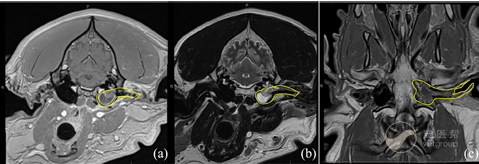
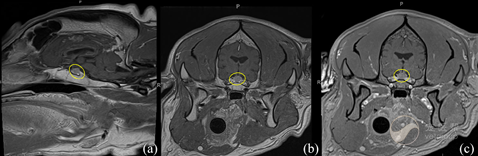
Magnetic resonance imaging (MRI) revealed T2 hyperintense fluid accumulation and contrast enhancement within the left tympanic bulla, with evidence of increased heterogeneous fluid within the left vestibule extending to surround the rostroventral margins of the ipsilateral vestibulocochlear nerve without any evidence of structural or signal abnor malities of the nerve itself (Figure 1). MRI characteristics of the fluid were most consistent with chronic inflammatory changes, which aligned with the patient’s chronic history of otitis externa. There was no evidence of intracranial exten sion or abscess formation. The pituitary gland was noted to be enlarged, approximately 7 mm in height, and extended dorsally beyond the sella turcica. Additionally, the central T1 hyperintense AVP storage centre was absent (Figure 2).
磁共振成像显示左侧鼓泡内有T2高信号液体积聚和对比增强,左前庭内有增加的异质性液体证据,延伸至同侧前庭耳蜗神经的吻腹侧边缘,但神经本身无结构或信号异常。液体的MRI特征最符合慢性炎症性改变,这与患的慢性外耳炎病史一致。无颅内延伸或脓肿形成的证据。注意到垂体增大,高度约7毫米,并向背侧延伸超出蝶鞍。此外,中央T1高信号的AVP储存中心缺失。
Based on these findings, a unilateral (left) myringotomy was performed. Cytology of the left tympanic fluid revealed a mixed bacterial infection characterised by numerous rods and occasional cocci, accompanied by neutrophilic inflammation. Pseudomonas aeruginosa was identified as the predominant organism, and culture confirmed its susceptibility to marbofloxacin. Cytology of the right external ear demonstrated 3+ yeast, suspected to be Malassezia spp. Adrenal testing revealed a low basal cortisol (1.06 μg/dL; RI: >2 μg/dL) with a normal post-ACTH response (9.78 μg/dL; RI: >6 μg/dL), which was inconsistent with hypo- or hyperadrenocorticism. A thyroid panel showed euthyroid status, with a total T4 of 1.75 μg/dL (RI: 1–4 μg/dL), free T4 of 0.744 ng/dL (RI: 0.5–2 ng/dL), and TSH of 0.047 ng/mL (RI: 0.03–0.6 ng/mL).
基于这些发现,我们进行了单侧(左)鼓膜切开术。左鼓室液细胞学检查显示混合性细菌感染,以大量链球菌和偶有球菌为特征,伴中性粒细胞炎症。主要病原菌为铜绿假单胞菌,培养结果证实其对马坡沙星敏感。右外耳细胞学检查示3+酵母菌,怀疑为马拉色菌。肾上腺素检查示基础皮质醇低(1.06 μg/dL, RI: bbb20 μg/dL), ACTH后反应正常(9.78 μg/dL, RI: >6 μg/dL),与肾上腺皮质过低或高不一致。甲状腺功能正常,总T4 1.75 μg/dL (RI: 1 ~ 4 μg/dL),游离T4 0.744 ng/dL (RI: 0.5 ~ 2 ng/dL), TSH 0.047 ng/mL (RI: 0.03 ~ 0.6 ng/mL)。
Given the chronic history of hyposthenuria in conjunction with MRI findings, it was elected to trial desmopressin acetate (DDAVP) for possible CDI. Pre-DDAVP treatment revealed persistent hyposthenuria with a USG of 1.005 and UOP of 3.1mL/kg/h.Twelve hours post-DDAVP,the USG significantly improvedto1.018, andUOPdecreasedto1mL/kg/h. Please note that these values were obtained while the dog was actively receiving fluid therapy, which was adjusted to match the dog’s reduced urine output. Urine output and weight were measured every 6 hours during this time.
鉴于慢性低渗尿病史结合MRI发现,决定试验性使用醋酸去氨加压素(DDAVP)治疗可能的CDI。治疗前USG为1.005。醋酸去氨加压素治疗后12小时,USG显著改善至1.018。在此期间,每6小时测量一次尿量和体重。
The next morning, the dog exhibited a consistent appetite, with a USG of 1.020 and a UOP of 1.1 mL/kg/h. A repeat venous blood gas test showed improved hypernatraemia (155 mmol/L), creatinine reduced to 0.85 mg/dL (RI: 0.4 1.6 mg/dL), and resolved hyperlactataemia (1 mmol/L, RI:<2mmol/L).
第二天早上,犬表现出一致的食欲,USG为1.020,UOP为1.1 mL/kg/h。重复静脉血气试验显示高钠血症改善(155 mmol/L),肌酐降至0.85 mg/dL (RI: 0.4 1.6 mg/dL),高乳酸血症缓解(1 mmol/L, RI:<2mmol/L)。
DIFFERENTIAL DIAGNOSIS
鉴别诊断
CDI was ultimately favoured based on the marked improve ment in urine concentrating ability following DDAVP admin istration, loss of the normal T1 hyperintense signal in the posterior pituitary on MRI, and absence of alternative aetiologies.Nephrogenic diabetes insipidus(NDI)was ruled out due to the dog’s strong response to exogenous AVP analogue therapy, as animals with NDI do not concentrate urine in this setting. Psychogenic polydipsia was considered unlikely, given the sustained hyposthenuria despite dehydration and the absence of behavioural triggers. Additional endocrinopathies, including hyperadrenocorticism, hypoadrenocorticism, and hypothyroidism, were excluded through diagnostic testing and were inconsistent with the clinical presentation. Systemic causes of impaired renal concentrating ability, such as chronic kidney disease,hypercalcaemia and hypokalaemia,were ruled out based on normal serum creatinine, ionised calcium and potassium concentrations.Pituitary neoplasia and hypophysitis were also considered. However, MRI findings did not reveal a discrete mass, pituitary stalk thickening or abnormal enhancement. Overflow incontinence was excluded based on normal bladder size, absence of post-void residual urine, and an unremarkable voiding pattern. Collectively, these findings support a diagnosis of acquired CDI with a suspected underlying inflammatory aetiology originating from chronic otitis media and interna.
CDI最终被优先考虑,基于使用DDAVP后尿液浓缩能力显著改善、MRI上垂体后叶正常T1高信号丢失以及无其他病因。肾性尿崩症因犬对外源性AVP类似物治疗有强烈反应而被排除。精神性多饮被认为不太可能。其他内分泌疾病,包括肾上腺皮质功能亢进、肾上腺皮质功能减退和甲状腺功能减退,已通过诊断检查排除。系统性病因导致的肾浓缩功能受损,如慢性肾病、高钙血症和低钾血症,基于正常的血清肌酐、离子钙和钾浓度被排除。垂体肿瘤和垂体炎也被考虑。然而,MRI结果未显示离散肿块、垂体柄增厚或异常增强。溢出性尿失禁基于正常膀胱大小、排尿后无残余尿和正常的排尿模式被排除。总之,这些发现支持获得性CDI的诊断,并怀疑潜在的炎症病因源于慢性中耳炎和内耳炎。
TREATMENT
治疗
At the time of presentation, treatment was initiated with lac tated Ringer’s solution (LRS; 95 mL/h) (1.25× RER), meclizine (0.3 mg/kg PO every 24 hours), maropitant (1 mg/kg intra venously every 24 hours), and urinary catheter placement to monitor urine output.
在开始治疗时,采用了以下方案:使用含乳酸的林格氏溶液(LRS;每小时 95 毫升)(1.25 倍的呼吸率),氯苯甲嗪(每 24 小时口服 0.3 毫克/千克),马罗匹坦(每 24 小时静脉注射 1 毫克/千克),以及放置导尿管以监测尿量。
The following morning,LRS was increased to 470mL/h(1× RER plus 6% rehydration over 12 hours). The meclizine dose was increased(1.85mg/kgPOevery24hours),and maropitant was discontinued.
次日早晨,输液量增加至 470 毫升/小时(1 倍的基础代谢率加上 6%的补液量,持续 12 小时)。氯苯甲嗪的剂量增加(每 24 小时口服 1.85 毫克/千克),停用马罗匹坦。
After MRI, DDAVP (0.1 mL; 0.12 μg/kg) OS every 12 hours and dexamethasone SP: enrofloxacin otic solution (1:1 ratio) 1 mL AS every 12 hours were added to the dog’s therapeutic plan.Given the severe inflammation noted on imaging,persistent vestibular signs and pain associated with the chronicity of the condition, oral prednisolone (20 mg; 0.2 mg/kg PO every 12 hours) was added to the therapeutic plan. This addition appreciably improved the dog’s auricular discomfort. Marbofloxacin (4.1 mg/kg; PO every 24 hours) was added after culture and sensitivity results returned.
MRI后,每12小时加入DDAVP (0.1 mL; 0.12 μg/kg) OS,每12小时加入地塞米松SP:恩诺沙星溶液(1:1比例)1 mL AS。考虑到影像学显示的严重炎症、持续的前庭症状和与慢性疾病相关的疼痛,在治疗计划中添加口服泼尼松龙(20mg; 0.2 mg/kg PO每12小时)。这种添加明显改善了犬的耳部不适。培养后加入马布沙星(4.1 mg/kg,每24小时PO一次),返回敏感性结果。
OUTCOME AND FOLLOW-UP
结果与随访
Two weeks after discharge, the dog was reportedly no longer exhibiting PU/PD at home with consistent improvement. At the 3-week recheck, clinical signs of PU/PD remained significantly improved, but USG had returned to 1.005. The dog’s course of prednisolone was completed shortly after this recheck, and repeat USG 10 days later showed improvement with a USGof1.015, which confirmed the suspicion that prednisolone exhibited an antagonistic effecton DDAVP.Given the improvements, the owner elected to discontinue the DDAVP administration to reduce the stress of multiple medication administrations. The dog continued to show clinical improvement of PU/PD-associated signs over subsequent evaluations over the last year, as well as the bilateral ear infections. However, it should also be noted that the dog did have multiple relapses of the ear infections without complaints of return of the PU/PD.
出院两周后,据报告犬在家不再表现出多尿/多饮,情况持续改善。在3周复查时,多尿/多饮的临床症状仍有显著改善,但USG已回到1.005。犬的泼尼松龙疗程在此次复查后不久完成,10天后的重复USG显示改善,确认了泼尼松龙对醋酸去氨加压素有拮抗作用的怀疑。鉴于病情改善,主人选择停止醋酸去氨加压素给药以减少使用多种药物的压力。在随后直到去年的评估中,犬继续表现出多尿/多饮相关症状以及双侧耳部感染的临床改善。然而,需要注意的是,犬的耳部感染确实有多次复发,但没有主诉多尿/多饮症状复发。
DISCUSSION
讨论
CDI is a disorder characterised by inadequate secretion of AVP in response to osmotic stimulation.As AVP is critical for the maintenance of fluid balance, when AVP levels are insufficient or the kidneys fail to respond to the hormone, the body cannot retain water and adequately concentrate urine. Thus, disorders of AVP commonly result in PU, PD, hypernatraemia, and the production of dilute urine regard less of hydration status. In people, it often arises due to acquired conditions such as neoplasia, Langerhans cell histiocytosis, or inflammatory and autoimmune diseases. Rarely, CDI stems from genetic defects that affect AVP synthesis, inherited via autosomal dominant, autosomal recessive, or X-linked recessive patterns.Similarly, in veterinary medicine, CDI is considered a rare condition, and is currently classified as primary (idiopathic or congenital) or secondary (head trauma or neoplasia). To date, inflammatory conditions such as otitis media or interna have not been reported as causes of CDI in dogs.While causation cannot be definitively established in this case, the absence of other structural brain lesions on MRI, loss of normal neuro hypophyseal signal intensity, and robust response to DDAVP strongly support a diagnosis of CDI. These findings raise the possibility that chronic otitis may, in rare instances, contribute to secondary CDI via inflammatory extension.
CDI 是一种以对渗透刺激反应时抗利尿激素分泌不足为特征的疾病。由于抗利尿激素对于维持体液平衡至关重要,当其水平不足或肾脏无法对这种激素作出反应时,身体就无法保留水分并有效地浓缩尿液。因此,抗利尿激素的紊乱通常会导致多尿、多饮、高钠血症以及不论水合状态如何都会产生稀释尿液的情况。在人类中,这种疾病通常由获得性疾病引起,如肿瘤、朗格汉斯细胞组织细胞增生症或炎症及自身免疫性疾病。罕见,CDI 由影响抗利尿激素合成的遗传缺陷引起,这种缺陷通过常染色体显性、常染色体隐性或 X 连锁隐性遗传模式遗传而来。在兽医学中,CDI 被视为一种罕见病症,目前被归类为原发性(特发性或先天性)或继发性(头部创伤或肿瘤)。到目前为止,尚未有中耳炎或内耳炎作为犬 CDI 的病因的报道。虽然在此次病例中无法确切确定因果关系,但磁共振成像未显示其他结构性脑损伤、正常神经垂体信号强度的丧失以及对DDAVP的强烈反应,这些都有力地支持了CDI的诊断。这些结果提出了这样一种可能性,即在极少数情况下,慢性耳炎可能通过炎症扩散而引发继发性 CDI。
MRI demonstrated T2 hyperintensity and contrast enhancement of the left tympanic bulla, consistent with otitis media and interna. Although CN VIII was not thickened, its course through the internal acoustic meatus places it adjacent to the hypothalamic–pituitary axis. Inflammatory spread along this pathway could disrupt hypothalamic AVP synthesis or impair axonal transport to the posterior pituitary. The observed depletion of the neurohypophyseal T1 signal, which represents diminished AVP stores, and the lack of alternative aetiologies support this biologically plausible mechanism of neuroendocrine interruption.
MRI显示左侧鼓室壁存在 T2 强信号及对比增强现象,这与中耳炎和内耳炎相符。尽管第八对脑神经未增厚,但其穿过内耳道的路径使其靠近下丘脑 - 垂体轴。沿着这条路径的炎症扩散可能会干扰下丘脑的抗利尿激素合成或妨碍到后脑垂体的轴突运输。所观察到的神经垂体 T1 信号的减少,这代表抗利尿激素储存量的减少,以及缺乏其他病因,支持了这种生物学上合理的神经内分泌中断机制。
The dog had a 5-month history of PU/PD, intermittent isosthenuria to hyposthenuria, and repeated ear infections. Recorded water intake exceeded the diagnostic threshold for polyuria, indicating a disorder of water metabolism. Currently, in literature, thickened pituitary stalks and discrete or large (>1 cm) masses associated with the pituitary gland are reportedly associated with diagnoses of hypophysitis and neoplasia, respectively. The diagnosis of CDI was supported by the combination of mild pituitary gland enlargement on MRI (7 mm height; reference range: 5.1 ± 0.9 mm), loss of the typical T1 hyperintense signal of the posterior pituitary (suggestive of AVP depletion), and a marked (>50%) increase in USG from 1.005 to 1.018 by Day 2 following DDAVP administration, despite ongoing fluid therapy. These findings are consistent with impaired endogenous AVP production and secretion.
该犬患有 5 个月的多尿症/多饮症病史,伴有间歇性的等渗尿到低渗尿,以及反复的耳部感染。其饮水量超过了多尿症的诊断阈值,表明存在水代谢紊乱。目前,在文献中,垂体柄增厚以及与垂体相连的分散或较大的(> 1 厘米)肿块分别与垂体炎和肿瘤的诊断相关联。CDI的诊断得到了以下因素的证实:MRI显示轻微的垂体增大(高度 7 毫米;参考范围:5.1 ± 0.9 毫米),后垂体的典型 T1 强信号缺失(提示抗利尿激素(AVP)耗竭),以及在使用去氨加压素(DDAVP)后第 2 天,超声检查显示的 USG 值从 1.005 增加到 1.018,增幅超过 50%,尽管正在进行液体治疗。这些发现与内源性 AVP 的生成和分泌受损相一致。
At recheck, hyposthenuria persisted despite DDAVP therapy, likely due to concurrent administration of prednisolone. Glucocorticoids counteract DDAVP effects via down regulation of kidney responsiveness to AVP, decreased aquaporin 2 channel and V2 receptor expression, and increased glomerular filtration rate. All of which results in excesive urine output. Glucocorticoids can also disrupt the thirst mechanism and promote sodium and water retention through other pathways, which can indirectly alter fluid balance. Although DDAVP may partially offset these effects, discontinuing prednisolone was prioritised to limit polypharmacy (five or more medications concurrently). Furthermore, current literature reports that dogs with CDI may have an acceptable quality of life as long as they are provided free access to water and access to a place to urinate. In this case, owner compliance with these recommendations and targeted management of the primary ear disease resulted in continued clinical improvement1yearafter diagnosis.
再次检查发现,尽管使用了DDAVP疗法,低渗尿症仍持续存在,这可能是由于同时使用了泼尼松龙所致。糖皮质激素通过下调肾脏对抗利尿激素的反应、减少水通道蛋白 2 通道和 V2 受体的表达以及增加肾小球滤过率来抵消去氨加压素的作用。这些因素会导致尿量过多。糖皮质激素还会破坏渴感机制,并通过其他途径促进钠和水的潴留,从而间接影响体液平衡。尽管去氨加压素可能部分抵消这些影响,但优先考虑停用泼尼松龙是为了减少药物的联合使用(同时使用五种或更多种药物)。此外,目前的文献报道,只要给予患有CDI的犬自由饮水和一个排尿的地方,它们的生存质量就可以是可接受的。在此病例中,主人遵守这些建议并针对主要的耳部疾病进行有针对性的管理,使得在确诊一年后临床状况持续改善。
LEARNINGPOINTS/TAKE-HOME MESSAGES
学习要点/核心信息
This case demonstrates the potential for chronic inflammatory conditions, such as otitis media and interna conditions, to result in secondary or acquired central diabetes insipidus.
Resolution of hyposthenuria following desmopressin acetate administration supports a diagnosis of central diabetes insipidus,as nephrogenic causes should fail to respond to desmopressin acetate.
Concurrent use of glucocorticoids may antagonise the action of desmopressin acetate, confounding diagnosis or leading to a premature conclusion that desmopressin acetate treatment has failed.
本病例证明了慢性炎性疾病,如中耳炎和内耳炎,可能导致继发性或获得性中枢性尿崩症。
使用醋酸去氨加压素后低渗尿得到缓解,支持中枢性尿崩症的诊断,因为肾性原因应对醋酸去氨加压素无反应。
同时使用糖皮质激素可能会拮抗醋酸去氨加压素的作用,干扰诊断或导致过早认为醋酸去氨加压素治疗失败。
FIGURE1 Magnetic resonance imaging of the skull base in an 8-year-old Spanish Mastiff with bilateral otitis externa and media. (a) Transverse post-contrast T1-weighted image with fat suppression, showing peripheral contrast enhancement along the mucosal lining of the left tympanic bulla wall and external ear canal. Non-enhancing material within the tympanic bulla and canal is consistent with ceruminous debris and inflammatory content confirmed by otoscopy and myringotomy. (b) Transverse T2-weighted image, demonstrating T2 hyperintense material within both compartments of the left tympanic bulla. The ventromedial compartment appears more hyperintense compared to the dorsolateral aspect. (c) Dorsal post-contrast T1-weighted image with fat suppression, providing a symmetric view of the skull base anatomy. The left tympanic bulla is fluid-filled and abnormal compared to the normally aerated right bulla.
图 1 一只 8 岁西班牙獒犬双侧外耳炎和中耳炎的颅底磁共振成像。 (a)横断面增强后 T1 加权像,脂肪抑制,显示左侧鼓室泡壁和外耳道黏膜衬里周围有对比剂增强。鼓室和耳道内未增强的物质与耳镜检查和鼓膜切开术所证实的耵聍碎屑和炎症内容物一致。 (b)横断面 T2 加权像,显示左侧鼓室泡两个腔室内的 T2 高信号物质。腹内侧腔室的信号强度高于背外侧腔室。 (c)矢状位增强后 T1 加权像,脂肪抑制,提供了颅底解剖结构的对称视图。左侧鼓室充满液体且异常,与正常气化的右侧鼓室泡形成对比。
FIGURE2 Magnetic resonance imaging of an 8-year-old dog with severe left-sided otitis media and interna. (a) Sagittal T1-weighted image without contrast, showing an enlarged pituitary gland (approximately 7 mm in height) extending dorsally beyond the sella turcica, with no evidence of intracranial extension or abscess formation. The hyperintense signal normally seen within the neurohypophysis, indicative of arginine vasopressin storage, is absent (yellow circle). (b,c) Transverse T1-weighted pre-contrast (b) and post contrast (c) image showing the absent hyperintense signal within the posterior pituitary (yellow circle).
图 2 一只 8 岁犬严重左侧中耳和内耳炎的磁共振成像。 (a)矢状位 T1 加权像未使用造影剂,显示垂体腺增大(约 7 毫米高),向背侧超出蝶鞍,无颅内扩展或脓肿形成的症状。正常情况下在神经垂体中可见的高信号(表明精氨酸加压素储存)缺失(黄色圆圈)。 (b,c)横断位 T1 加权像,造影前(b)和造影后(c),显示后垂体中高信号缺失(黄色圆圈)。
IMAGE QUIZ
影像问答
Figure 1. Magnetic resonance imaging (MRI) of an 8-year old dog with severe left-sided otitis media and interna. (A) Sagittal MRI view demonstrates an enlarged pituitary gland (approximately 7 mm in height) extending dorsally beyond the sella turcica, with no evidence of intracranial extension or abscess formation. The hyperintense signal within the neurohypophysis of thepituitary gland on T1Wimagingchar acteristic of arginine vasopressin storage is absent (yellow circle).
图1. 一只患有严重左侧中耳炎和内耳炎的8岁犬的磁共振成像。(A)矢状面MRI视图显示增大的垂体(高度约7毫米)向背侧延伸超出蝶鞍,无颅内延伸或脓肿形成的证据。TIW成像上垂体神经垂体部特征性的精氨酸加压素储存高信号缺失(黄色圆圈)。
MULTIPLE-CHOICE QUESTION
多选题
What is the most likely clinicopathological finding based on this MRI?
POSSIBLE ANSWERS TO MULTIPLE-CHOICE QUESTION
A. Hyposthenuria
B. Hyperlactataemia
C. Hyponatremia
D. Isosthenuria
根据此MRI,最可能的临床病理学发现是什么?
多选题的可能答案
A. 低渗尿
B. 高乳酸血症
C. 低钠血症
D. 等渗尿
CORRECT ANSWER
A.Absence of arginine vasopressin is suggestive of central diabetes insipidus (CDI), which should result in hyposthenuria due to free water loss in the urine.Hyperlactataemia may be present due to dehydration; however, many patients with CDI are able to maintain hydration through marked polydipsia. Many patients with CDI are hypernatraemic due to free water loss
答案
A. 精氨酸加压素缺失提示中枢性尿崩症(CDI),由于尿液游离水丢失,应导致低渗尿。高乳酸血症可能因脱水而存在;然而,许多CDI患病动物能够通过显著的多饮维持水合。许多CDI患病动物因游离水丢失而出现高钠血症。
| 


 |Archiver|手机版|小黑屋|宠医帮
( 京ICP备2022012070号-2 )
|Archiver|手机版|小黑屋|宠医帮
( 京ICP备2022012070号-2 ) 




 发表于 2026-3-25 16:28:53

 收藏
收藏 转播
转播 分享
分享 淘帖
淘帖