|
Updates on the Pathogenesis of Canine and Feline Atopic Dermatitis Part 1, History, Breed Prevalence, Genetics, Allergens, and the Environment
犬和猫特应性皮炎发病机制的最新进展,第1部分:历史、品种发病率、遗传学、过敏原和环境
作者:Christina M. Gentry, DVM
翻译:王帆
KEYWORDS
关键词
Canine atopic dermatitis
Feline atopic skin syndrome
Allergic skin and ear disease
Allergy
犬特应性皮炎
猫特应性皮肤综合征
过敏性皮肤病和耳病
过敏症
KEY POINTS
关键点
Canine atopic dermatitis is the most common cause of pruritic skin disease in the dog and is caused by a combination of hereditary and environmental factors.
Boxer, French Bulldog, German Shepherd dog, Labrador Retriever, Pug, and West High land White Terrier dog breeds have increased prevalence of canine atopic dermatitis.
Common affected body areas include the concave pinna, paws, and ventrum. Less commonly affected areas include the lip margin, flexural surface of the elbows, and dorsal lumbar region.
Feline atopic skin syndrome is the second most common pruritic skin disease in the cat. It clinically presents as one or more cutaneous reaction patterns.
Allergens that cause canine atopic dermatitis and feline atopic skin syndrome include environmental allergens (house dust mites, pollens, molds), foods, and the opportunistic yeast pathogen Malassezia.
犬特应性皮炎是犬瘙痒性皮肤病最常见的病因,由遗传和环境因素共同导致。
拳师犬、法国斗牛犬、德国牧羊犬、拉布拉多猎犬、巴哥犬和西高地白梗等犬种患犬特应性皮炎的风险增加。
常见的发病部位包括耳廓凹面、爪部和腹侧。较少的患病部位包括唇缘、肘部屈曲面和腰背区域。
猫特应性皮肤综合征是猫第二常见的瘙痒性皮肤病。临床上表现为一种或多种皮肤反应模式。
引起犬特应性皮炎和猫特应性皮肤综合征的过敏原包括环境过敏原(屋尘螨、花粉、霉菌)、食物以及条件致病酵母菌马拉色菌。
HISTORY AND DEFINITIONS
历史和定义
Canine
犬
In 2023, the International Committee on Allergic Disease of Animals (ICADA) released an updated definition for canine atopic dermatitis (cAD): “cAD is a hereditary, typically pruritic, and predominantly T-cell-driven inflammatory skin disease involving interplay among skin barrier abnormalities, allergen sensitization, and microbial dysbiosis.”
2023年,国际动物过敏性疾病委员会发布了对犬特应性皮炎的更新定义:“cAD是一种遗传性、通常瘙痒性的、主要由T细胞驱动的炎症性皮肤病,涉及皮肤屏障异常、过敏原致敏和微生物菌群失调之间的相互作用。”
|
Abbreviations 缩写
AD atopic dermatitis特应性皮炎
cAD canine atopic dermatitis犬特应性皮炎
FA food allergy食物过敏
FASS feline atopic skin syndrome猫特应性皮肤综合征
GSD German Shepherd dog 德国牧羊犬
HDM house dust mite 屋尘螨
ICADA International Committee on Allergic Disease of Animals国际动物变态反应性疾病委员会
TSLP thymic stromal lymphopoietin 胸腺间质淋巴生成素
WHWT West Highland White Terrier西高地白梗 |
This definition emphasizes that the clinical presentation of cAD occurs with input of genetics, a dysregulated immune system response, damaged skin barrier, environ mental and food allergens, and changes to the diversity and quantity of microorganisms, namely Staphylococcus bacteria and Malassezia yeast.
这一定义强调,cAD的临床表现是遗传、免疫系统反应失调、皮肤屏障受损、环境和食物过敏原以及微生物(主要是葡萄球菌和马拉色菌酵母菌)多样性和数量变化共同作用的结果。
This new description differs from the previous ICADA 2015 definition of cAD of “a genetically predisposed inflammatory and pruritic allergic skin disease with characteristic clinical features associated with immunoglobulin E (IgE) antibodies most commonly directed against environmental allergens.”
这个新的描述不同于2015年ICADA对cAD的定义:“一种具有遗传倾向的炎症性和瘙痒性过敏性皮肤病,具有特征性临床症状,与最常针对环境过敏原的免疫球蛋白E抗体相关。”
While most dogs with cAD have elevated levels of IgE, there are a suspected 10% to 15% of patients with what was termed “atopic-like dermatitis” that had clinical features of cAD, but lacked elevated serum or intradermal IgE to the allergens tested. Based on the 2023 ICADA definition, these patients have cAD. This is supported by a study where there was no difference in clinical signs and response to treatment of the allergic disease between patients with the previous definition of cAD that had elevated IgE on serum or intradermal testing compared to those with “atopic-like dermatitis” where elevated IgE could not be demonstrated.4 The updated definition reflects that cAD requires a dysregulated immune response and, in most cases, but not all, leads to the production of IgE by B lymphocytes under the direction of a Th2 lymphocytic response.
虽然大多数cAD患犬IgE水平升高,但据估计有10%至15%的患犬曾被称为“特应样皮炎”,他们具有cAD的临床特征,但血清或皮内试验未检测到针对所测过敏原的IgE升高。根据2023年ICADA的定义,这些是cAD患犬。一项研究支持这一点,该研究发现,在临床症状和对过敏症治疗的反应方面,既往定义中血清或皮内试验显示IgE升高的cAD患犬与无法证明IgE升高的“特应样皮炎”患犬之间没有差异。更新后的定义反映了cAD需要一种失调的免疫反应,并且在大多数(但非全部)病例中,会导致B淋巴细胞在Th2淋巴细胞反应指导下产生IgE。
Although the ICADA 2015 definition hints that not all forms of cAD are caused by environmental allergens, it does not directly state that canine food allergy (FA) is a form of cAD.3 The ICADA 2023 definition is broader by using the phrase “allergens” that may occur from environmental allergens such as pollens or dust mites, food allergens, and microorganisms such as Malassezia.1
尽管ICADA 2015年的定义暗示并非所有形式的cAD都由环境过敏原引起,但它并未直接说明犬食物过敏是cAD的一种形式。ICADA 2023年的定义更广泛,使用了“过敏原”一词,这些过敏原可能来自环境过敏原(如花粉或尘螨)、食物过敏原以及微生物(如马拉色菌)。
Feline
猫
Feline atopic syndrome describes allergic diseases occurring in the skin as well as the respiratory tract (feline asthma) and gastrointestinal tract FA. The 2021 updated term feline atopic skin syndrome (FASS) is used when patients have cutaneous manifestations of allergic skin disease most commonly caused by environmental allergens. The manifestations of feline FA may include gastrointestinal signs and identical cutaneous signs that are seen with FASS. The hypersensitivity reactions caused by flea allergy dermatitis have overlapping clinical signs of FASS and may contribute to the clinical presentation of FASS.
猫特应性综合征描述了发生在皮肤以及呼吸道(猫哮喘)和胃肠道(食物过敏)的过敏性疾病。2021年更新的术语“猫特应性皮肤综合征”用于指那些主要由环境过敏原引起的过敏性皮肤病皮肤表现的患猫。猫食物过敏的表现可能包括胃肠道症状和与FASS完全相同的皮肤症状。跳蚤过敏引起的超敏反应与FASS的临床症状有重叠,并可能促成FASS的临床表现。
FASS replaces the term non-flea nonfood hypersensitivity dermatitis. The previous terminology was used because allergic skin disease in the cat could not consistently be proven to have an IgE component, which historically was considered a central feature of allergic skin disease in humans and dogs. Along with the broader definitions of cAD and human atopic dermatitis (AD), the feline clinical presentation, immunologic changes, and response to therapy support calling feline allergic skin dis ease caused mainly by environmental allergies FASS.
FASS取代了“非跳蚤非食物性超敏反应皮肤病”这一术语。之前使用这个术语是因为猫的过敏性皮肤病无法一致地证明有IgE成分,而历史上这被认为是人类和犬过敏性皮肤病的核心特征。随着cAD和人类特应性皮炎定义的拓宽,猫的临床表现、免疫学变化和对治疗的反应支持将主要由环境过敏引起的猫过敏性皮肤病称为FASS。
Two FASS cats in a colony of 35 non-related allergic cats did not have any serum or intradermal allergen reactivity, suggesting a lack of IgE to commonly tested environ mental allergens.These cats may represent an “atopic-like” or intrinsic AD in the cat and one of 2 cats requiring medication was responsive to dexamethasone. The current FASS definition is inclusive of patients who have IgE (extrinsic) and those without (intrinsic).
在一个由35只无亲缘关系的过敏症猫组成的群体中,有两只FASS猫没有任何血清或皮内过敏原反应性,这表明对常见测试的环境过敏原缺乏IgE。这些猫可能代表了猫的“特应样”或内源性AD,其中一只需要药物治疗的猫对地塞米松有反应。目前的FASS定义包括了有IgE(外源性)和没有IgE(内源性)的患猫。
Human
人类
In human AD, there are multiple subclassifications including extrinsic versus intrinsic AD, age of onset (pediatric vs adult onset), and ethnicity. Extrinsic AD, accounting for approximately 80% of AD, would be more comparable to classic patients with cAD in that both have elevated IgE levels. Intrinsic AD does not have elevated levels of IgE and would be more comparable to patients with canine historically diagnosed with “atopic-like dermatitis.”In AD, the subclassifications correlate to differing pat terns of T-cell-driven inflammation that may allow for more individualized treatments. As our knowledge increases for cAD and FASS, it is likely that we will continue to find more genetic and inflammatory pattern differences between different breeds and between patients with juvenile versus adult onset of clinical signs.
在人类AD中,存在多种亚分类,包括外源性 vs 内源性AD、发病年龄(儿童 vs 成人发病)和种族。外源性AD约占AD的80%,与经典的cAD患者更具可比性,因为两者都有IgE水平升高。内源性AD没有IgE水平升高,与历史上诊断为“特应样皮炎”的患犬更具可比性。在特应性皮炎中,这些亚分类与不同的T细胞驱动炎症模式相关,这可能允许更个性化的治疗。随着我们对cAD和FASS认识的增加,我们很可能继续在不同品种之间以及在幼年发病与成年发病临床症状的患者之间发现更多的遗传和炎症模式差异。
PATHOGENESIS PART 1: BREED PREVALENCE, BODY-SITE PREDISPOSITION, AND GENETICS
发病机制第1部分:品种流行率、部位易感性和遗传学
Canine
犬
Allergic skin disease is most often a disease of the young adult with dogs first developing signs aged between 6 months and 3 years.According to Favrot’s criteria, patients with cAD are more likely to live indoors, have itch that proceeds the development of lesions, and have corticosteroid responsive dermatitis. In clinical practice, breeds of dogs including the West Highland White Terrier (WHWT), French Bulldog, and English Bulldogs may develop clinical signs before the age of 6 months.
过敏性皮肤病最常见于年轻成年犬,犬首次出现症状的年龄在6月龄到3岁之间。根据Favrot的标准,cAD患犬更可能生活在室内,瘙痒先于皮肤病变发生,并且皮质类固醇治疗有效。在临床实践中,包括西高地白梗、法国斗牛犬和英国斗牛犬在内的犬种可能在6月龄之前就出现临床症状。
cAD appears more often in certain breeds and groups of dogs.In general,there is no sex predilection for cAD in the dog. However, breed predisposition can vary across regions within and outside of North America. This variability may be due in part to geographic breed preferences; however, some may be due to limitations of retrospective studies. These limitations include lack of a control population or using a hospital or insured dog population to serve as the control; as these animals are more likely to be unwell.
cAD在某些犬种和犬类群体中更常见。一般来说,犬cAD没有性别倾向。然而,品种易感性在北美内外不同地区可能有所不同。这种可变性可能部分归因于地理上的品种偏好;然而,部分可能由于回顾性研究的局限性。这些局限性包括缺乏对照组人群,或使用医院或有保险的犬群作为对照;因为这些动物更可能处于不健康状态。
A retrospective study comparing dogs with cAD and a reference hospital population in Australia, Germany, and the United States had an increased prevalence in German Shepherd dogs (GSDs), Golden retriever, and Labrador retriever in multiple, but not all locations, with the Boxer, French bulldog, Cavalier King Charles Spaniel, Bullterrier, Great Dane, Jack Russell terrier, Silky terrier, and WHWT having increased prevalence in one location.In a 2018 study from Minnesota,soft-coated wheaten terriers,English Bulldogs, American Staffordshire terrier, and Labrador retriever dogs were overrepresented in both having a clinical diagnosis of cAD and positive serum or intradermal allergy testing. An Australian prevalence study using a hospital as the reference population had elevated prevalence in 11 breeds including the beagle, bichon frise, boxer,bulldog,bullmastiff, Great Dane,Labrador retriever, pug,Shar Pei,Staffordshire terrier, and WHWT.Using a healthy dog reference population is ideal,and in Picco and colleagues, a review of Swiss dogs revealed an increase in allergic skin disease in WHWT,boxer,French bulldog,bullterrier, and Basset hound. A European study found that chocolate Labrador retrievers were more likely to develop AD when compared to yellow or black dogs.
一项在澳大利亚、德国和美国比较患有cAD的犬和参考医院犬群的回顾性研究发现,德国牧羊犬、金毛猎犬和拉布拉多猎犬在多个(但非所有)地点的患病率增加,而拳师犬、法国斗牛犬、骑士查理王猎犬、斗牛梗、大丹犬、杰克罗素梗、丝毛梗和西高地白梗在一个地点的患病率增加。在2018年明尼苏达州的一项研究中,软毛麦色梗、英国斗牛犬、美国斯塔福德梗和拉布拉多猎犬在临床诊断为cAD和血清或皮内过敏原试验呈阳性的犬中比例过高。澳大利亚一项使用医院作为参考群体的患病率研究发现,11个品种的患病率升高,包括比格犬、比熊犬、拳师犬、斗牛犬、斗牛獒、大丹犬、拉布拉多猎犬、巴哥犬、沙皮犬、斯塔福德郡梗和西高地白梗。使用健康犬参考群体是理想的,在Picco及其同事的研究中,对瑞士犬的回顾发现西高地白梗、拳师犬、法国斗牛犬、斗牛梗和巴吉度猎犬的过敏性皮肤病发病率增加。一项欧洲研究发现,与黄色或黑色犬相比,巧克力色拉布拉多猎犬更容易发生特应性皮炎。
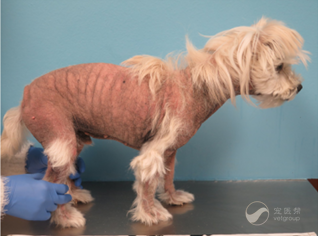
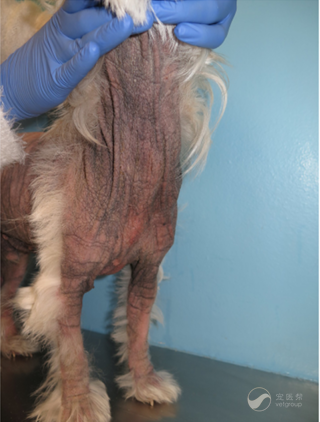
In a cohort of 90 WHWT, 52% were given a clinical diagnosis of cAD by the age of 3 years and half of these dogs had clinical signs by the age of 6 months13 (Figs. 1 and 2). Although this prospective article only evaluated the WHWT, the cAD prevalence is higher than the reported approximately 10% prevalence of cAD in the general population.18 Approximately 10% of this cohort was diagnosed with an FA as all or part of their cAD by the age of 3 years.
在一个由90只西高地白梗组成的队列中,52%在3岁前被临床诊断为cAD,其中一半的犬在6月龄时就有临床症状(图1和2)。尽管这篇前瞻性文章只评估了西高地白梗,但cAD的患病率高于报告的大约10%的全科病例群。大约10%的该队列犬在3岁前被诊断患有食物过敏,作为其cAD的全部或部分原因。
Fig. 1. Middle-aged West Highland White Terrier with canine atopic dermatitis. There is moderate erythema, lichenification, and widespread alopecia of the trunk, ventral neck, and paws. (Photo courtesy of Texas A&M University Veterinary Dermatology Teaching Collection.)
图1。中年西高地白梗犬患有犬特应性皮炎。躯干、颈部腹侧和爪子有中度发红、苔藓化和广泛的脱毛。(图片来源:Texas A&M University Veterinary Dermatology Teaching Collection)
Fig. 2. Close up of the ventral neck, chest, and paws of the same middle-aged West High land White Terrier in Fig. 1. There are moderate erythema, hyperpigmentation, lichenification, alopecia, and seborrhea oleosa. (Photo courtesy of Texas A&M University Veterinary Dermatology Teaching Collection.)
图 2. 与图 1 中同一只中年西高地白梗犬的颈部、胸部和爪子的特写图像。可见中度的红斑、色素沉着、苔藓化、脱毛和油性皮脂溢症状。(图片由德克萨斯农工大学兽医皮肤病学教学收藏所提供。)
Body-Site Locations
机体部位
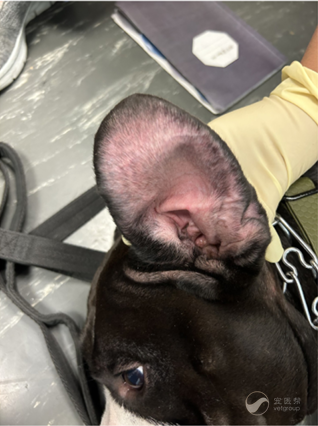
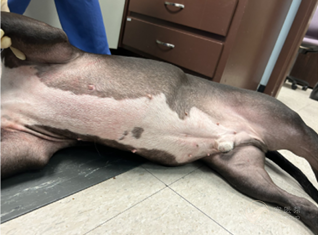
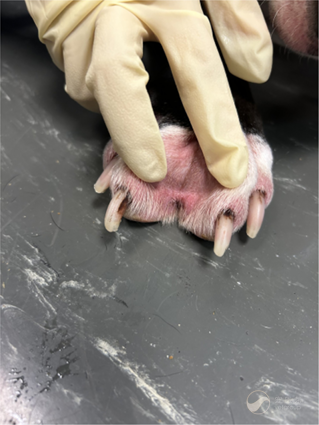
Early cAD is characterized by pruritus and erythema. Across breeds, commonly affected sites are the paws, axilla, inguinal region, face, concave pinna, and ear canals (Figs. 3–5). Certain breeds may have less common affected areas involved including French bulldog’s eyelids and flexural surfaces (such as that of the elbow), GSD’s elbows and thorax, Shar Pei’s flexural surfaces, dorsal lumbar and thorax, WHWT’s lips, flexural surfaces, and dorsal lumbar area. Certain breeds are also more likely to have a specific common affected site including the face of the boxer and French bulldog and the ventrum of the GSD. The WHWT and the GSD were more likely to have seborrhea oleosa (greasy scaling) in one study. Secondary Staphylococcal pyoderma and Malassezia dermatitis can enlarge the affected areas as can self-trauma/excoriations and are common with cAD.
早期cAD的特征是瘙痒和发红。在不同品种中,常见的患病部位是爪部、腋窝、腹股沟区域、面部、耳廓凹面和耳道(图3-5)。某些品种可能涉及较少见的患病区域,包括法国斗牛犬的眼睑和屈曲面(如肘部)、德国牧羊犬的肘部和胸部、沙皮犬的屈曲面、腰背部和胸部、西高地白梗的唇部、屈曲面和腰背部区域。某些品种也更可能有特定的常见患病部位,包括拳师犬和法国斗牛犬的面部,以及德国牧羊犬的腹侧。在一项研究中,西高地白梗和德国牧羊犬更可能有油性皮脂溢(油腻皮屑)。继发性葡萄球菌性脓皮病和马拉色菌性皮炎,以及自损/抓痕,可扩大患病区域,这在cAD中很常见。
Fig. 3. A 3 year old Pit Bull Terrier mixed dog with moderate erythema and mild tissue swelling of the concave pinna. (Photo Christina Gentry.)
图3。一个3岁的比特斗牛梗混合犬中度发红和轻度组织肿胀的耳廓凹面。(克里斯蒂娜·金特里摄)
Fig. 4. A 3 year old Pit Bull Terrier mixed dog with mild erythema of the axilla and inguinal region. (Photo Christina Gentry.)
图4。一个3岁的比特斗牛犬混合犬与轻度发红腋窝和腹股沟区域。(克里斯蒂娜·金特里摄)
Fig. 5. A 3 year old Pit Bull Terrier mixed dog with moderate interdigital erythema and mild tissue swelling. There is brown debris on the nail meds caused by Malassezia dermatitis. (Photo Christina Gentry.)
图5。一只3岁的比特斗牛梗混血犬,患有中度指间发红和轻度组织肿胀。指甲上有棕色碎屑,这是由马拉色菌皮炎引起的。(克里斯蒂娜·金特里摄)
Nonneoplastic anal sac disease commonly presents as licking, chewing, and scoot ing of the perianal region. It may be caused by impaction, anal sacculitis (inflammation and possible infection), and abscessation. Anal sac disease was associated with cAD in over 30% of patients in a study where poor stool quality was also found to play a role.20 Perianal pruritus without anal sac disease will present with similar clinical signs. In a prospective study evaluating perianal pruritus not associated with anal sac disease, nearly 60% of patients with cAD caused by either environmental or food trig gers had perianal pruritus.The severity of lesional perianal skin was correlated with pruritus.
非肿瘤性肛囊疾病通常表现为肛门周围区域的舔舐、啃咬和蹭地。它可能由嵌塞、肛囊炎(炎症和可能的感染)以及脓肿引起。在一项研究中,超过30%的患犬肛囊疾病与cAD相关,该研究还发现粪便质量差也起一定作用。与肛囊疾病无关的肛门周围瘙痒会表现出相似的临床症状。在一项评估与肛囊疾病无关的肛门周围瘙痒的前瞻性研究中,近60%由环境或食物诱因引起的cAD患犬有肛门周围瘙痒。肛门周围皮肤病变的严重程度与瘙痒相关。
Patients with cAD caused by FA are more likely to have a generalized distribution of pruritus.22
由食物过敏引起的cAD患犬更可能有全身性分布的瘙痒。
Feline
猫
Most cats with FASS present as young adults and are more likely to have nonseasonal clinical signs compared to seasonal clinical signs. One study found that over 60% of cats were noted to have lesions before the age of 3 years. In cats more than dogs, it may be difficult to estimate exact age in patients adopted as adults. Additionally, clients may not always identify self-induced alopecia on the belly of cat as pruritus, and thus, the lesion may be present for an extended period of time prior to presentation to a veterinarian.
大多数患有FASS的猫表现为年轻成年猫,并且与非季节性临床症状相比,更可能有季节性临床症状。一项研究发现,超过60%的猫在3岁前就发现有皮肤病变。在猫中比在犬中更难准确估计成年被收养患猫的年龄。此外,主人可能不总是能识别出猫腹部的自损性脱毛是瘙痒,因此,在就诊兽医前,皮肤病变可能存在了很长时间。
The majority of cats owned in North America are domestic mixed breed cats of varying coat length with unknown parentage and may represent the most prevalent group of cats with FASS. In a study of over 500 pruritic cats in Europe and the United States, Siamese, Persian, Abyssinian, and Maine coon were overrepresented in the cats having either FA or non-flea-non-FA (comparable to FAS)compared to the pruritic cats that had flea bite allergy. However, the results were not compared to a control population. The Abyssinian, Devon Rex, Himalayan, and Persian appear predisposed in 2 other studies comprising a total of 239 cats with presumed FAS.Overall, there does not appear to be a sex predilection in cats; however, some studies have female individuals overrepresented.
在北美拥有的大多数猫是不同被毛长度的家养混种猫,血统未知,可能代表了FASS猫中最普遍的群体。在欧洲和美国一项对500多只瘙痒猫的研究中,与患有跳蚤叮咬过敏的瘙痒猫相比,暹罗猫、波斯猫、阿比西尼亚猫和缅因猫在患有食物过敏或非跳蚤-非食物过敏(相当于FASS)的猫中比例过高。然而,结果未与对照组群体进行比较。在另外两项总共包括239只推测患有FASS的猫的研究中,阿比西尼亚猫、德文卷毛猫、喜马拉雅猫和波斯猫似乎有易感性。总体而言,猫似乎没有性别倾向;然而,一些研究中雌性比例过高。
Body-Site Locations
机体部位
Cats with FASS may show one or more cutaneous reaction patterns.These cutaneous reaction patterns are identical to FA with overlapping patterns for flea bite allergy dermatitis, mosquito bite hypersensitivity, demodicosis caused by Demodex gatoi, and occasionally dermatophytosis. They are self-induced alopecia, miliary dermatitis, head and neck pruritus, and eosinophilic granuloma complex (indolent ulcers, eosinophilic plaques, and eosinophilic granulomas).
患有FASS的猫可能表现出一种或多种皮肤反应模式。这些皮肤反应模式与食物过敏相同,并与跳蚤叮咬过敏、蚊虫叮咬超敏、由猫蠕形螨引起的蠕形螨病,有时是皮肤癣菌病有重叠模式。它们是自损性脱毛、粟粒性皮炎、头颈部瘙痒和嗜酸性肉芽肿复合物(无痛性溃疡、嗜酸性斑块和嗜酸性肉芽肿)。
Self-induced alopecia, which is often non-inflammatory to minimally inflammatory, is the most common pattern for FASS. The second most common pattern is head and neck pruritus, followed by miliary dermatitis, with eosinophilic granuloma complex being the least common, although most clinically striking.
自损性脱毛,通常为非炎性或仅有轻微炎症,是FASS最常见的模式。第二常见的模式是头颈部瘙痒,其次是粟粒性皮炎,嗜酸性肉芽肿复合物最不常见,尽管在临床上最引人注目。
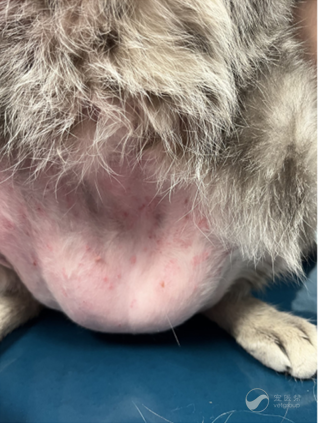
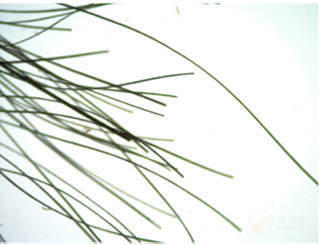
Self-induced alopecia is colloquially called “fur mowing” and can have such distinct boundaries that it appears it was created by a clipper blade (Fig. 6). When there is concern that the hair is being lost versus removed by the patient, a trichogram evaluated microscopically can often confirm traumatic hair loss with broken hair tips at the margins of the alopecia (Fig. 7).
自损性脱毛俗称“理毛”,可以有如此清晰的边界,看起来像是用推子刀头造成的(图6)。当担心毛发是脱落还是被患猫移除时,在显微镜下毛发检查通常可以确认为创伤性脱毛,脱毛边缘有毛尖断裂(图7)。
Fig. 6. Self-induced alopecia with few papules on the ventral abdomen and inguinal region of an adult cat with food-induced FASS. (Photo Christina Gentry.)
图6。患有食物诱发性FASS的成年猫腹部和腹股沟区域出现少量丘疹的自损性脱毛。(克里斯蒂娜·金特里摄)
Fig. 7. Microscope image at 40x magnification. Barbered and blunted hairs in a cat with self-induced alopecia. With nontraumatic alopecia, the hairs should taper to a point. (Photo Christina Gentry.)
图 7. 40 倍放大的显微镜图像。一只患有自损型脱毛的猫身上有呈钩状和钝状的毛发。对于非创伤性脱毛,毛发应逐渐变细直至尖端(图片由克里斯蒂娜·金特雷提供)
Head and neck pruritus is characterized by mostly severe, nearly manic levels of pruritus, excoriations, and significant self-trauma. The pinna, face, and neck may be involved. Due to the level of pruritus, open bleeding wounds may be created. Repetitive scratching of the face may lead to corneal ulceration. These patients often require a hard Elizabethan collar and plastic claw coverings to prevent severe self-trauma until pruritus is improved.
头颈部瘙痒的特点是多为严重、近乎狂躁的瘙痒、抓痕和严重的自我损伤。耳廓、面部和颈部可能患病。由于瘙痒程度高,可能会造成开放性出血伤口。反复抓挠面部可能导致角膜溃疡。这些患猫通常需要硬的伊丽莎白项圈和塑料指甲套,以防止严重的自我损伤,直到瘙痒改善。
Miliary dermatitis is a pattern that may be felt before it is seen. These small, almost pinpoint crusted papules may be on the dorsum and ventrum and may or may not be pruritic. Miliary dermatitis can also be seen with feline pyoderma, dermatophytosis, and flea allergy dermatitis.
粟粒性皮炎是一种可能在看到之前就能感觉到的模式。这些小到几乎针尖大小的结痂性丘疹可能位于背部和腹侧,可能瘙痒也可能不痒。粟粒性皮炎也可见于猫脓皮病、皮肤癣菌病和跳蚤过敏。
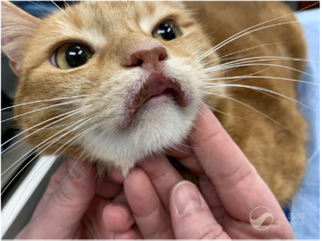
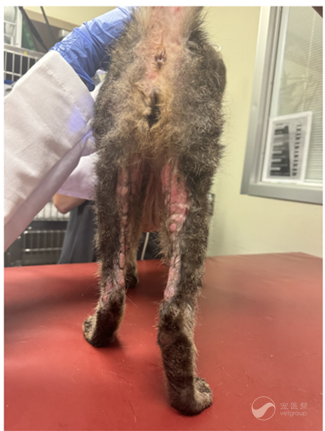
Eosinophilic granulomas complex may present as 3 different syndromes and cats can have more than one lesion type present. Eosinophilic granulomas can also be found in the mouth (often the tongue and the hard palate), as a swollen or “fat chin,” and as linear raised and slightly irregular thickening on the medial legs. Indolent ulcers, also known as rodent ulcers, are present on the upper lip and often cross the midline to have a bilaterally symmetric clinical appearance (Fig. 8). Eosinophilic plaques occur most commonly on the ventrum and hindlimbs (Fig. 9).
嗜酸性肉芽肿复合物可表现为3种不同的综合征,并且猫可以同时存在不止一种皮肤病变类型。嗜酸性肉芽肿也可以在口腔中发现(通常在舌头和硬腭),表现为肿胀的“肥下巴”,以及在后腿内侧呈线状隆起且略不规则的增厚。无痛性溃疡,也称为惰性溃疡,出现在上唇,并常跨越中线,呈现双侧对称的临床表现(图8)。嗜酸性斑块最常见于腹侧和后肢(图9)。
Fig. 8. Indolent ulcer on the maxillary lip of a young adult cat with FASS. This ulcerated lesion has led to tissue loss of the central maxillary lip. (Photo Christina Gentry.)
图 8. 一只患有 FASS 疾病的年轻成年猫上颌唇部的慢性溃疡。这个溃疡性病变导致了上颌中央部分的组织缺失。(照片由克里斯蒂娜·詹特里拍摄。)
Fig. 9. Coalescing eosinophilic plaques on the caudal and medial hind limbs of a middle aged cat. The cat’s hair is wet from near constant licking. The perianal region has self induced alopecia.
图9. 在一只中年猫的尾部和后肢内侧出现了聚集的嗜酸性斑块。这只猫的毛发因持续舔舐而湿润。其肛周区域出现了自损性脱毛现象。
The head and neck pruritus pattern was seen in approximately 50% of cats with fe line FA.The next most common pattern for feline FA was self-induced alopecia.
在患有猫食物过敏的猫中,大约50%出现头颈部瘙痒模式。猫食物过敏的第二常见模式是自损性脱毛。
Canine Genetics
犬遗传学
Breed predilections allowed for the initial assumption that cAD had to be, at least in part, a genetic disorder.27,28 In AD, multiple genes as well as environmental factors lead to the development and progression of clinical disease.8
品种易感性最初使人们假设cAD至少部分是一种遗传性疾病。在特应性皮炎中,多种基因以及环境因素导致临床疾病的发生和发展。
Variants in the filaggrin gene are common in humans with extrinsic (high IgE) forms of AD. Given that cAD shares many features of AD, it was suspected that filaggrin could play a significant role in CAD. In a group of British Labrador retrievers, a single nucleotide polymorphism variant in filaggrin was associated with cAD. However, this variant was not found in tested Labradors from the United States and Japan nor pre sent in other breeds evaluated. To date, variants in the filaggrin gene have not been associated with WHWT cAD. At this time, it does not appear that filaggrin gene variants play a significant role in the development of cAD in the majority of predis posed breeds.
丝聚蛋白基因的变异在患有外源性(高IgE)形式特应性皮炎的人类中很常见。鉴于cAD与特应性皮炎有许多共同特征,人们怀疑丝聚蛋白可能在cAD中起重要作用。在一组英国拉布拉多猎犬中,丝聚蛋白的一个单核苷酸多态性变异与cAD相关。然而,在美国和日本测试的拉布拉多犬以及其他评估的品种中没有发现这种变异。迄今为止,丝聚蛋白基因的变异尚未与西高地白梗cAD相关。目前,丝聚蛋白基因变异在大多数易感品种cAD的发展中似乎不起重要作用。
A genome-wide association studies (GWAS) found that thymic stromal lymphopoietin (TSLP) receptor gene variant was identified in all 8 breeds evaluated (Boxer, GSD, Labrador retriever, golden retriever, Shiba Inu, Shih Tzu, pit bull terrier, and WHWT). TSLP acts as an “alarmin” in keratinocytes and encourages a T helper 2 immune response. This type of response propagates allergic inflammation (see Pathogenesis Part 2). Other variants in multiple breeds were identified and included serine protease inhibitor kazal type (SPINK) 5, which has a role in desquamation. A GSD variant in a desmosomal(keratinocyte tokeratinocyte connection) structural protein plakophi lin 2 was found in a separate study, but this did not correlate to changes in expression of plakophilin 2 in future work.
一项全基因组关联研究发现,在所有8个评估品种(拳师犬、德国牧羊犬、拉布拉多猎犬、金毛猎犬、柴犬、西施犬、比特梗和西高地白梗)中都鉴定出了胸腺基质淋巴细胞生成素受体基因变异。TSLP在角质形成细胞中充当“警报素”,并促进辅助性T细胞2免疫反应。这种类型的反应会助长过敏性炎症。在其他多品种中发现了其他变异,包括丝氨酸蛋白酶抑制剂Kazal 5型,它在皮肤脱屑中起作用。在另一项研究中,在德国牧羊犬中发现了一种桥粒(角质形成细胞间连接)结构蛋白斑珠蛋白2的变异,但在后续工作中这并未与斑珠蛋白2表达的变化相关联。
Given the high prevalence of cAD in the WHWT, there have been multiple GWAS studies evaluating the WHWT from different regions with multiple gene variants identified.35,36 The different genes identified in these studies may suggest that the genetic basis for cAD in this breed may be multifactorial.
鉴于西高地白梗cAD的高患病率,已有多项全基因组关联研究评估了来自不同地区的西高地白梗,并鉴定出多个基因变异。这些研究中鉴定的不同基因可能表明该品种cAD的遗传基础可能是多因素的。
Feline Genetics
猫遗传学
There is a single case series documenting 3 littermates with allergic skin disease sug gesting genetics as a contributing factor.37 This is anecdotally recognized in practice when an owner has multiple allergic cats from the same litter. The increased preva lence in certain pure-bred cats is also suggestive of unknown genetic variants contrib uting to the pathogenesis of FASS.
有一份病例系列报告记录了三只同窝出生的猫患有过敏性皮肤病,表明遗传是一个促成因素。在临床上,当主人有多只来自同一窝的过敏症猫时,这被经验性地认可。某些纯种猫患病率的增加也提示未知的遗传变异促成了FASS的发病机制。
PATHOGENESIS PART 2: THE ENVIRONMENT AND ALLERGENS
发病机制第2部分:环境和过敏原
The Environment
环境
A lifestyle involving increased access to the outdoors, increased ultraviolet light, ani mals, and decreased air pollutants may decrease the incidence of AD.38,39 As described by Favrot and colleagues,12 a mainly indoor lifestyle is strongly correlated with the development of cAD. In 2 questionnaire-based studies of European Labrador retrievers and golden retrievers, a rural lifestyle, access to other animals, and early adoption (8 weeks or less) were protective against the development of cAD, while ac cess to upholstered furniture and the use of flea control increased the risk cAD.17,40 In experimentally house dust mite (HDM) sensitized beagle dogs, the dogs that were infected with Toxocara canis previously had less clinical signs when subsequently exposed to HDM. The T canis-exposed dogs did have higher levels of IgE against both T canis and HDM.41
涉及更多户外活动、更多紫外线、动物接触以及更少空气污染物的生活方式可能会降低特应性皮炎的发病率。正如Favrot及其同事所描述的,主要在室内的生活方式与cAD的发生密切相关。在欧洲拉布拉多猎犬和金毛猎犬的两项基于问卷的研究中,乡村生活方式、接触其他动物和早期领养(8周或更小)对cAD的发生有保护作用,而接触软垫家具和使用跳蚤控制产品则增加了cAD的风险。在实验性屋尘螨致敏的比格犬中,先前感染犬弓首蛔虫的犬随后暴露于屋尘螨时临床症状较少。暴露于犬弓首蛔虫的犬确实对犬弓首蛔虫和屋尘螨都有更高的IgE水平。
These finding along with other environmental data support but do not conclu sively prove, the colloquially called “hygiene hypothesis.” In this hypothesis, increased sanitation and limited access to outdoor environments may increase the development of allergic diseases in humans and animals. Access to a wide va riety of environmental, microbial, and parasitic stimuli may lessen the risk of allergic diseases.
这些发现以及其他环境数据支持但并未最终证明俗称的“卫生假说”。在这个假说中,卫生条件改善和户外环境接触有限可能会增加人类和动物过敏性疾病的发生。接触多种环境、微生物和寄生虫刺激可能会降低过敏性疾病的风险。
High level of exposure to cigarette smoke (over 21 cigarettes) per day in indoor dogs increased the odds of developing cAD compared to patients with lower exposure or no exposure in one prospective study of patients presenting to a wellness clinic.
在一项对到健康诊所就诊患犬的前瞻性研究中,室内犬每天高水平暴露于香烟烟雾(超过21支)与暴露较低或无暴露的患犬相比,发生cAD的几率增加。
In a studyof Labradorretrievers, pregnant bitches and their offspring were fed a diet supplemented with nicotinamide, pantothenate, histidine, inositol, and choline for 1 year. Dogs in the supplemented group had lower levels of dust mite IgE and had a lower incidence of cAD based on owner questionnaire. Unfortunately, early manipulation of a diet that would decrease the risk of developing cAD is not always feasible due to timing of adoption and owners awareness ofthe risk of cAD intheir pet.
在一项对拉布拉多猎犬的研究中,怀孕母犬及其幼犬被喂食补充了烟酰胺、泛酸、组氨酸、肌醇和胆碱的饮食一年。基于主人问卷,补充组犬的尘螨IgE水平较低,cAD发病率也较低。不幸的是,早期调整饮食以降低发生cAD的风险并不总是可行,因为领养时间不确定,且主人对其宠物患cAD的风险认识不足。
Allergens
过敏原
The most common allergen is dog and human is HDM(Dermatophagoides spp).Storage mite IgE reactivity is also prevalent in dogs and hums, but it is not always clear if this is cross-reactivity from HDM or polysensitization with more recent data suggesting cross-reactivity is more likely than polysensitization.There are regional prevalences for molds and plant pollen-based allergens (weeds,trees, and grasses) in North America.
犬和人类最常见的过敏原是屋尘螨。仓储螨IgE反应性在犬和人类中也很普遍,但并不总是清楚这是与屋尘螨的交叉反应还是多重致敏,而最近的数据表明交叉反应比多重致敏更可能。在北美、霉菌和植物花粉过敏原(杂草、树木和草)存在地区性流行。
HDM is ubiquitous in most parts of the United States where there is adequate heat, humidity, and the presence of dander. Areas of the home most likely to contain HDMs include carpets, bedding, and fabric covered furniture. Patients with cAD caused by HDM will most of ten present with year round clinical signs. The allergenicity of HDM appears to correlate with increased prevalence of cAD in mainly indoor dogs.
屋尘螨在美国大部分地区普遍存在,只要有足够的热量、湿度和皮屑。家中最可能含有屋尘螨的区域包括地毯、床上用品和布艺家具。由屋尘螨引起的cAD患犬最常表现为全年性临床症状。屋尘螨的致敏性似乎与主要在室内生活的犬cAD患病率增加相关。
Measured air levels of molds and pollen-basedallergens fluctuate based onthe time of the year and region. However, since cAD is most often triggered by contact of allergens to the local cutaneous immune system, allergens that are no longer airborne (past their pollinating season) could still potentially lead to clinical signs in patients contacting these allergens in outdoor environments such as lawns, trails, or patios. This may increase the length of the “allergy season” for certain allergens.
测量的霉菌和花粉过敏原空气水平随一年中的时间和地区而波动。然而,由于cAD最常由过敏原接触局部皮肤免疫系统而触发,那些不再在空气中传播(过了授粉季节)的过敏原,在患病动物于户外环境(如草坪、小径或露台)接触时,仍可能导致临床症状。这可能会延长某些过敏原的“过敏季节”。
Airborne allergens can be deposited manymilesfromtheir origin based on humidity, rainfall, and wind. This is often patients with cAD have dissatisfactory results when a known plant allergen is removed the local environment. In rare cases, pollens can move thousands of miles. As an example, mountain cedar, which leads to allergic signs in patients with AD and cAD from December to February in Texas and Okla homa, was documented in London, Ontario (Canada).
空气中的过敏原可以基于湿度、降雨和风力沉积在距离其源头许多英里之外的地方。这通常是为什么当已知的植物过敏原从当地环境中移除时,cAD患犬的效果却不令人满意。在罕见病例中,花粉可以传播数千英里。例如,在德克萨斯州和俄克拉荷马州,从12月到2月导致特应性皮炎和cAD患犬出现过敏症状的山地雪松,曾在加拿大安大略省的伦敦市被记录到。
Most allergens tested in either serum or intradermal testing are whole allergens, meaning the extracts contain both the allergenic and nonallergenic portions of the mite or pollen material and are ground or emulsified into the testing medium. In certain commonallergens such asHDMandragweed,thespecific protein allergen(s) causing the allergic reaction is known for humans and dogs.Tests using components (the specific proteins that cause allergy) would be more likely to provide interpretable test results. Currently, testing kits for intradermal allergen testing rely on whole aller gens as do most commercially available serum allergy tests. One commercially avail able serum test for dogs and cats is using known component allergens (when available) as well as whole allergens. To date, in North America, allergen-specific immunotherapy is created using whole allergens.
大多数在血清或皮内试验中测试的过敏原都是全过敏原,意味着提取物含有螨或花粉物质的致敏和非致敏部分,并被研磨或乳化到测试介质中。在某些常见过敏原如屋尘螨和豚草中,导致人类和犬过敏反应的特定蛋白质过敏原是已知的。使用组分(引起过敏的特定蛋白质)的测试将更可能提供可解释的测试结果。目前,皮内过敏原测试试剂盒依赖于全过敏原,大多数市售的血清过敏测试也是如此。有一种市售的犬猫血清测试使用了已知的组分过敏原(当可用时)以及全过敏原。迄今为止,在北美,过敏原特异性免疫疗法是使用全过敏原创建的。
Clinically, some patients with allergic dermatitis will have an exaggerated worsening of clinical signs when Malassezia overgrowth occurs. These patients may have a hy persensitivity to the Malassezia yeast that can be supported by positive reactions to intradermal or serum allergy testing.
在临床上,一些患有过敏性皮肤病的患病动物在马拉色菌过度增殖时会出现临床症状的显著恶化。这些患病动物可能对马拉色菌酵母有超敏反应,这可以通过皮内或血清过敏试验的阳性反应来支持。
DISCUSSION
讨论
cAD and FASS are diagnoses of exclusion. This inherently increases barriers to an accurate diagnosis. Ruling out parasitic causes of itch, dermatophytes, as well as addressing secondary Staphylococcal and Malassezia infections early in the investiga tion will allow the clinician to evaluate for the more classic signs of pruritus and inflammation in commonly affected body sites.
cAD和FASS是排除性诊断。这本质上增加了准确诊断的障碍。在调查早期排除寄生虫性瘙痒病因、皮肤癣菌病,以及处理继发性葡萄球菌和马拉色菌感染,将使临床医生能够评估常见患病部位的更典型的瘙痒和炎症症状。
History data such as age of onset, lifestyle, and known responsiveness to cortico steroids can support a diagnosis of cAD and FASS. Patients with nonseasonal signs must be evaluated for food triggers and environmental allergen triggers as they both cause year round clinical signs consistent with cAD and FASS.
病史数据,如发病年龄、生活方式和已知对皮质类固醇的反应性,可以支持cAD和FASS的诊断。有非季节性症状的患病动物必须评估食物诱因和环境过敏原诱因,因为它们都会导致与cAD和FASS一致的全年性临床症状。
Understanding the genetic variants and breed predisposition can improve client education and allow the client to make informed choices about breeding affected animals. Although allergen avoidance would be ideal, the indoor lifestyle of most dogs and cats may make it impossible to avoid the most common allergen HDM. Pollen avoidance is also difficult given the distance that these allergens can travel.
了解遗传变异和品种易感性可以改善客户教育,并让客户就繁殖患病动物做出知情选择。虽然避免过敏原是最理想的,但大多数犬猫的室内生活方式可能使得无法避免最常见的过敏原屋尘螨。鉴于这些过敏原可以传播的距离,避免花粉也很困难。
In the second pathogenesis article, changes to the skin barrier, the cutaneous microbiome, and a dysregulated immune system will be discussed and will reflect the clinical presentation described in this article.
在第二篇发病机制文章中,将讨论皮肤屏障、皮肤微生物组的变化以及失调的免疫系统,并将反映本文描述的临床表现。
SUMMARY
总结
The understanding of the pathogenesis of cAD and FASS has increased dramatically in the last decade and adjustments to the definitions of cAD and FASS reflect this. Improvement in genetic testing has provided additional evidence for the breed predilections that have been historically described. Both patients with canine and feline have predictable and repeatable clinical signs that along with appropriate history and elimination of confounding factors can allow clinicians to accurately diagnose cAD and FASS. Although the authors may have minimal control of the patient’s environment as a puppy and environmental allergens, understanding how these factors affect cAD and FASS can improve client education and expectation management.
在过去十年中,对cAD和FASS发病机制的理解有了显著提高,对cAD和FASS定义的调整反映了这一点。基因检测的改进为历史上描述的品种易感性提供了更多证据。犬和猫患者都有可预测和可重复的临床症状,结合适当的病史和消除混杂因素,可以使临床医生准确诊断cAD和FASS。虽然作者对患病动物幼年时期的环境和环境过敏原可能控制有限,但了解这些因素如何影响cAD和FASS可以改善客户教育和期望管理。
|
CLINICS CARE POINTS
临床护理要点
Clinicians should discuss allergies with owners of predisposed breeds to improve owner awareness of clinical signs.
It is recommended to limit breeding of severely affected individuals.
Avoidance of allergens in cAD and FASS is often impossible due to ubiquitous nature of common allergens.
临床医生应与易感品种的主人讨论过敏症,以提高主人对临床症状的认识。
建议限制繁育严重患病的个体。
由于常见过敏原的普遍存在,在cAD和FASS中避免过敏原通常是不可能的。 |
| 


 |Archiver|手机版|小黑屋|宠医帮
( 京ICP备2022012070号-2 )
|Archiver|手机版|小黑屋|宠医帮
( 京ICP备2022012070号-2 ) 




 发表于 2026-3-24 08:59:01

 收藏
收藏 转播
转播 分享
分享 淘帖
淘帖
 学习
学习